Electro-Voice EVID (c. 2002)
A ceiling speaker shaped like a football, mounted on a cast-alloy arm, and specified like a piece of laboratory equipment.
Overview
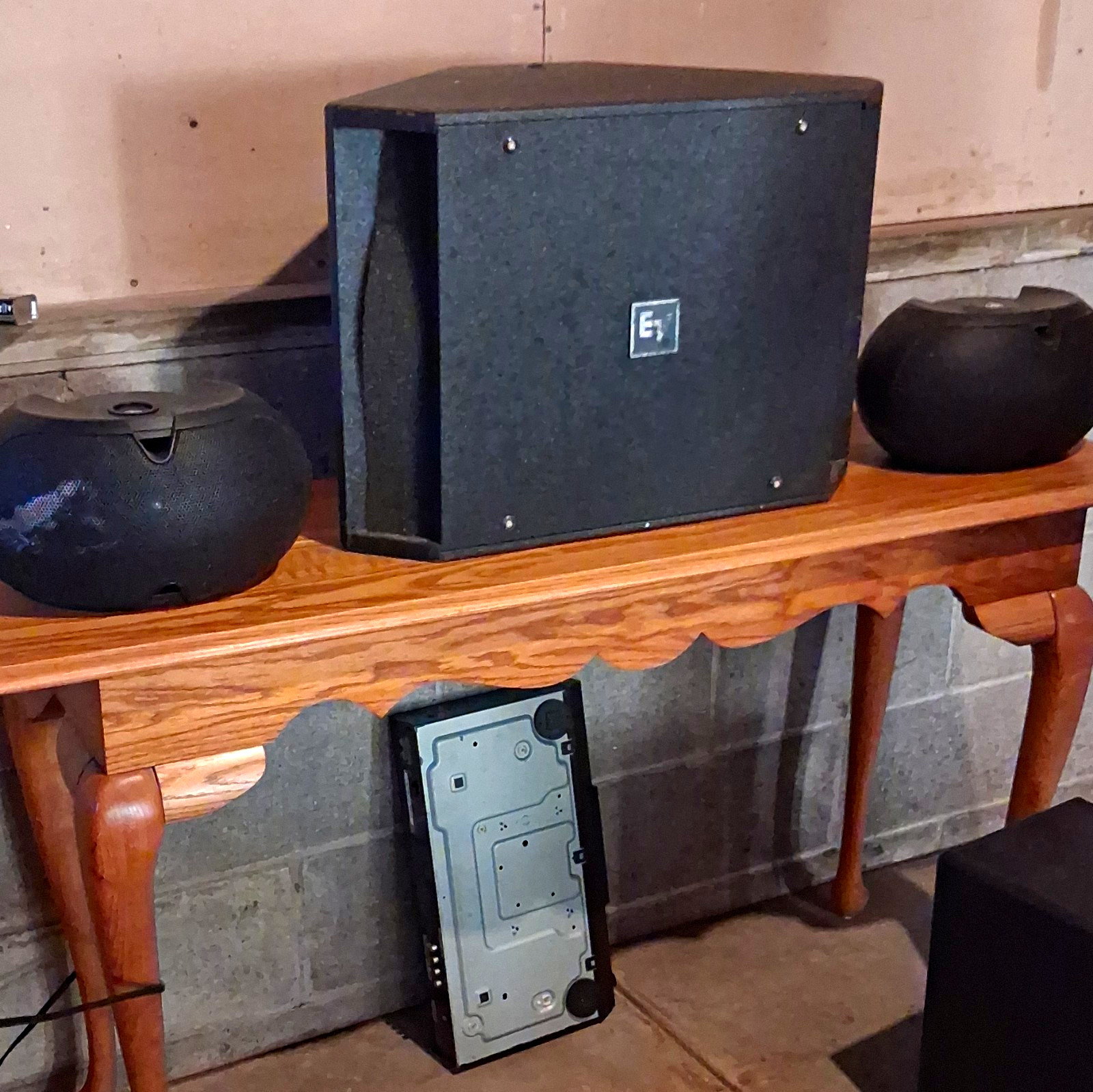
Most of what carries the Electro-Voice name through this archive is a microphone or a raw driver. The EVID line is different. It's a finished, installed loudspeaker system, molded from the same ARS plastic as the SX series and built for distributed sound in ceilings and on walls. EVID stands for EV Innovative Design. The enclosures are ellipsoidal, almost football-shaped, and the mounting hardware is a cast-alloy arm instead of the usual ball-and-socket joint. The line came in three surface-mount versions: the 3.2 with 3.5-inch woofers, the 4.2 with 4-inch woofers, and the 6.2 with 6-inch woofers. All three were offered in black or white paintable finish with a zinc-plated steel grille, video shielding, and a multitap transformer option on the two larger models. Push terminals are spaced to accept banana plugs, which is a small courtesy you don't always get on a contractor box.
The shape isn't decoration. Pro-Audio-Review (September 2002, p.22) described the EVID as a radical departure from the typical box enclosure and noted that the ellipsoidal cabinet looks almost like a pair of motocross goggles from the front. The review also pointed out the practical payoff. The cabinet's rotation and the SAM (Strong Arm Mount) system give the installer a 45-degree rotation range at the cabinet pivot and a 100-degree sweep range at the mounting plate. That's real aiming flexibility for a surface-mount box. The cast-alloy arm with its hex-nut tightening system was singled out as having a more positive feel than the ball-and-socket mounts it competes with.
On the ceiling side, the C-series models are complete packages, not bare drivers. The C4.2 is a two-way ceiling system built around a 4-inch coaxial driver with a waveguide-coupled titanium-coated dome tweeter. It crosses over through a second-order network at 3.3 kHz, with a protection circuit guarding the network and both drivers. Its internal line-matching transformer offers 1.88, 3.75, 7.5, 15, or 30 watts on 70-volt or 100-volt lines, or an 8-ohm bypass, selected by a switch on the front baffle. The C8.2 and C8.2HC step up to an 8-inch low-frequency cone with the same coaxially mounted titanium-coated dome tweeter. The C10.1 is a dedicated low-frequency ceiling subwoofer - a 10-inch polypropylene cone with a high-temperature voice coil - meant to extend any EVID ceiling speaker. Its transformer taps run 7.5, 15, 30, or 60 watts, again with an 8-ohm bypass.
The measured specifications are unusually complete for this class of product. The C4.2 carries an AES power rating of 75 watts of band-limited pink noise, with sensitivity of 85 dB SPL at one meter on axis with one watt. The C8.2 is rated at 100 watts AES with 89 dB sensitivity. The C8.2HC also rates 100 watts but specifies 91 dB sensitivity. The C10.1 subwoofer rates 100 watts AES over a 45 Hz to 150 Hz band with 93 dB sensitivity. Minimum impedance is specified at 6.0 ohms across the ceiling models. One catch: the published response figures for the C4.2, C8.2, and C8.2HC in the available documentation list the upper limit as "20 Hz". That's an obvious typo in the source manuals and should read 20 kHz. Treat the high-frequency figure as unverified until a corrected spec sheet turns up.
The ceiling models are sized for standard tile-grid installation. The C4.2 measures 181 mm (7.1 in.) in diameter and 176 mm (6.9 in.) deep at 2.7 kg (6.0 lb). The C8.2 is 255 mm (10.0 in.) across and 270 mm (10.6 in.) deep at 5.0 kg (11.0 lb). The C8.2HC is 303 mm (11.9 in.) in diameter and 320 mm (12.6 in.) deep at 6.0 kg (13.2 lb). The C10.1 subwoofer matches the C8.2HC footprint at 303 mm (11.9 in.) by 320 mm (12.6 in.) but weighs 7.0 kg (15.5 lb). All of them meet UL 2043, the standard covering fire and smoke characteristics for plenum-rated equipment. That means the enclosures can sit in the air-handling space above a ceiling without a separate fire-rated box.
The construction is consistent across the ceiling line. The baffle and bezel are heat-resistant UL-approved ABS. The rear enclosure is zinc-plated heavy-gauge steel with fiberglass damping chosen to give the driver an optimum internal volume. The perforated grille is finished in semi-gloss white powder-coated enamel. A rear cover with provisions for a junction box fitting gives access to a 4-pin terminal block that accepts 12-gauge wire and passes signal through to additional speakers. A tile bridge is included for safe suspension in drop ceilings using mineral wool or other fiber-based tiles. Baffle, grille, enclosure, transformer, and driver were designed together as a system.
For the wall-mount EVIDs, the 8-ohm 4.2 was the model reviewed. It's rated at 200 watts power handling with a claimed frequency response of 65 Hz to 20 kHz and 90 dB sensitivity at 1W/1M. Coverage is claimed at 120 degrees horizontal and 80 degrees vertical. A matching subwoofer, the 12.1, could be paired with the wall units for extended bass, and the SAM mounting system is found across all models in the line. The documentation credits Telex Communications as the parent company, with the manuals dated April 2002 and part numbers assigned per model: 301258-000 for the C4.2, 301261-000 for the C8.2, and 301263-000 for the C10.1.
The EVID line stayed in production long enough to keep showing up in the trade press. Mix (July 2015, p.57) covered the compact EVID Series as small-format install monitors positioned around performance-to-size ratio. EQ (January 2002, p.44) reported on Electro-Voice rolling out a substantial batch of new loudspeakers at the 111th AES convention. That's a long run for an install product, and used EVID ceiling speakers still surface with some regularity, often pulled from a restaurant or office remodel where the building changed hands and the new tenant wanted something else.
The EVID is a distributed-sound product, tuned for coverage and intelligibility rather than audiophile listening. The transformer taps, the UL 2043 rating, the tile bridge, the zinc-plated steel rear can, and the switchable 8-ohm bypass were all decisions made for the person on a ladder with a fish tape, not for a showroom demo.
eBay Listings



As an eBay Partner, we earn from qualifying purchases. This helps support our independent vintage technology research.