Electro-Voice EVID C4.2
A six-pound ceiling speaker that disappears into the tiles and still manages a 130-degree cone of sound. Just don't expect bass.
Overview
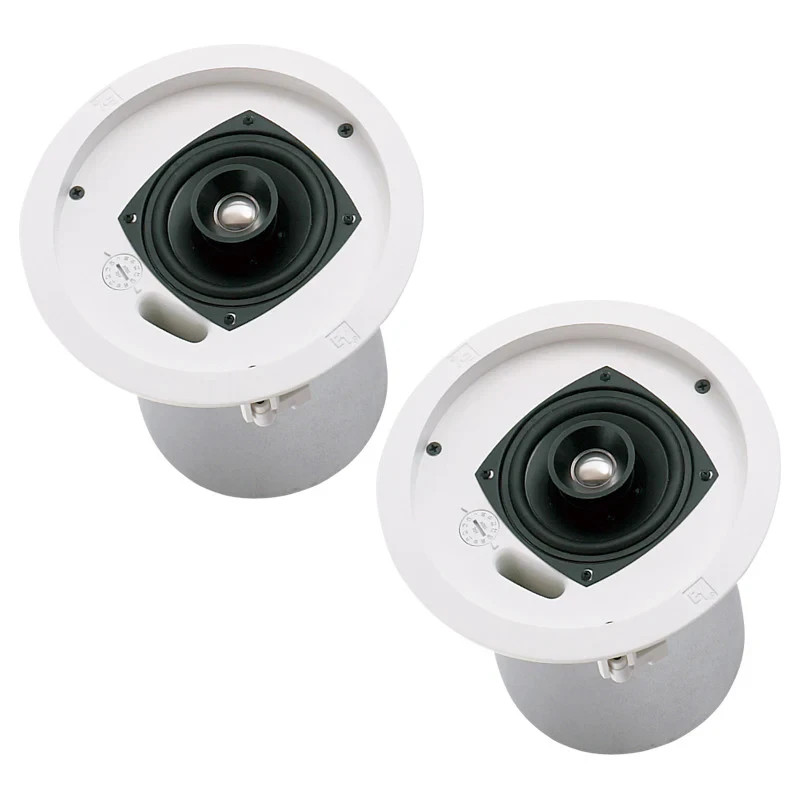
The EVID C4.2 is the smallest member of Electro-Voice's EVID Ceiling line. EV calls it a "complete two-way ceiling loudspeaker package." It ships as a bezel assembly, grille, rear enclosure, a 4-inch coax two-way loudspeaker, and an internal line-matching transformer. It's a compact, low-profile 4" coaxial installation speaker built for one job: putting intelligible music and paging into offices, waiting rooms, and retail spaces without cutting a hole big enough to worry the building manager.
The transformer is the interesting part if you've wired a commercial space. It offers taps of 1.88 (70 V only), 3.75, 7.5, 15, or 30 watts. You can switch it between 70V or 100V distributed lines, or bypass it entirely for 8-ohm operation. The switch lives on the front baffle, so you can change the tap after the speaker is already in the ceiling. Anyone who has pulled a speaker back out of a tile grid to flip a jumper will get why that's handy.
The manufacturer's own documentation rates the C4.2 at 75 watts continuous and 300 watts peak, with a sensitivity of 85 dB SPL at 1 meter and a maximum calculated output of 107 dB. The fact sheet's retail listings quote the same speaker at 80W continuous/320W peak and 110 dB. Treat the manual figures as the conservative ones. Either way, that's a lot of headroom for a driver this size, and the protection circuit is the reason. The C4.2 carries full-bandwidth overload protection that guards the network, woofer, and tweeter drivers from excessive power levels.
The C4.2 is no longer available. Electro-Voice's own commercial channel points buyers to the Bosch LC2-PC30G6-4, which it describes as having identical specifications with the addition of fire-rated terminals.
Key Features
4" Coaxial Two-Way with Waveguide-Coupled Titanium Tweeter
Coaxial mounting keeps the two drivers on the same axis, so the sound arrives from one point rather than two. That helps when listeners are scattered across a room at wildly different angles. The waveguide on the tweeter controls where the high frequencies go, and the coverage spec is 130 degrees conical.
The crossover is a second-order network at 3.3 kHz, with the protection circuit folded in to keep the network, woofer, and tweeter safe from overload. That's a relatively high crossover point for a 4-inch woofer. It means the polypropylene cone carries most of the midrange on its own, which suits a speaker whose primary job is voice intelligibility.
Dual-Impedance Transformer with Front-Baffle Tap Selection
The internal line-matching transformer is what separates a commercial ceiling speaker from a home audio one. Five taps - 1.88, 3.75, 7.5, 15, and 30 watts - cover everything from a single speaker on a long 70V run to a small cluster driven at 8 ohms. The 1.88-watt tap is 70V only. The rest work on either 70V or 100V lines.
Selection is via a convenient switch on the front baffle. Distributed audio systems get re-tapped all the time. A retail space gets subdivided, a paging zone gets louder, a conference room gets quieter. Having the switch reachable from below the ceiling saves a service call every time.
Ported Enclosure and Air-Handling-Space Rating
The C4.2 uses a ported enclosure for extended bass response. The rear can is zinc-plated heavy gauge steel with fiberglass damping material inside to tune the internal volume. Unlike an open-back ceiling speaker, a sealed, ported back can means the driver's low-frequency behavior doesn't change depending on what's above the ceiling - plenum, insulation, or nothing at all.
The speaker is rated to UL 2043, the standard for use in air-handling spaces. In plain terms, you can install it in a plenum ceiling without violating fire code. That's often the difference between a speaker that can be specified on a commercial job and one that can't. The baffle and bezel are heat-resistant UL-approved ABS. The grille is perforated, semi-gloss white powder-coated enamel. The speaker is available in black or white.
Tile Bridge, Mounting Ring, and Installation Hardware
The package includes a tile bridge for safe suspension of the speaker in a drop ceiling using mineral wool or other fiber-based ceiling tiles, plus a mounting ring and a cutout template. The cutout is 7.25 inches (184 mm). The assembled speaker measures 6.9" deep by 7.1" in diameter - 176 mm by 181 mm. At 6 pounds each, it's light enough that one person can install a pair without help.
A rear cover with provisions for a junction box fitting gives access to a 4-pin terminal block that accepts 12-gauge wire and provides pass-through to additional speakers. You run the distributed line to the first speaker, then daisy-chain from there, rather than home-running every speaker back to the rack.
Historical Context
The C4.2 belongs to EV's EVID Ceiling series, at the small end of that family. The lineup also included the EVID-C4.2LP, an extreme low-profile back can enclosure version for tight plenum spaces, the EVID-C4.2-G2 revision, and the EVID C4.2D, a co-axial 4", 2-way ceiling speaker rated 75W, 8 ohm / 30W, 100V line. Those are separate models with their own specs. The C4.2's numbers don't transfer to them.
No production years or original launch price for the base C4.2 surfaced in the available documentation. What's documented is the end of the line: the EVID C4.2 is no longer available, and Electro-Voice's commercial channel directs buyers to the Bosch LC2-PC30G6-4, which it describes as having identical specifications with the addition of fire-rated terminals. A current MSRP listing of $394.00 per pair is the only pricing figure available, and it's a retail listing rather than a launch price.
The C4.2 was designed for wide-range reproduction of music or voice across a range of ceiling constructions. The marketing positions it for background music and paging in offices, waiting rooms, and retail spaces. One retail listing calls it a "stellar-sounding speaker that's tailor-made for air-handling spaces." That's a dealer's line, not an independent measurement. A single user rating of 7.5 out of 10 appears in one database, which is too thin a sample to mean much.
eBay Listings


As an eBay Partner, we earn from qualifying purchases. This helps support our independent vintage technology research.