Eico ST-3120 Stereo Tuner: A Forgotten Gem of 1970s Hi-Fi
In the early 1970s, the world of high-fidelity audio was undergoing a transformation. Vacuum tubes were giving way to transistors, and manufacturers were racing to deliver reliable, high-performance components at accessible prices. Among the brands leading this shift was Eico — a company renowned not only for its affordable yet capable audio gear but also for its pioneering role in the kit-based electronics market. While Eico is perhaps best remembered for its amplifiers and test equipment, the Eico ST-3120 stereo tuner stands as a quiet testament to the company’s commitment to quality reception and tunable fidelity during the golden age of FM broadcasting.
Though not as widely celebrated as some of its contemporaries from Marantz, Fisher, or Scott, the ST-3120 carved out a niche among audiophiles and DIY enthusiasts who valued clean design, solid construction, and excellent tuner performance — particularly for FM stereo broadcasts, which were rapidly gaining popularity in the early '70s.
Technical Specifications
The Eico ST-3120 is a solid-state stereo FM/AM tuner released in 1973, designed to integrate seamlessly into a high-fidelity stereo system as a standalone component. It was marketed both as a kit for hobbyists and as a factory-assembled unit, appealing to Eico’s dual audience of tinkerers and practical listeners.
| Specification | Detail |
| Model | ST-3120 |
| Manufacturer | Eico (Electro Instrument Company) |
| Year of Release | 1973 |
| Type | FM/AM Stereo Tuner |
| Tuning System | Analog dial with mechanical counter |
| Frequency Range (FM) | 88–108 MHz |
| Frequency Range (AM) | 530–1710 kHz |
| Tuning Accuracy | ±50 kHz |
| Sensitivity (FM) | 1.8 µV for 30 dB quieting |
| Signal-to-Noise Ratio | >60 dB (weighted) |
| Stereo Separation | >35 dB at 1 kHz |
| Output Level | 0.5 mV (RCA phono jacks) |
| Output Impedance | 10 kΩ |
| Power Requirement | 120V AC, 60 Hz, 20 watts |
| Dimensions | 19" (W) × 6" (H) × 12" (D) |
| Weight | Approx. 15 lbs |
| Construction | Solid-state, modular PCB design |
| Kit Availability | Yes – Eico offered full assembly kits |
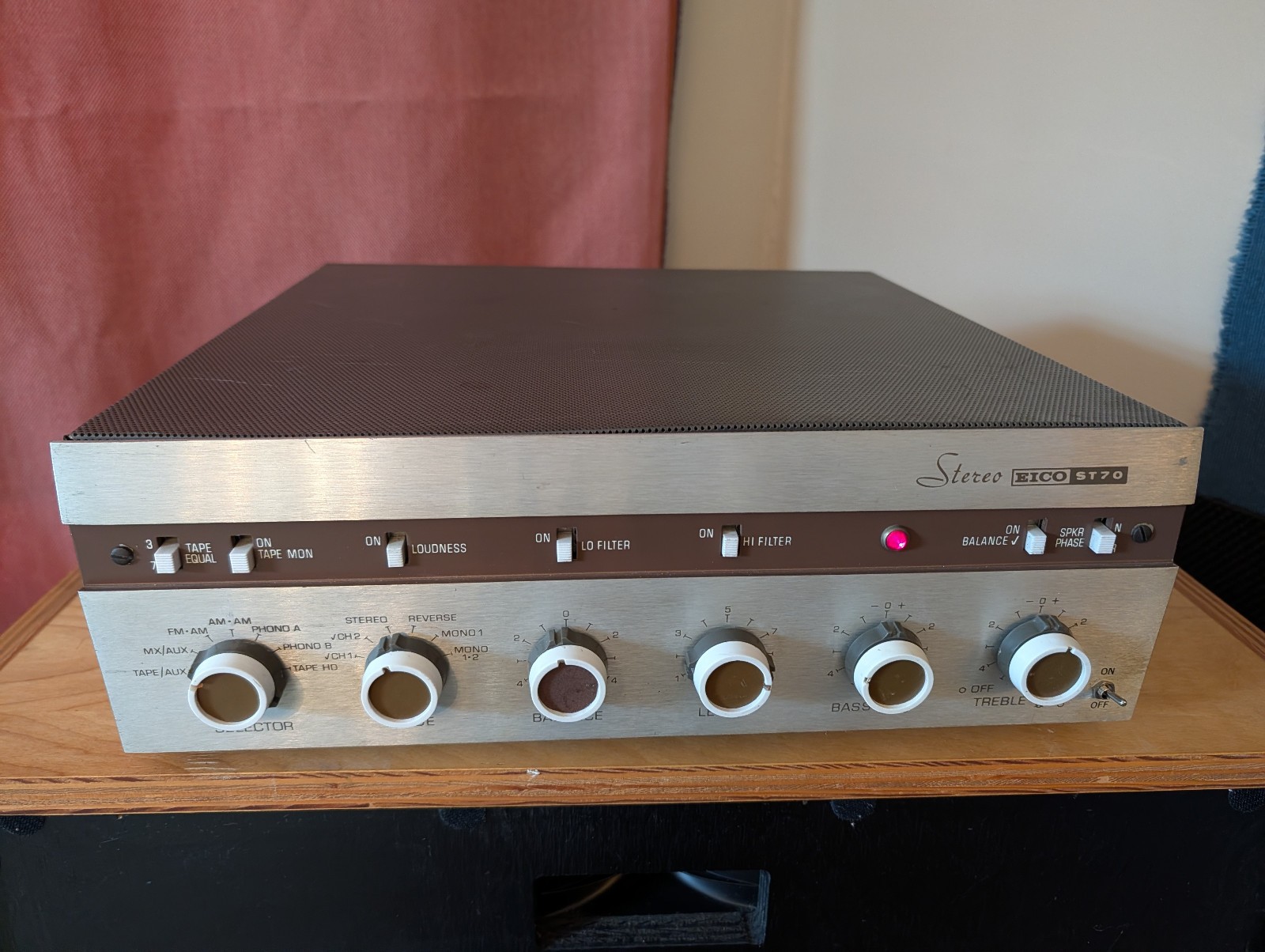
Unlike many tuners of the era that relied on complex tuning meters or early digital readouts, the ST-3120 featured a large analog dial with a clear frequency window and a mechanical tuning counter — a hallmark of Eico’s user-friendly, no-frills engineering. The front panel was minimalist, with a brushed aluminum finish, a large tuning knob, and separate controls for FM/AM selection, stereo/mono switching, and signal strength indication.
Sound Characteristics and Performance
The Eico ST-3120 was engineered to deliver clean, transparent FM reception with a focus on stereo imaging and low noise — essential qualities during the rise of FM stereo broadcasting in the 1970s. Its solid-state design provided consistent performance without the drift issues common in tube-based tuners, and its double-conversion superheterodyne FM section ensured excellent selectivity and rejection of adjacent channels.
In practice, the ST-3120 offered strong stereo separation and a wide capture range, making it capable of pulling in distant stations with clarity. The signal-to-noise ratio was competitive for its time, and the stereo decoder circuitry was based on the pilot-tone system, which had become the industry standard by the early '70s.
AM reception, while not the primary focus, was surprisingly capable for a tuner of this class. The AM section used a conventional superheterodyne design with adequate filtering to reduce interference, making it suitable for news, talk radio, and broadcast music with reasonable fidelity.
Many users report that the ST-3120 delivers a neutral, uncolored sound — a trait prized by audiophiles who wanted their tuner to be an invisible conduit for broadcast content, not a colorant of tone. When paired with a high-quality preamp and amplifier, the ST-3120 could extract every nuance from a well-transmitted FM signal.
Notable Features and Innovations
While the ST-3120 wasn’t packed with flashy features, it embodied several thoughtful design choices:
- Modular Construction: The use of plug-in circuit boards made servicing and upgrades easier — a boon for technicians and hobbyists.
- Stereo Pilot Detection: Accurate detection of the 19 kHz pilot tone ensured stable stereo decoding and automatic switching between mono and stereo modes.
- Front-Panel Signal Strength Meter: A simple yet effective analog meter helped users fine-tune reception for optimal clarity.
- Separate RF and IF Shielding: Internal shielding minimized crosstalk and interference, contributing to cleaner reception.
- Kit-Friendly Design: True to Eico’s roots, the ST-3120 came with detailed assembly manuals, making it a popular project for electronics enthusiasts.
The tuner also featured gold-plated RCA output jacks and high-quality internal wiring, reflecting Eico’s commitment to durability and signal integrity.
Common Issues and Maintenance
Like any vintage electronic component, the Eico ST-3120 benefits from regular maintenance, especially if it has been in storage or continuous use for decades.
Common issues include:
- Deteriorated Electrolytic Capacitors: Over time, capacitors in the power supply and audio coupling circuits can dry out, leading to hum, low output, or power failure. A full recap is recommended for units that haven’t been serviced in 30+ years.
- Tuning Dial Stiffness: The mechanical tuning mechanism can become stiff or noisy due to dried lubricants. Cleaning and re-lubrication with appropriate electronics-grade grease can restore smooth operation.
- Worn Potentiometers: The stereo/mono switch and tuning knob pot can develop crackling sounds. Contact cleaner (e.g., DeoxIT) often resolves this, but replacement may be necessary in severe cases.
- Antenna Terminal Corrosion: Outdoor FM antennas can introduce moisture, leading to corrosion on the 300-ohm twin-lead terminals. Inspect and clean as needed.
Because Eico provided detailed schematics and service manuals, the ST-3120 is relatively straightforward to repair — a major advantage for vintage gear collectors.
Current Market Value and Collectibility
The Eico ST-3120 is not a high-profile collector’s item like a Marantz 10B or a Harman Kardon tuner, but it holds steady appeal among vintage audio enthusiasts, kit-building historians, and FM radio purists.
In the current market (2024), a fully functional, factory-assembled ST-3120 typically sells for $125–$200, depending on condition and originality. Units that have been professionally restored or come with original manuals and packaging may command slightly higher prices.
Kit versions in original, un-assembled condition are rarer and can fetch $150–$250 from collectors of vintage electronics kits, especially those interested in mid-century DIY culture.
While not a "blue chip" vintage tuner, the ST-3120 is appreciated for its historical significance, repairability, and excellent FM performance — especially in areas with strong broadcast signals.
Conclusion and Legacy
The Eico ST-3120 may not have the glamour of high-end tuners from the 1970s, but it represents something equally valuable: accessible, high-quality audio engineering during a pivotal moment in broadcast history. At a time when stereo FM was becoming a household reality, the ST-3120 offered a reliable, well-built gateway to the new world of stereo radio.
More than just a tuner, it reflects Eico’s broader mission — to democratize high-fidelity audio through smart design, modular construction, and a commitment to the DIY spirit. For today’s vintage audio enthusiasts, the ST-3120 is a rewarding find: a capable performer, a repairable classic, and a tangible link to the era when tuning into your favorite station was an act of precision and pleasure.
Whether you're restoring a full Eico system, building a retro radio setup, or simply exploring the golden age of FM, the ST-3120 deserves a place on the shelf — not as a showpiece, but as a working tribute to analog clarity and honest engineering.
eBay Listings

As an eBay Partner, we earn from qualifying purchases. This helps support our independent vintage technology research.
Related Models
- Pioneer QX-949A (1978)
- Pioneer SX-2000 (1978)
- Pioneer SX-2500 (1978)
- Marantz SR-2000 (1999–2001)
- Onkyo TX-1500MKII (1975)
- Pioneer QX-646 (1978)
- Pioneer SX-1900 (1978)
- Pioneer SX-201 (1978)
- Pioneer SX-251R (1976)
- Realistic STA-2250 (1975)