Dynaco ST-70 (1959)
Thirty-five watts a side, a kit price that undercut everything, and a Dynaco transformer set that still embarrasses modern iron - the amplifier that put tubes in American living rooms.
Overview
The ST-70 is the amp that made David Hafler's Dynaco a household name among hobbyists. Introduced in 1959, it was the company's first stereo amplifier. It used a push-pull ultralinear circuit and came two ways: as a Dynakit the buyer assembled at the kitchen table, or as a factory-wired Dynaco unit. Dynaco, based in Philadelphia, had been founded in 1955 by Hafler and Ed Laurent. The ST-70 carried their affordable-high-fidelity philosophy into a generation of listening rooms. It went on to become the best-selling tube amplifier in history, which sounds like marketing until you look at how many survive today.
On the bench, the ST-70 is a 35-watts-per-channel stereo amplifier into 8Ω. Frequency response is 10Hz to 40kHz, and rated total harmonic distortion is 1% (some sources cite 0.05% THD at 1 watt). Those numbers are honest, not heroic. The ST-70 was never a powerhouse. It was a well-executed ultralinear design that made the most of a modest parts budget. Speaker load impedance runs from 4Ω to 16Ω, and input sensitivity is 1.3 volts RMS for full output. Damping factor is 15, which is fine for the high-efficiency speakers of the day and merely adequate for anything thirstier.
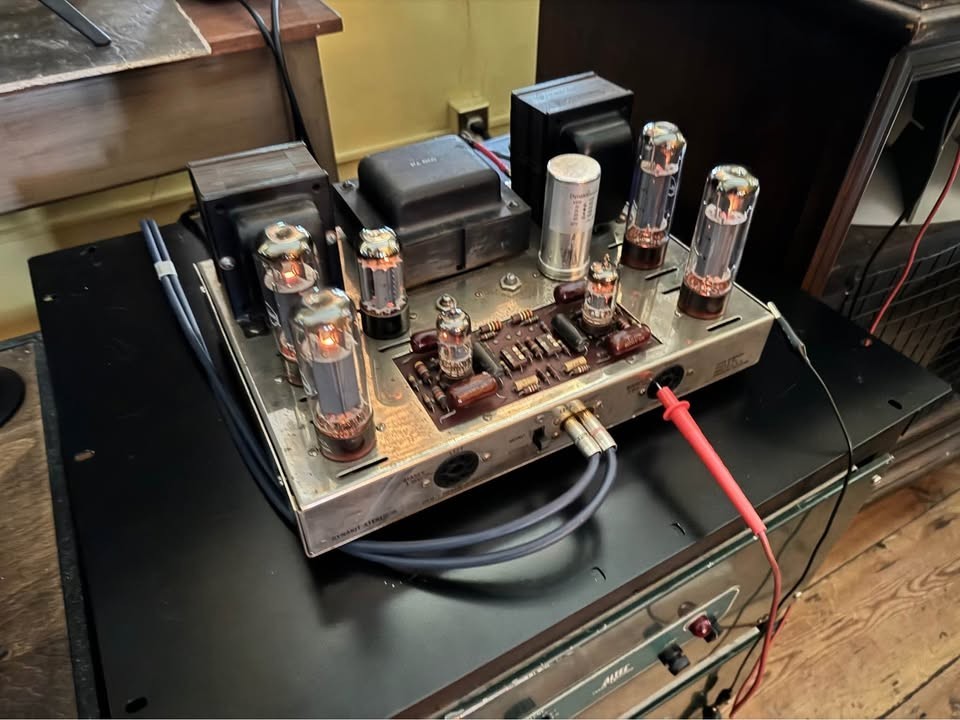
The tube lineup is the classic Dynaco one: four EL34 output tubes, two 7199 driver tubes, and one 5AR4/GZ34 rectifier. The 7199 was purpose-built for low hum, low leakage noise, and minimal microphonism, which is what you want in a high-fidelity driver stage. The original factory output tubes were Mullard EL34s, though they left the plant labeled Dynaco. Signal-to-noise is quoted at 90dB. Input impedance is a very high 470k, which suits passive preamps and tube sources alike.
It is not a neutral amp in the modern sense. The ST-70 is known for a warm, musical sound, and that is part of why the restoration community keeps it alive. If you want clinical, look elsewhere. If you want an amplifier that flatters a pair of vintage speakers and doesn't fight the music, this is the one.
Key Features
Push-Pull Ultralinear Output Stage
The ST-70 runs two ultralinear output transformers and a single power transformer in a push-pull ultralinear configuration. Dynaco's own reasoning was that UL operation with feedback was the best compromise for the power, distortion, frequency response, and damping factor they were targeting. That reasoning still holds up. The topology is why the amp measures as well as it does for its price, and why it responds so predictably to modification. The transformers are the reason so many ST-70s are worth restoring rather than parting out.
7199 Driver Tube
The two 7199 driver tubes weren't an off-the-shelf choice. They were designed for low hum, low leakage noise, and minimal microphonism, which matters a lot in a high-gain driver stage feeding EL34s. This is also the tube that causes the most headaches today, because it is no longer in production. U.S. manufacturing ended in the 1980s, and Russian Sovtek production ceased around 2007. NOS 7199s exist, but they're getting scarce and expensive, and many restorers swap to alternate driver boards for that reason.
Quad-Cap Power Supply and .1uf Coupling Caps
The original power supply used a multi-section "quad-cap" electrolytic, and the circuit board carried .1uf interstage coupling caps. You will almost certainly replace both on any unrestored example. The quad-cap is prone to drying out with age, and board replacement is a common part of any serious restoration. This isn't a design flaw so much as a fact of electrolytic life, but it's the first thing a buyer should budget for.
Kit or Factory-Wired
Dynaco sold the ST-70 as a Dynakit for the purchaser to assemble, or as a complete factory-wired Dynaco unit. The kit put audiophile-grade tube amplification within reach of people who could never have afforded a finished high-end amplifier. Original assembly quality varies wildly between examples, and a clean factory-wired unit or a well-built kit is worth more than a sloppy home build. When evaluating one, look at the solder joints as carefully as you look at the transformers.
PAS-3 Preamplifier Pairing
The ST-70 pairs with the Dynaco PAS-3 preamplifier, and the two were frequently sold and used together. A matching pair is a period-correct system rather than a random pairing, and it's worth keeping them together. The 470k input impedance of the ST-70 plays nicely with the PAS-3's output stage, so the combination behaves the way Dynaco intended.
Historical Context
Dynaco built the ST-70 around a vision of affordable, high-quality audio, and the timing was right. In the 1950s and 1960s, high-fidelity audio was becoming a serious American hobby. The ST-70 gave ordinary music lovers tube-amplifier performance they could afford, and even build themselves. It served as the foundation for the Mark IV monoblock.
The line didn't stop with the original. A Series II followed, and it used output tubes by Siemens, labeled Dynaco but made in East Germany. A Series 3 exists as well, described by the company as the introduction of a third generation of vacuum tube products bearing the Dynaco name. The trademark has since changed hands. One source suggests the current owner is Pan Orient Corporation, which would make newer "Dynaco" reproductions a different animal from a Philadelphia-built original. If provenance matters, check the chassis and paperwork before assuming a modern unit is the real thing.
Collectibility & Value
The ST-70 is one of the most sought-after vintage amplifiers on the market, appreciated for its sound and its enormous potential for modification. Contemporary reviewers noted that the ST-70 Series II, when paired with a system that already had some warmth and was not too power hungry, was an entry-level contender among tube amplifiers (Audiophile 1992, p.197). Earlier, Audio (April 1989, p.147) carried an advertisement offering ST-70 upgrades and assembly services for $450, which shows the modification market around the amplifier was already thriving by the late 1980s.
It is also one of the most common, which keeps prices from reaching the stratosphere. A used ST-70 sold for $69.50 back in 1965. Today, tested original units list in the $820 range, very clean examples push past $1,200, and VTA-modified or upgrade-ready units trade around $365 - $475 depending on what's been done. Countless units remain in service, supported by an active restoration community that has kept parts, boards, and knowledge flowing for decades.
Maintenance is well documented. The original quad-cap is prone to drying out, and replacing the circuit board and components is common practice on any unrestored amp. The 7199 is out of production, so budget for NOS or a driver-board swap. Replacing the two-prong power cord with a three-prong is a popular safety upgrade, but it can introduce ground loop hum if it isn't done correctly. Signal ground and chassis ground need to be handled deliberately. Modifications are everywhere: Curcio Audio boards, VTA conversions, the Evolution 4T circuit, and a long list of driver designs. The Curcio board, for example, accepts 6922, 6N1P, 7308, 6DJ8, or 6CG7 tubes, which sidesteps the 7199 problem entirely. Output transformer upgrades are also available for anyone building from scratch or pushing an existing amp further.
One caution for buyers: a modified ST-70 is not the same product as a stock one. A VTA-converted amp and an original restored amp sound different and appeal to different buyers. Decide which you want before you bid, because the market prices them accordingly and the "upgrades" aren't universally considered improvements.
eBay Listings


As an eBay Partner, we earn from qualifying purchases. This helps support our independent vintage technology research.