Dynaco PAS-3 (1963–1980s)
At 4.8 kg, it carries the weight of an era when tubes ruled and high fidelity didn’t require a second mortgage.
Overview
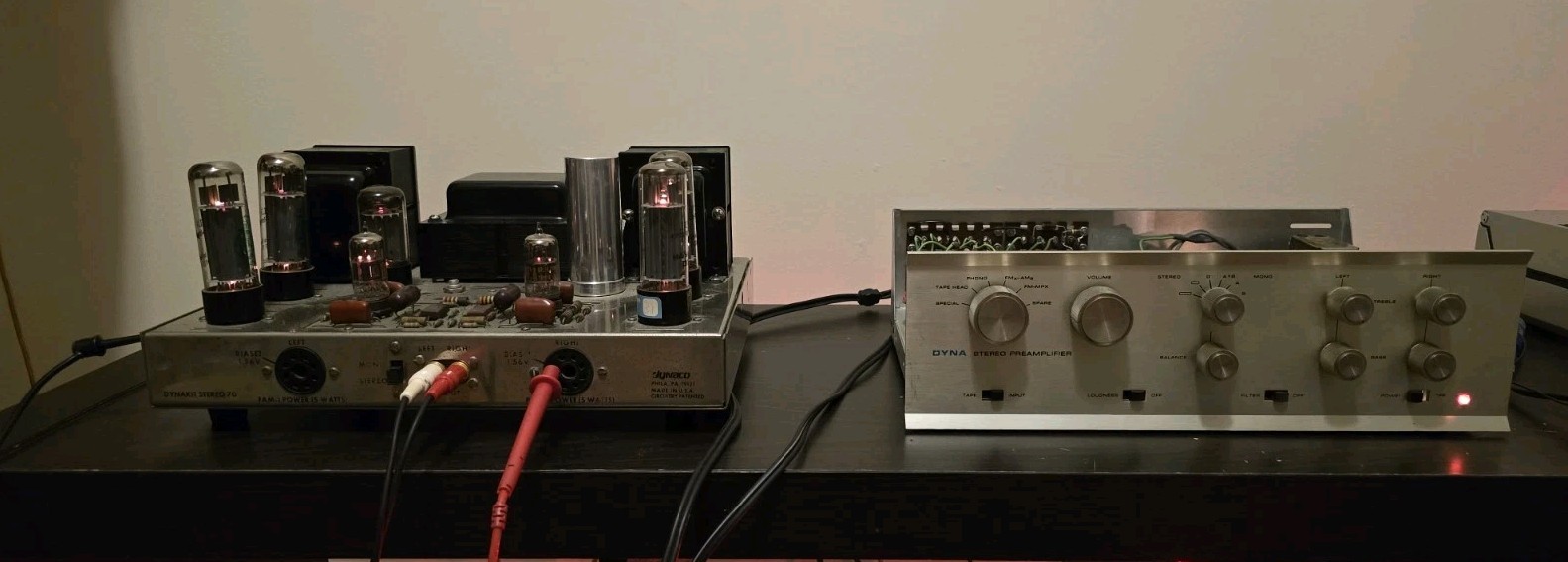
The Dynaco PAS-3 isn’t a relic wrapped in nostalgia so much as a working blueprint of what made tube gear desirable in the first place: simplicity, musicality, and a circuit that invites tinkering. Introduced in 1963, this all-tube stereo preamplifier was engineered to be the brains of a high-performance audio system without the boutique price tag. It paired most famously with the legendary ST-70 power amplifier, forming a combo that delivered rich, dynamic sound to a generation of audiophiles who valued performance over polish. Owners report a warm, slightly lush character—particularly in the low mids—that complements the ST-70’s punch without tipping into syrupy excess. But make no mistake: this is a product of its time, with all the quirks that implies. The PAS-3 doesn’t chase neutrality; it leans into its tube coloration, offering a presentation that some describe as “musical” and others, less charitably, as “bright” when mismatched.
Despite its straightforward appearance, the PAS-3 packed a surprising number of features for its era. It offered multiple inputs—phono, tape, FM, and even a mic input that could double as a third phono stage—giving users flexibility long before the term “source selector” became standard. The tone controls, with ±20 dB of bass adjustment at 20 Hz and ±18 dB of treble at 20 kHz, are aggressive by modern standards, but they were designed for real-world records and less-than-perfect listening rooms. When centered, the tone controls disengage completely thanks to a special potentiometer arrangement, allowing the signal to pass through flat—a clever design touch that avoided the tonal degradation common in passive tone circuits of the day.
Still, the PAS-3 isn’t without its compromises. The lack of published crosstalk specs between line-level inputs suggests a certain engineering pragmatism—owners note that switching between sources can sometimes result in bleed or interaction, especially if cables aren’t properly shielded. And while the signal-to-noise ratio is respectable at 85 dB for auxiliary inputs and 74 dB for phono, the phono stage, though sensitive at 2.5 mV, was built for moving magnet cartridges of the 1960s and may struggle with lower-output models. There’s no RIAA equalization switch or subsonic filter, just a straightforward, no-frills phono preamp that expects you to know what you’re doing.
Specifications
| Manufacturer | Dynaco |
| Product type | Tube stereo preamplifier |
| Production years | Introduced 1963, produced into the 1980s |
| Frequency characteristic | 10 Hz ~ 40 kHz ± 0.5 dB (Aux) |
| Harmonic distortion factor | Below the measurement limit |
| Cross modulation distortion factor | 0.05% or Less (at 2 V, Rated Output) |
| Signal-to-noise ratio | Phono:74dB Aux:85dB |
| Input circuit | Phono, Tape head, Special (used as Phono2) Mic (can be used as Phono3), Tape head AM-FM, FM-multi, Tape, Spear |
| Input sensitivity | Phono:2.5mV Tape head:188mV Spear:100mV |
| Input impedance | Low level : 50k Ω High level : 250k Ω |
| Output voltage | 10V/100k Ω |
| Phono allowable input voltage | 250mV |
| Tone control | Bass : ± 20 dB (20 Hz) Treble : ± 18 db (20 khz) |
| Semiconductor used | 12AX7 : 4 Pieces 12X4 : 1 Piece |
| External dimensions | Width 343x Height 108x Depth 230 mm |
| Weight | 4.8 kg |
Key Features
Negative Feedback Across Entire Circuit
Dynaco applied global negative feedback throughout the PAS-3’s design to minimize distortion, a decision that contributed to its relatively clean measured performance despite being entirely tube-based. This approach helped keep harmonic distortion below measurable thresholds under normal operating conditions, though some owners argue that this feedback, while technically beneficial, slightly dampens the “liveness” that pure single-ended designs can offer. The trade-off was stability and compatibility—this preamp could drive long interconnects and a variety of power amps without oscillation or loading issues.
Tone Controls That Disconnect at Center
One of the PAS-3’s standout engineering choices was the use of a special volume and tone potentiometer setup that fully removes the tone network from the signal path when the controls are set to the middle position. This meant users could enjoy a passive, flat response when desired—effectively turning the preamp into a pure gain stage—without the usual capacitive or resistive artifacts that plague tone circuits even when “bypassed.” Both bass and treble controls operated independently on left and right channels, a feature that offered precise room correction but also opened the door to channel imbalance if adjusted carelessly.
Flexible Input Configuration
With inputs labeled Phono, Tape, FM, Mic, and even “Spear,” the PAS-3 was built for adaptability. The Mic input, capable of handling low-level signals, could be repurposed as a second or third phono stage—handy for collectors spinning both mono and stereo records. The “Special” input was often used for additional sources like reel-to-reel decks. While the labeling might seem cryptic today, it reflected the modular nature of hi-fi systems in the 1960s, where users cobbled together gear from multiple manufacturers. Input impedance is set at 50k Ω for low-level sources and 250k Ω for high-level, ensuring compatibility with most contemporary gear.
All-Tube Signal Path with 12AX7s
The PAS-3 relies on four 12AX7 dual-triode tubes for amplification and one 12X4 tube, likely for rectification or buffering. This all-tube design is central to its sonic character—soft on transients, rich in harmonics, and forgiving of compressed recordings. The 12AX7s, widely available and easily swapped, make tube rolling a popular mod, though Dynaco’s original circuit was optimized for standard-spec tubes. The absence of solid-state components in the signal path ensures a consistent tube flavor from input to output.
High Output Voltage and Drive Capability
Rated at 10V output into 100k Ω, the PAS-3 has more than enough voltage swing to drive even the most demanding power amplifiers of its era—and many modern ones. This high output capability made it a reliable partner for the ST-70, eliminating the need for additional gain stages. It also meant the preamp could handle long cable runs without signal degradation, a practical advantage in larger listening rooms.
Historical Context
The PAS-3 arrived in 1963 as part of a broader movement to democratize high-fidelity audio. Alongside the FM-3 tuner, it helped form a complete system that could be assembled for under $200—a staggering value at the time. This pricing strategy wasn’t accidental; Dynaco built its reputation on kit-based electronics that offered near-commercial performance at DIY prices. The PAS-3 was the companion preamplifier to the ST-70, and together they became one of the most popular tube amplifier combinations in history. The PAS series had begun earlier with the PAS-2, but the PAS-3 refined the formula with improved layout, better shielding, and more input options. Production continued into the 1980s, a testament to its enduring appeal and simple, serviceable design.
Collectibility & Value
Current market prices for the Dynaco PAS-3 vary widely based on condition and restoration status. Listings have appeared at $495 for sold units and $699 for examples in very good condition (such as a 1969 model on Reverb). One Facebook group post reported a sale at $1,825, though this may reflect a fully restored or exceptionally rare configuration. Forum discussions suggest a fair price for unrestored units is around $375—half the value of a $750 asking price—reflecting the cost and effort of refurbishment. Common issues include static during volume adjustment and degraded capacitors, particularly the molded paper and electrolytic types used in the power supply. Complete recap kits are available on eBay, and numerous YouTube tutorials cover filter capacitor replacement and volume control mods. Owners report that restoring a PAS-3 often involves installing a new power supply board, a testament to the wear these units have seen over decades of use.
eBay Listings

As an eBay Partner, we earn from qualifying purchases. This helps support our independent vintage technology research.