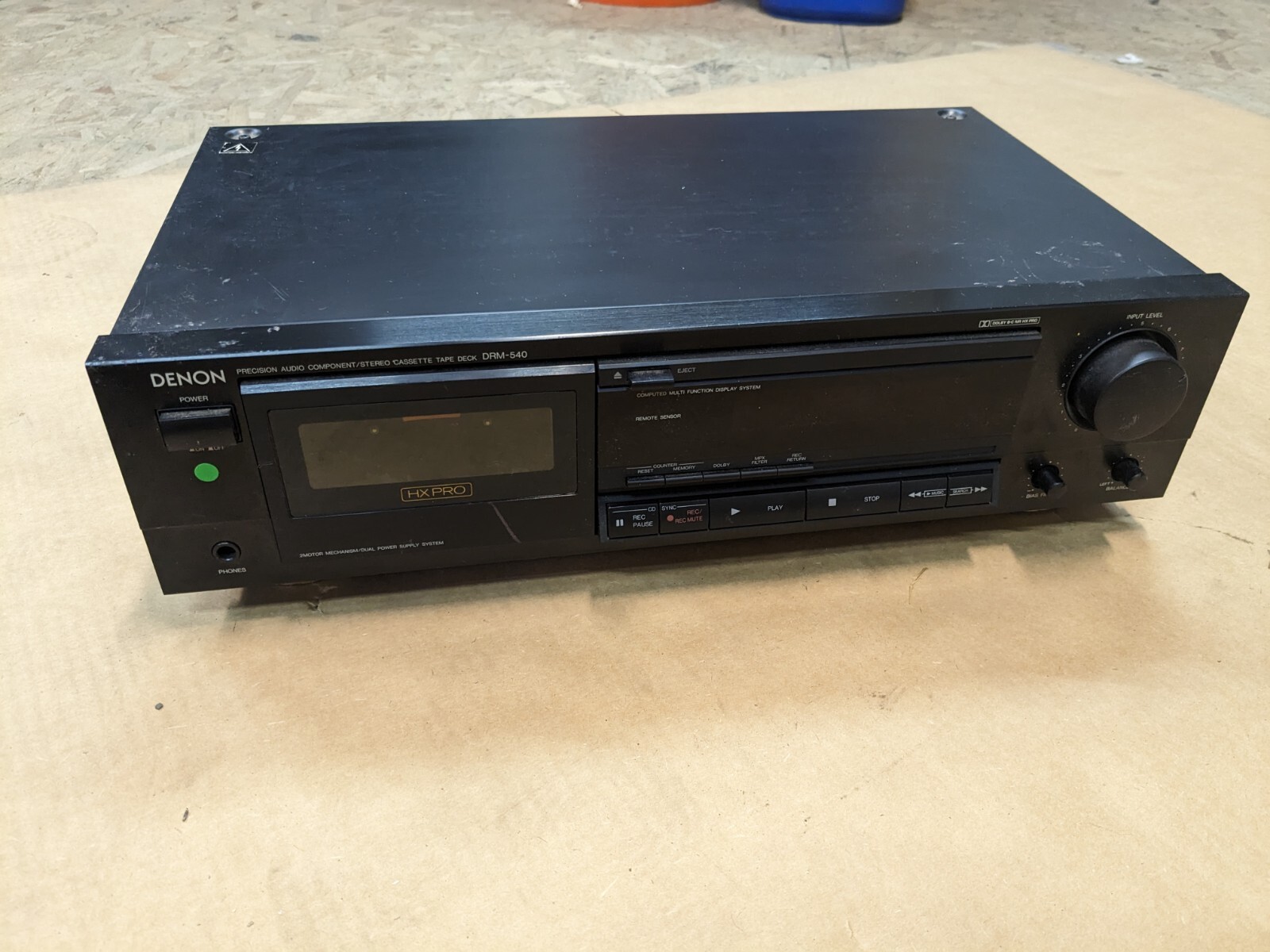
Denon DRM-540: The Precision Dual Cassette Deck of the Late 1970s
In the late 1970s, as high-fidelity audio systems reached new heights of performance and accessibility, cassette decks evolved from simple playback devices into serious tools for audiophiles and home recording enthusiasts. Denon, already renowned for its excellence in turntables, amplifiers, and professional audio gear, entered this competitive arena with a series of high-end cassette recorders that emphasized precision engineering and sonic accuracy. Among these, the Denon DRM-540 stands out as a rare and sophisticated dual cassette deck designed for users who demanded more than just convenience — they wanted fidelity, control, and the ability to create high-quality tape copies with minimal generational loss.
Though not as widely known as some of its contemporaries from Nakamichi or Sony, the DRM-540 reflects Denon’s commitment to audio integrity and mechanical excellence. Released in 1978, it arrived during a pivotal moment in audio history — just before the cassette format began its ascent as a legitimate high-fidelity medium, thanks to advancements in tape formulation, bias calibration, and transport design.
Technical Specifications
The Denon DRM-540 was engineered as a dual-deck solution, meaning it featured two complete tape mechanisms in one chassis — a configuration favored by users who frequently made cassette dubs or needed precise monitoring during recording. Unlike budget dual decks that compromised on head quality or transport stability, the DRM-540 used high-grade components throughout.
| Specification | Detail |
| Model | DRM-540 |
| Year of Release | 1978 |
| Type | Dual cassette deck |
| Recording Tracks | 2-track, stereo |
| Playback Speed | 1⅞ ips (4.76 cm/s) |
| Head Configuration | Dual playback/record heads (per deck) |
| Head Type | Ferrite (record/play), dual-gap design |
| Motors | Dual direct-drive capstan motors |
| Wow and Flutter | < 0.08% (weighted) |
| Frequency Response | 40Hz – 15kHz (IEC B, normal tape) |
| Signal-to-Noise Ratio | 58 dB (Dolby B) |
| Input/Output | Line In/Out (RCA), headphone jack |
| Recording Equalization | 120 µs / 70 µs (switchable) |
| Tape Types Supported | Type I (Normal), Type II (Chrome) |
| Noise Reduction | Dolby B (per deck) |
| Calibration Features | Level meter, bias/tone calibration controls |
| Dimensions | 430 × 145 × 330 mm (W×H×D) |
| Weight | 11.2 kg (24.7 lbs) |
Sound Characteristics and Performance
The DRM-540 was not designed for flashy specs or flashy looks — it was built for accuracy. Its dual direct-drive capstan system ensured stable tape speed and minimized wow and flutter, critical for maintaining pitch stability and preserving the integrity of the source material. The dual-gap head design allowed for separate optimize record and playback gaps, improving high-frequency response and reducing print-through.
Sonically, the DRM-540 delivered a clean, neutral tonal balance. It lacked the exaggerated warmth sometimes associated with budget cassette decks, instead favoring transparency and detail. When paired with high-quality Type II (chrome) tapes and properly calibrated, the deck could produce copies that were remarkably close to the original, making it a favorite among users who valued archival quality.
Dolby B noise reduction was standard, helping to suppress tape hiss without introducing the "breathing" artifacts common in less refined implementations. The inclusion of individual calibration controls for bias and level on each deck allowed advanced users to fine-tune performance based on tape brand and batch — a feature typically found on professional recorders.
Notable Features and Innovations
What set the DRM-540 apart from most dual cassette decks of its era was its professional-grade calibration suite. While many consumer dual decks were "set and forget" machines, the DRM-540 invited user adjustment. Each deck had independent level meters, record level controls, and switches for bias and equalization. This allowed users to match the recording characteristics of different tape types precisely.
Other standout features included:
- Dual direct-drive capstans: Eliminated belt slippage and ensured long-term speed consistency.
- Individual deck monitoring: You could listen to either deck independently, essential for editing and quality control.
- Tape type switching: Optimized replay equalization and bias settings for Normal and Chrome tapes.
- Robust chassis construction: A heavy steel frame minimized vibration and contributed to mechanical stability.
- Front-panel cassette wells: Designed for easy access and smooth loading, with illuminated tape windows.
The dual-deck layout also supported high-speed dubbing, allowing users to copy tapes at real-time speed from one deck to the other — a major convenience before digital copying became commonplace.
Common Issues and Maintenance
Like all vintage cassette decks, the Denon DRM-540 requires careful maintenance to perform at its best. Over time, rubber components such as pinch rollers and idler tires can harden or degrade, leading to speed inaccuracies or tape slippage. These should be inspected and replaced as needed by a qualified technician.
The dual capstan motors are generally reliable, but dust accumulation on the capstan shafts and heads can degrade sound quality and cause tape wear. Regular cleaning with isopropyl alcohol and a lint-free swab is essential.
One unique challenge with dual decks like the DRM-540 is head alignment drift. Because both decks must remain precisely aligned for optimal playback, periodic azimuth and alignment checks are recommended — especially if the unit has been moved or stored improperly.
Additionally, the internal lubricants may dry out after decades of inactivity. A full mechanical service, including lubrication of gears and transport mechanisms, is often necessary to restore smooth operation.
Owners should also be cautious about using old or degraded tapes, as sticky shed syndrome can transfer residue to the heads and rollers, potentially damaging the transport.
Current Market Value and Collectibility
The Denon DRM-540 is a rare find today. Unlike mass-market dual decks from brands like JVC or Sharp, Denon produced the DRM-540 in limited numbers, targeting a niche market of audiophiles and semi-professional users. As a result, working units in good condition are scarce and highly sought after by vintage audio collectors.
On the secondhand market, a fully serviced DRM-540 typically commands $300–$500, depending on condition and provenance. Units with original packaging, manuals, or calibration tapes may fetch higher prices, especially among purists.
Its collectibility is enhanced by Denon’s reputation for engineering excellence and the deck’s understated, professional aesthetic. While it may not have the flashy design or cult status of a Nakamichi Dragon, the DRM-540 represents a serious, no-compromise approach to cassette duplication and playback.
Conclusion and Legacy
The Denon DRM-540 is more than just a dual cassette deck — it’s a testament to a time when analog tape was taken seriously as a high-fidelity medium. Built with precision, designed for control, and engineered for longevity, it served a specific but important role in the audiophile’s toolkit.
Though overshadowed by more famous contemporaries, the DRM-540 deserves recognition for its technical sophistication and user-focused design. For collectors and vintage audio enthusiasts, it offers a rare opportunity to experience Denon’s mastery of analog recording technology beyond their celebrated turntables and receivers.
If you’re lucky enough to find a well-maintained DRM-540, it’s worth restoring. Not just as a functional piece of gear, but as a symbol of an era when every detail — from bias calibration to capstan drive — mattered in the pursuit of perfect sound.
eBay Listings


As an eBay Partner, we earn from qualifying purchases. This helps support our independent vintage technology research.
Related Models
- Denon DR-M3 (1985)
- Denon DR-171 (1978)
- Denon DR-210 (1985)
- Denon DR-600 (1982)
- Denon DR-800 (1985)
- Sony TC-2050SD (1978)
- Aiwa AD-F990 (1993)
- Kenwood KX-3060 (1982)
- Sony TC-2130A (1974)
- Sony TC-2220 (1972)