Denon DR-M12HR: The High-Resolution Cassette Deck from a Golden Era
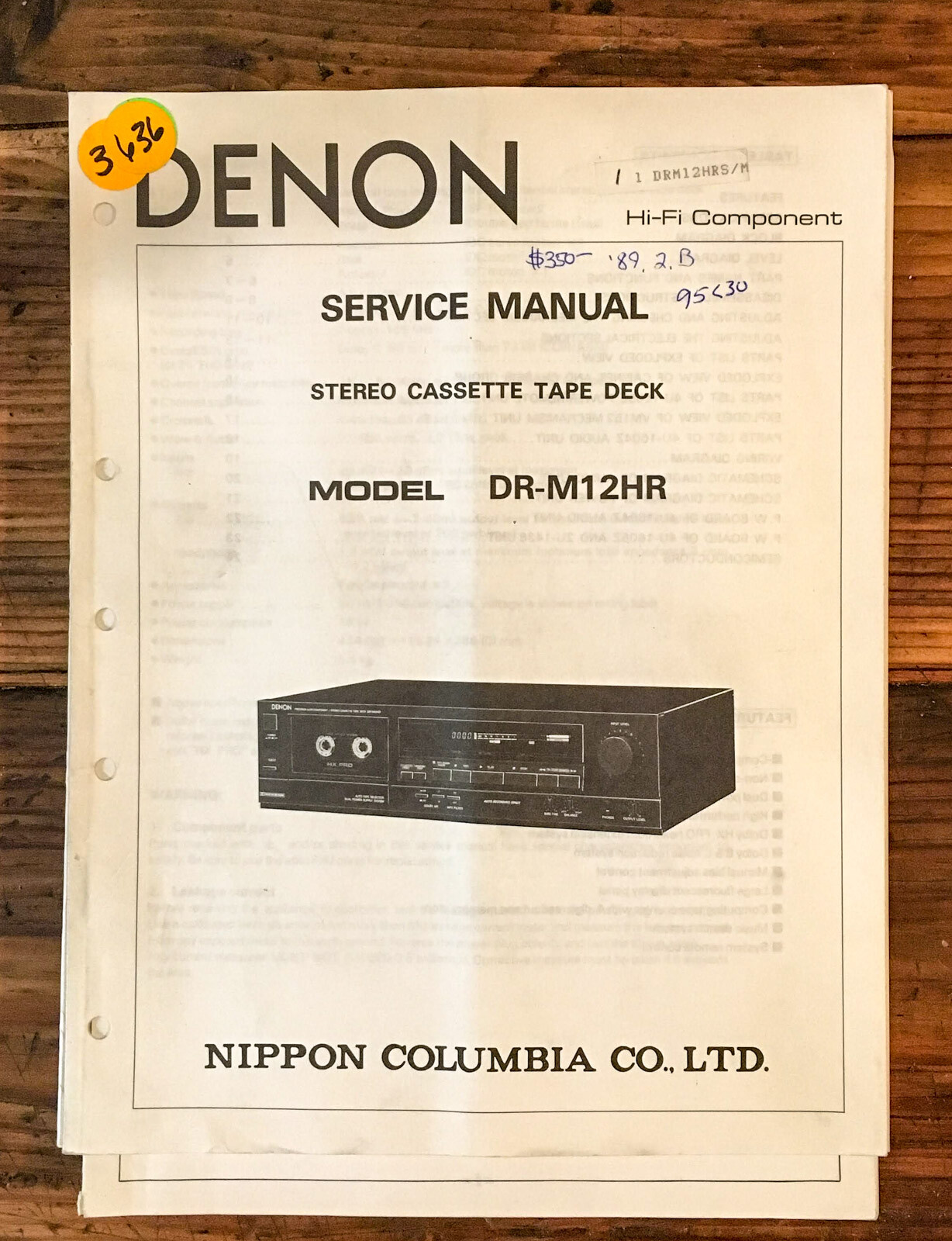
In the early 1980s, as the audiophile community debated the merits of vinyl versus the emerging compact disc, a quieter revolution was taking place in the world of analog tape: the high-end cassette deck. While many dismissed cassette tapes as a medium for casual listening or car audio, companies like Nakamichi, Revox, and Denon were pushing the format to its technical limits. Among Denon’s most ambitious offerings in this space was the DR-M12HR, a high-resolution cassette deck introduced in 1984 that represented the pinnacle of Denon’s tape engineering and a bold statement about the potential of compact cassette fidelity.
Though not as widely documented as some of its contemporaries, the Denon DR-M12HR stands as a rare and intriguing artifact from a time when analog tape technology was being refined with near-scientific precision. Designed for serious home recording and critical listening, the DR-M12HR was engineered to extract the maximum possible dynamic range, frequency response, and stereo imaging from the compact cassette format—offering performance that, in ideal conditions, approached that of early digital recordings.
Technical Specifications
| Feature | Specification |
| Year Introduced | 1984 |
| Type | 3-Head, Dual Capstan Cassette Deck |
| Tape Speed | 1⅞ ips (4.76 cm/s) |
| Heads | Denon-manufactured record, playback, erase |
| Motor System | Dual direct-drive capstan motors |
| Wow & Flutter | < 0.055% (measured RMS) |
| Frequency Response | 20Hz – 20kHz (±2dB) with metal tape |
| Signal-to-Noise Ratio | > 72dB (with dbx Type I noise reduction) |
| Total Harmonic Distortion | < 1.0% at 3% output |
| Input/Output | Line In (RCA), Line Out (RCA), Mic In (3.5mm) |
| Noise Reduction | dbx Type I, optional Dolby B compatibility |
| Bias & EQ | Adjustable for Type I, II, IV tapes |
| Display | Analog VU meters, mechanical tape counter |
| Dimensions | 440 mm (W) × 145 mm (H) × 350 mm (D) |
| Weight | 12.8 kg (28.2 lbs) |
Sound Characteristics and Performance
The Denon DR-M12HR was engineered with one goal in mind: transparency. Unlike mass-market cassette decks that prioritized convenience over fidelity, the DR-M12HR was built for audiophiles and semi-professional users who demanded studio-grade sound from a compact format. Its three-head configuration (separate record, playback, and erase heads) allowed for precise monitoring during recording and minimized crosstalk and print-through.
The deck’s dual direct-drive capstan system eliminated the need for rubber pinch rollers and belts, reducing mechanical noise and ensuring exceptional speed stability. This contributed to its remarkably low wow and flutter—well below 0.06%, a figure that rivaled many open-reel machines of the era.
When paired with high-quality metal-formulated tapes (such as Sony’s HF-XM or TDK MA), the DR-M12HR could achieve a frequency response extending from 20Hz to over 20kHz, with tight bass, clear mids, and sparkling highs. Its use of dbx Type I noise reduction—a companding system that compressed the dynamic range during recording and expanded it on playback—allowed it to achieve a signal-to-noise ratio exceeding 72dB, effectively eliminating tape hiss without the artifacts sometimes associated with Dolby systems.
Critically, the DR-M12HR offered manual control over bias and equalization, allowing users to fine-tune performance for different tape types. This level of adjustability was rare outside professional decks and reflected Denon’s commitment to precision.
Notable Features and Innovations
The DR-M12HR was packed with features that set it apart from even high-end consumer decks:
- Dual Capstan Transport: By using two independently driven capstans (one at each end of the tape path), Denon eliminated tape slippage and ensured constant tension. This design reduced modulation noise and improved tracking accuracy.
- dbx Type I Integration: While Dolby B was standard on most decks, dbx offered superior noise reduction. The DR-M12HR’s full implementation of dbx Type I made it ideal for recording live music and classical works with wide dynamic range.
- Three-Head System with Full Logic Control: The deck featured automatic tape switching and logic-controlled functions, including auto-reverse and end-of-tape sensing, while maintaining manual override for purists.
- High-Visibility VU Meters: Large, well-damped VU meters allowed for precise level monitoring during recording, essential for avoiding distortion or under-modulation.
- Modular Construction: Internal components were arranged in isolated modules to reduce electrical and mechanical interference, a design philosophy borrowed from Denon’s professional audio lineage.
Common Issues and Maintenance
As with any high-precision analog tape machine from the 1980s, the Denon DR-M12HR requires careful maintenance to perform at its best. Common issues include:
- Capstan Bearing Dryness: The dual capstan system relies on precision bearings that can dry out over time, leading to speed instability or motor strain.
- Head Alignment Drift: The three heads must remain perfectly aligned; even minor misalignment can degrade high-frequency response and stereo imaging.
- Deterioration of Rubber Components: Though the DR-M12HR uses minimal rubber (no pinch roller), any residual dampers or idler wheels may degrade and need replacement.
- dbx Circuit Aging: The dbx companding circuits use specialized ICs and capacitors that can drift or fail over decades, requiring recalibration or component-level repair.
Owners are advised to have the deck serviced by a technician experienced with high-end tape equipment. Regular demagnetization, head cleaning with isopropyl alcohol, and use of fresh, high-quality tapes are essential for optimal performance.
Current Market Value and Collectibility
The Denon DR-M12HR is a rare find today. Unlike more famous models such as the Nakamichi Dragon, it never achieved widespread fame, which contributes to its obscurity—but also to its appeal among tape enthusiasts and Denon collectors.
Units in excellent working condition, especially those with clean heads, responsive motors, and functional dbx circuits, typically command prices between $600 and $1,200 on the secondary market, depending on provenance and accessories. Fully serviced examples with documentation are increasingly sought after.
Its collectibility is enhanced by its unique position in Denon’s history: one of the few cassette decks the company ever produced, and arguably their most ambitious. For collectors of Japanese high-fidelity gear or analog tape technology, the DR-M12HR represents a fascinating “what if” moment—what if high-resolution cassette had become the norm?
Conclusion and Legacy
The Denon DR-M12HR may not be a household name, but it embodies the spirit of analog innovation that defined the early 1980s. At a time when digital audio was still in its infancy, Denon demonstrated that the humble cassette could be transformed into a high-fidelity medium through precision engineering and uncompromising design.
Though overshadowed by the rise of the CD, the DR-M12HR remains a testament to the potential of analog tape when pushed to its limits. For today’s audiophiles, it offers a unique listening experience—one that combines the warmth of analog with the clarity of advanced noise reduction and transport mechanics.
In the world of vintage audio, where rarity, performance, and craftsmanship converge, the Denon DR-M12HR earns its place as a hidden gem: a high-resolution cassette deck that dared to challenge the boundaries of its format.
eBay Listings



As an eBay Partner, we earn from qualifying purchases. This helps support our independent vintage technology research.
Related Models
- Denon DR-M3 (1985)
- Denon DR-171 (1978)
- Denon DR-210 (1985)
- Denon DR-600 (1982)
- Denon DR-800 (1985)
- Sony TC-2050SD (1978)
- Aiwa AD-F990 (1993)
- Kenwood KX-3060 (1982)
- Sony TC-2130A (1974)
- Sony TC-2220 (1972)