Crown D-150A (1975)
Eighty watts per channel, a faceplate full of brushed aluminum, and a front-panel light that comes on the moment the amplifier stops telling the truth.
Overview
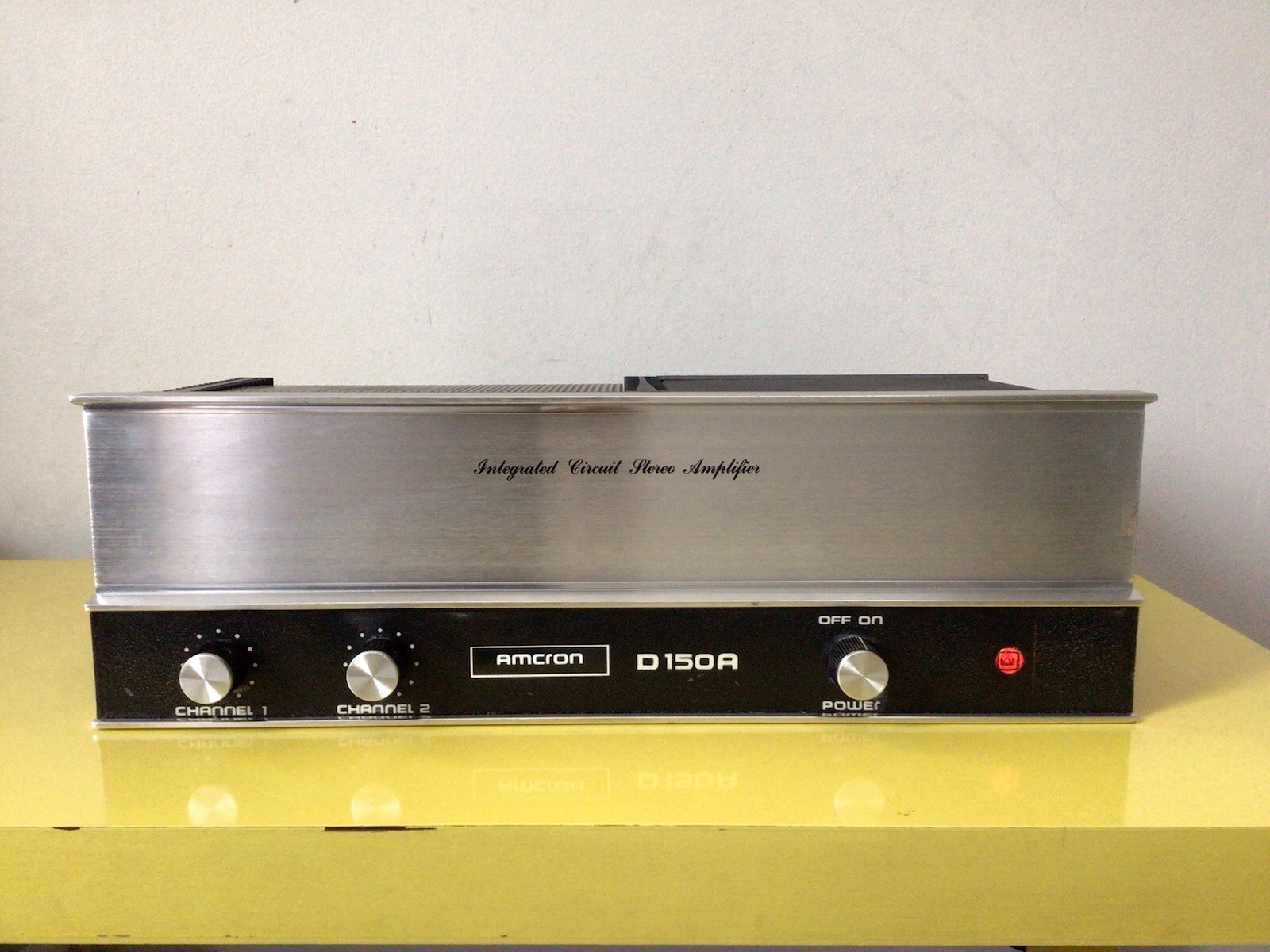
The Crown D-150A is a dual-channel power amplifier built by Crown International, Inc. of Elkhart, Indiana. It was sold under the AMCRON/CROWN banner in markets where the Amcron name applied. Crown's own documentation calls it an integrated-circuit stereo amplifier, and a 1975 product listing gives the full phrasing: "1975 Crown D150A Integrated Circuit Stereo Amplifier." Contemporary sources rate it at 80 watts per channel minimum RMS into an 8 ohm load, measured over a 1 Hz to 20 kHz bandwidth at a rated RMS sum total harmonic distortion of 0.05% of the fundamental output voltage. Bridged into mono, the same chassis is rated at 160 watts minimum RMS into a 16 ohm load.
The feature that sets the D-150A apart from the other 1970s power amps is the IOC circuit - Input Output Comparator. Crown's literature describes it as a real-time distortion detection mechanism. It compares the input waveform against the amplifier's actual output and catches non-linearities that conventional clip indicators miss. A dedicated IOC indicator on the front panel lights when discrepancies exceed threshold levels. For studio engineers and home listeners, that light is a diagnostic window, not a decoration. It tells you when the amplifier has stopped being a straight wire.
This is not a heavyweight. The D-150A is a single rack-height chassis, 133 mm tall, 483 mm wide and 222 mm deep. The Series II variant is documented at 24 lbs (10.9 kg), with a measured idle power draw of 38 watts. It was marketed as a smaller sibling to the DC300, and it sits within Crown's broader D-150 model line. The exact production years remain undocumented, though the 1975 designation and the Series II's documented lineage place it in the middle of the decade.
Key Features
IOC (Input Output Comparator) Distortion Detection
The IOC system is the reason collectors seek this amp out over a dozen other period Crowns. Unlike a simple peak or clip lamp, it continuously compares the input signal with the actual output waveform and flags any deviation caused by non-linear distortion. Crown's documentation notes that the system could catch distortion components that conventional methods overlooked, which was a real capability in an era before digital signal analysis was available at anything resembling consumer prices. In practice, the IOC lamp tells a mastering engineer when the amplifier is running out of headroom. It tells a home user when a difficult reactive load is pushing the output stage somewhere it doesn't want to go.
DC-Coupled Response from 0 Hz
The D-150A's frequency characteristic is rated DC to 20 kHz, ±0.1 dB at 1 watt output. DC coupling eliminates the input and output coupling capacitors that would otherwise introduce phase shifts and limit low-frequency transient response. That shows up in the bass, which is tightly controlled, with the speed and accuracy studio engineers need when judging mix balances. Home listeners notice it when a recording has real low-end content. The spec is not a marketing number. It is a deliberate design choice.
Integrated Circuit in the High-Level Stage
The high-level amplification section incorporates a new integrated circuit, as noted in Crown's official test documentation. Using an IC in this stage was not common in high-power amplifiers of the era, where discrete transistor designs dominated. The intent was improved gain consistency and reduced distortion in the critical voltage amplification phase. The harmonic distortion figure bears it out: 0.001% or less from 20 Hz to 400 Hz, the range where human hearing is most sensitive to harmonic artifacts. Crown's documentation doesn't detail the topology.
Brushed Aluminum Chassis and Jeln Cabinet Option
The D-150A wears what period descriptions call classic 1970s rugged brushed aluminum construction. The Series II variant was also offered in an original walnut veneer cabinet by Jeln, which is the version most often photographed in domestic settings. The rack-mount configuration is 3 RU with a 19-inch panel and an 8-inch mounting depth. That is deep enough to require a proper rack but shallow enough to fit in a broadcast or studio bay without eating half the rail.
Three-Year No-Fault Warranty
Crown backed the D-150A with a full three-year no-fault warranty, a rare commitment at the time. That warranty is part of the reason so many of these amps survived into the present day. Owners report units still functioning decades later, some having been serviced by Crown itself as recently as a year before the owner's report.
Historical Context
The D-150A emerged from Crown's engineering-first approach in the 1970s, a period when professional audio brands began making serious inroads into high-end home systems. It found its footing in both recording studios and home listening setups, and Crown positioned it as a smaller sibling to the DC300, the company's better-known workhorse. The documented lineage is specific: the D-150A Series II is described as the grandson of the 75 WPC Crown D 150 of 1971, which was rated at 75 watts per channel. That model's number came from simple arithmetic - 75 watts times two channels equals 150 - and the naming carried forward through the line.
Crown's own cutsheet language for the Series II is ambitious. Traveling sound companies, discos, and sports arenas throughout the world, the company wrote, had recognized the D-150A II as a standard of audio excellence. That's marketing copy and should be read as such. It does indicate the scale of the market Crown was chasing. The exact production years remain undocumented.
Collectibility & Value
Market listings for the D-150A vary widely. Sources suggest starting prices as low as $129.99, though individual units in working condition with original cases command considerably more. Recent eBay listings have shown a D-150A Series II Power Amplifier at $250, a unit listed as a "Vintage AMCRON Crown D-150A-2 Power Amp - 150W IOC Pro Audio" at $831, and a "CROWN D-150A power amplifier #BE12436" at $1,014. A separate source cites about $150 as a typical used price. A Facebook listing noted a D-150A among a group of vintage Crown gear priced at $1,400, though it's unclear whether that unit sold separately at that price. One restoration kit, a filter capacitor repair and rebuild package for the Crown (Amcron) D-150A, was listed at $176 in August 2022.
Common problems reported by owners include distortion in the lower frequencies and thermal or regulation issues that can cause the amplifier to run abnormally. One forum report describes a bad solder joint that had fooled three repairmen, the last of whom labeled one channel DO NOT USE because it would swing to +180 VDC. Another thread title asks whether all output transistors in a D150A are blown. These amps are old enough that a full recap and output-stage inspection should be assumed on any unrestored unit. Restoration kits, including capacitor recap services, are available, and a full service manual exists detailing disassembly, troubleshooting, and repair procedures. Crown's own parts documentation notes that while many electrical and electronic parts in the D-150A are standard items available from electronic supply houses, some parts that appear standard are actually special. A part ordered from Crown assures an acceptable replacement.
eBay Listings



As an eBay Partner, we earn from qualifying purchases. This helps support our independent vintage technology research.
Related Models
- Crown C-4 (1965)
- Crown D-150
- Crown D-150A IOC
- Crown D-60 (1972)
- Crown D-75 IOC
- Eico 3150 (1967)
- Fisher CUSTOM-ELECTRA-I (K-14/K-15) (1957)
- Fisher CUSTOM-ELECTRA IV (E33/E44) (1960)
- Akai AM-2400 (1978)
- Akai AM-2600 (1977)