Carver AVR-100: The Forgotten Fusion of High-End Audio and Early Home Theater
In the late 1990s, as home theater began to emerge from niche hobbyist circles into mainstream living rooms, audio manufacturers faced a critical challenge: how to blend the fidelity of high-end stereo with the immersive demands of multi-channel surround sound. Few companies approached this transition with as much boldness and engineering flair as Carver Corporation, led by the legendary audio designer Bob Carver. Among their most enigmatic offerings from this transitional era stands the Carver AVR-100—a rare, forward-thinking audio-video receiver that quietly bridged the gap between audiophile purity and cinematic immersion.
Though not as widely documented or produced as Carver’s legendary tube amplifiers or the iconic M-400 "magnetic field amplifier," the AVR-100 represents a fascinating chapter in Carver’s history—a time when the company sought to redefine what a receiver could be. Released in 1997, the AVR-100 arrived at a pivotal moment when Dolby Digital and DTS were just beginning to make their way into consumer electronics via DVD players. Carver, known for its no-compromise approach to analog sound, entered the AV receiver market with a product that prioritized both musicality and surround sound precision.
Technical Specifications
| Specification | Detail |
| Model | Carver AVR-100 |
| Year of Release | 1997 |
| Category | Audio/Video Receiver |
| Number of Channels | 5.1 |
| Audio Inputs | 4 stereo analog, 1 phono (MM), coaxial & optical digital (2 each) |
| Video Inputs | 3 composite, 2 S-Video |
| Audio Processing | Dolby Digital, DTS, Dolby Pro Logic |
| Tuner | AM/FM with 30 presets |
| Remote Control | Full-function IR remote (RC-100 compatible) |
| Dimensions (W×H×D) | 17" × 6.5" × 15" |
| Weight | 28 lbs (12.7 kg) |
| Power Output (AV Mode) | Not specified (external amplification recommended) |
| Impedance Compatibility | N/A (preamp/processor only) |
| Special Features | Tape loops, assignable zones, RS-232 control, Carver Sonic Holography® |
> Note: The Carver AVR-100 is primarily a preamp/processor, not a power amplifier. It lacks built-in amplification, meaning it must be paired with external power amps—a rarity in consumer AV receivers but common in high-end installations.
Sound Characteristics and Performance
The AVR-100 stands out for its audiophile-grade signal path and transparent decoding of both stereo and surround formats. Unlike many AV receivers of the era that sacrificed stereo fidelity for surround capabilities, the AVR-100 treated music with reverence. Its analog circuitry, designed with Carver’s signature attention to detail, delivers a warm, dynamic midrange, tight bass control, and airy highs—hallmarks of the Carver sound.
When decoding Dolby Digital or DTS from early DVD releases, the AVR-100 presents a spacious, well-defined soundstage. The surround imaging is precise without being clinical, and the center channel integration is remarkably coherent—no small feat for a 1997 processor. For stereo sources, the unit shines brightest: vinyl played through its MM phono stage reveals a rich, analog character, while CD playback via digital inputs is clean and detailed.
One of its most distinctive sonic features is Carver Sonic Holography®, an early spatial enhancement technology designed to widen the soundstage and create a more immersive listening experience—especially effective in smaller rooms or non-ideal speaker placements. While not a true surround format, it adds a sense of envelopment to stereo content that many users found captivating.
Notable Features and Innovations
The AVR-100 was packed with features that were advanced for its time, especially in the context of a high-fidelity-focused AV processor:
- Modular Design: The internal layout allowed for potential future upgrades, a forward-thinking approach that anticipated evolving audio standards.
- RS-232 Control: Catering to custom installers, the AVR-100 could be integrated into home automation systems—a rarity in consumer gear at the time.
- Zone 2 Output: Enabled audio playback in a second room, with independent source selection.
- Tape Monitor Loops: A nod to audiophiles, allowing for external processing or recording.
- High-Quality DACs: While exact models aren’t documented, the unit used premium digital-to-analog converters for its era, contributing to its clean sound.
Perhaps most impressively, the AVR-100 avoided the “digital harshness” that plagued many early surround processors. Bob Carver’s philosophy of "making it sound real" clearly influenced the tuning of this unit—prioritizing natural timbre and spatial coherence over artificial excitement.
Common Issues and Maintenance
Due to its age and relatively low production numbers, the Carver AVR-100 is now a rare find, and surviving units require careful attention:
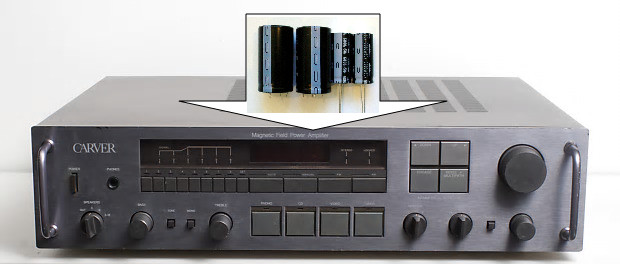
- Capacitor Aging: Like all electronics from the late '90s, electrolytic capacitors may have degraded, leading to power supply issues or channel dropouts. A full recapping by a qualified technician is recommended for long-term reliability.
- Remote Control Compatibility: The original remote (RC-100) is often lost or damaged. Universal remotes with learning functions can be programmed, but original replacements are scarce.
- Firmware Limitations: The unit cannot decode modern formats like Dolby TrueHD or DTS-HD Master Audio, limiting its use with Blu-ray or streaming sources unless used as a legacy processor.
- No HDMI: Video switching is limited to composite and S-Video, making it incompatible with modern 4K sources without external upscaling.
Owners should store the unit in a dry, cool environment and power it on periodically to prevent internal corrosion. Cleaning internal connectors and switches with contact cleaner can restore functionality to sticky controls.
Current Market Value and Collectibility
The Carver AVR-100 is a sleeper collectible. While not as sought-after as Carver’s tube amplifiers or the M-series monoblocks, it appeals to a niche group of vintage AV enthusiasts and Carver completists. Units in working condition typically sell for $250–$400, with pristine, boxed examples occasionally reaching $500.
Its value lies not in raw power or modern connectivity, but in its engineering pedigree and historical significance as one of the few high-end AV processors to emerge from a brand rooted in pure audio. For those building a retro home theater with period-correct components—pairing it with a Pioneer Elite DVD player, Carver amplifiers, and vintage surround speakers—the AVR-100 offers an authentic and sonically rewarding experience.
Conclusion and Legacy
The Carver AVR-100 may not be the most famous product from Bob Carver’s storied career, but it embodies the spirit of innovation and uncompromising quality that defined his work. At a time when most AV receivers were becoming commoditized, the AVR-100 stood apart—a preamp for audiophiles who also loved movies.
Though it never achieved mass-market success, the AVR-100 remains a testament to Carver’s belief that surround sound shouldn’t mean sacrificing musicality. Today, it serves as a fascinating artifact of a transitional era in home audio—one where the future of entertainment was being reimagined, and Carver was there, quietly pushing the envelope.
For the discerning collector or vintage AV enthusiast, the Carver AVR-100 is more than just a relic—it’s a rare fusion of art and engineering, waiting to be rediscovered.
eBay Listings


As an eBay Partner, we earn from qualifying purchases. This helps support our independent vintage technology research.
Related Models
- Pioneer QX-949A (1978)
- Pioneer SX-2000 (1978)
- Pioneer SX-2500 (1978)
- Marantz SR-2000 (1999–2001)
- Onkyo TX-1500MKII (1975)
- Pioneer QX-646 (1978)
- Pioneer SX-1900 (1978)
- Pioneer SX-201 (1978)
- Pioneer SX-251R (1976)
- Realistic STA-2250 (1975)