Bozak B-302A (1957–1971)
Four drivers, a hermetically sealed oak cabinet, and a lot of mass. Bozak's mid-sized heavyweight.
Overview
At roughly 54 kg per cabinet, the Bozak B-302A is not a speaker you move on a whim. It is a three-way, four-driver floor-standing system in a hermetically sealed enclosure. Bozak positioned it as the highest-level medium-sized system in its lineup, a speaker meant to dominate a room both physically and sonically. Production ran from 1957 to 1971, according to available documentation. It shared shelf space with the B-305, B-310A, and B-400.
The driver lineup is all Bozak: a 30 cm B-199A woofer down low, a 16 cm B-209B midrange in the middle, and a pair of 5 cm B-200Y tweeters on top. An N-10102 crossover network ties them together. Rated playback frequency runs 40 Hz to 20 kHz, with crossover points at 800 Hz and 2.5 kHz on 6 dB/octave slopes. That is a gentle, first-order approach, not the steeper slopes many later designs adopted. Nominal impedance is 8 ohms, and Bozak rated allowable input at 50W (music).
Bozak's own advertising billed the system as a "trio matched for music," with the three basic Bozaks speaking with a single voice. You were to assemble them in a sturdy infinite baffle, power them with the finest associated equipment, and add more at any time to extend bass-range, power, and realism. The "add more" pitch was literal. The system was designed to be expanded, and the sealed cabinet was a deliberate choice toward that end, not a cost-saving shortcut. The B-302A was a mid-range addition to the B-300, developed as an evolution of it by adding a dedicated midrange driver to make the three-way configuration.
Key Features
30 cm B-199A Woofer with Variable-Density Cone
The low end comes from a 30 cm cone-type woofer, the B-199A, mounted in the sealed enclosure. The diaphragm is a felted paper cone containing wool, chosen for lightness, rigidity, and high compliance. It uses a variable-density construction: density is highest at the center and decreases toward the periphery. The gradient is there to prevent interference from flapping and reflection of propagating waves, which gives a more constant response across the woofer's range.
16 cm B-209B Midrange with Neoprene-Sandwiched Aluminum Diaphragm
The dedicated midrange driver is the 16 cm B-209B, and it is what separates the B-302A from its two-way B-300 ancestor. Its diaphragm sandwiches light aluminum between two thin neoprene rubber films, with the center and periphery processed into a stepped shape. Bozak described this construction as realizing a clear and natural sound. The neoprene layers damp the aluminum's resonances without deadening it, and the stepped profile helps control breakup. This driver covers the vocal range, where a two-way system of the era would typically be straining its woofer.
Twin 5 cm B-200Y Tweeters with Aluminum Center Domes
High frequencies come from two 5 cm cone tweeters, the B-200Y, each mounted on a foam rubber platform to damp spurious peaks and vibrations. Above 10 kHz, reproduction passes to a 2 cm aluminum center dome. Bozak cited the principle behind this explicitly: the diameter of the cone must not exceed the wavelength of the maximum reproduction frequency. So one tweeter is not asked to cover the entire top octave, and the B-200Y hands off to the smaller dome where the physics favor it.
N-10102 Crossover with Multi-Amplifier Selector
The N-10102 crossover network splits the signal at 800 Hz and 2500 Hz using 6 dB/octave slopes. The terminal section includes a multi-amplifier selector switch and terminals, which reflects the era's interest in bi-amping and multi-amp setups. That was unusual in a consumer speaker of this class. The crossover designation appears in the wild as both N-10102 and N-10102A, and the archive has found no documentation distinguishing the two. Listings for replacement N-10102A units with fresh capacitors are common, which suggests recapping is standard practice on any example that hasn't been serviced. The gentle 6 dB/octave slopes mean the drivers overlap more than they would in a steeper design. That puts a premium on well-behaved drivers and on crossover components being in spec.
Hermetically Sealed Cabinet with Greco-Roman Styling
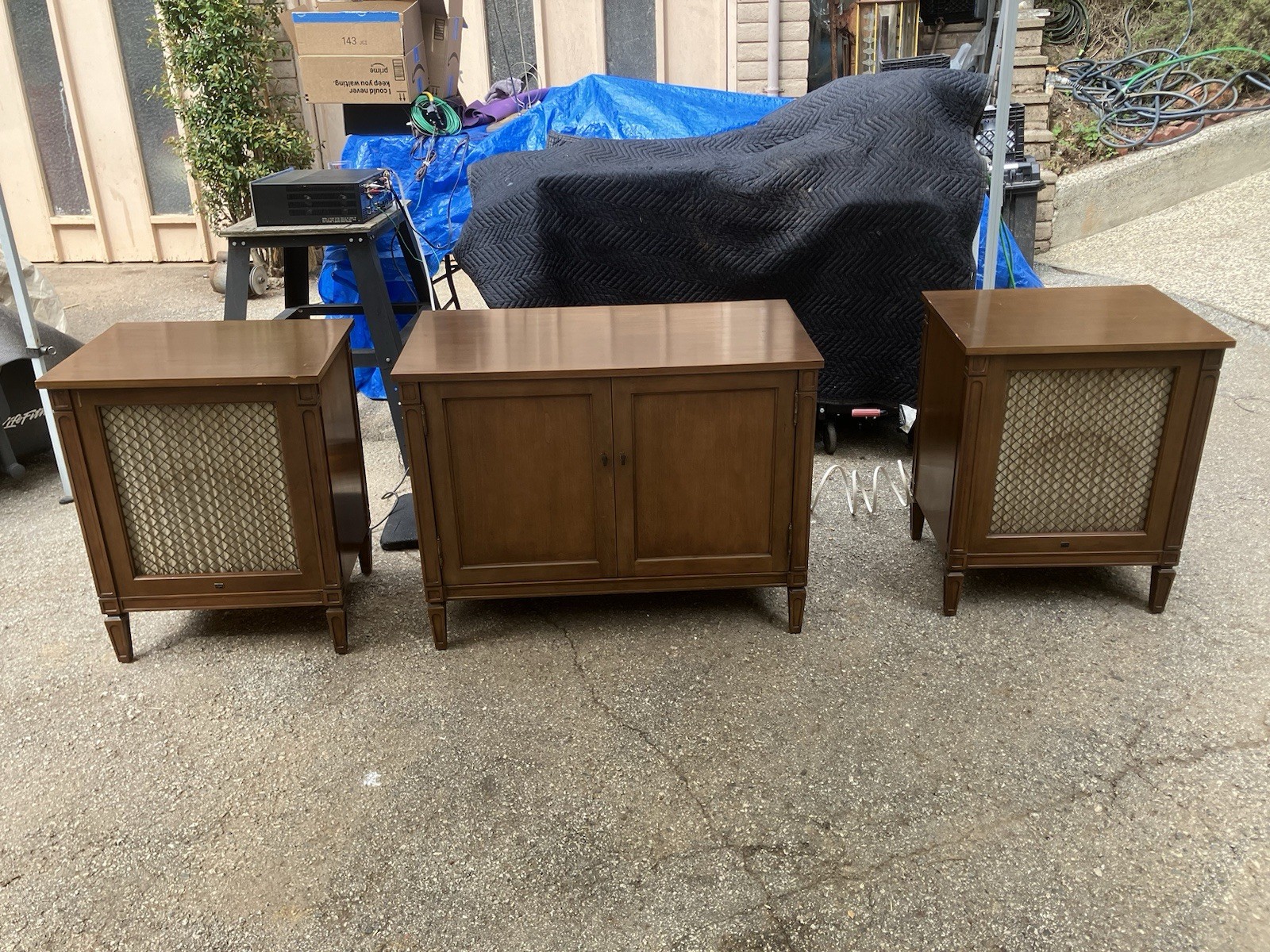
The enclosure is sealed. Bozak's own literature describes it as hermetic. Sources describe the exterior as designed to remind the viewer of Greco-Roman art, with grill cloth and iron decorations across the panel. Finish documentation is inconsistent: some sources cite a walnut oil finish, others an oak finish, and these may reflect different styling variants rather than a contradiction. The size is consistent at 600 mm wide by 765 mm high by 500 mm deep, and so is the weight, 54.4 kg per cabinet.
Historical Context
The B-302A was produced from 1957 to 1971, a fourteen-year run. It was developed from the B-300 by adding a dedicated midrange driver. Bozak positioned it as the highest-level medium-sized system in its range, above the B-300 but below the larger Concert Grand-class systems. It shared its product family with the B-305, B-310A, and B-400.
Period advertising positioned the system as a more affordable entry into Bozak ownership than the company's flagship offerings. Bozak's own advertising leaned on expandability. As the company put it in Audiocraft (July 1958, p.18), the three basic Bozaks speak with a single voice, and buyers were invited to assemble them in a sturdy infinite baffle and add more at any time to extend bass-range, power, and realism. The upgrade path ran deeper into the catalog rather than out of it.
Original pricing is documented for the Japanese market at ¥115,900 per unit around 1966, with a later figure of ¥265,000 per unit around 1974 for the Mediterranean Concerto V variant. No US-market pricing has surfaced in the archive. The two figures likely reflect both inflation and the difference between standard and deluxe styling variants, but the archive treats them as separate data points rather than a single price history.
eBay Listings


As an eBay Partner, we earn from qualifying purchases. This helps support our independent vintage technology research.
Related Models
- Bozak 14
- Bozak 30
- Bozak 31
- Bozak 4000A
- Bozak B-1000
- Braun AUDIO-1 (1965)
- Braun AUDIO-250 (1965)
- Magnavox Component Systems (1972)
- Acoustic Research AR (1967-1976)
- Acoustic Research 11