Bozak B-300 Concerto IV (Late 1960s–Early 1970s)
At 41 kg, it doesn’t just sit in the room—it commands it, with a presence as bold as its 30 cm woofer’s low-end reach.
Overview
The Bozak B-300 Concerto IV isn’t a speaker for the background; it’s a statement. Built during a time when American hi-fi was embracing both technical rigor and theatrical design, this floor-standing system emerged as the flagship standard in the TRIO-BOZAK lineup. At 41 kg and nearly 77 cm tall, it’s a physical presence, but its weight isn’t just mass for show. Every kilogram supports serious driver engineering, a sealed enclosure tuned for accuracy, and a crossover designed to manage a dual-tweeter array with surgical intent. While some contemporaries chased efficiency or compact form, the B-300 leaned into control, aiming for a flat, extended response from 40 Hz to 20 kHz with minimal coloration.
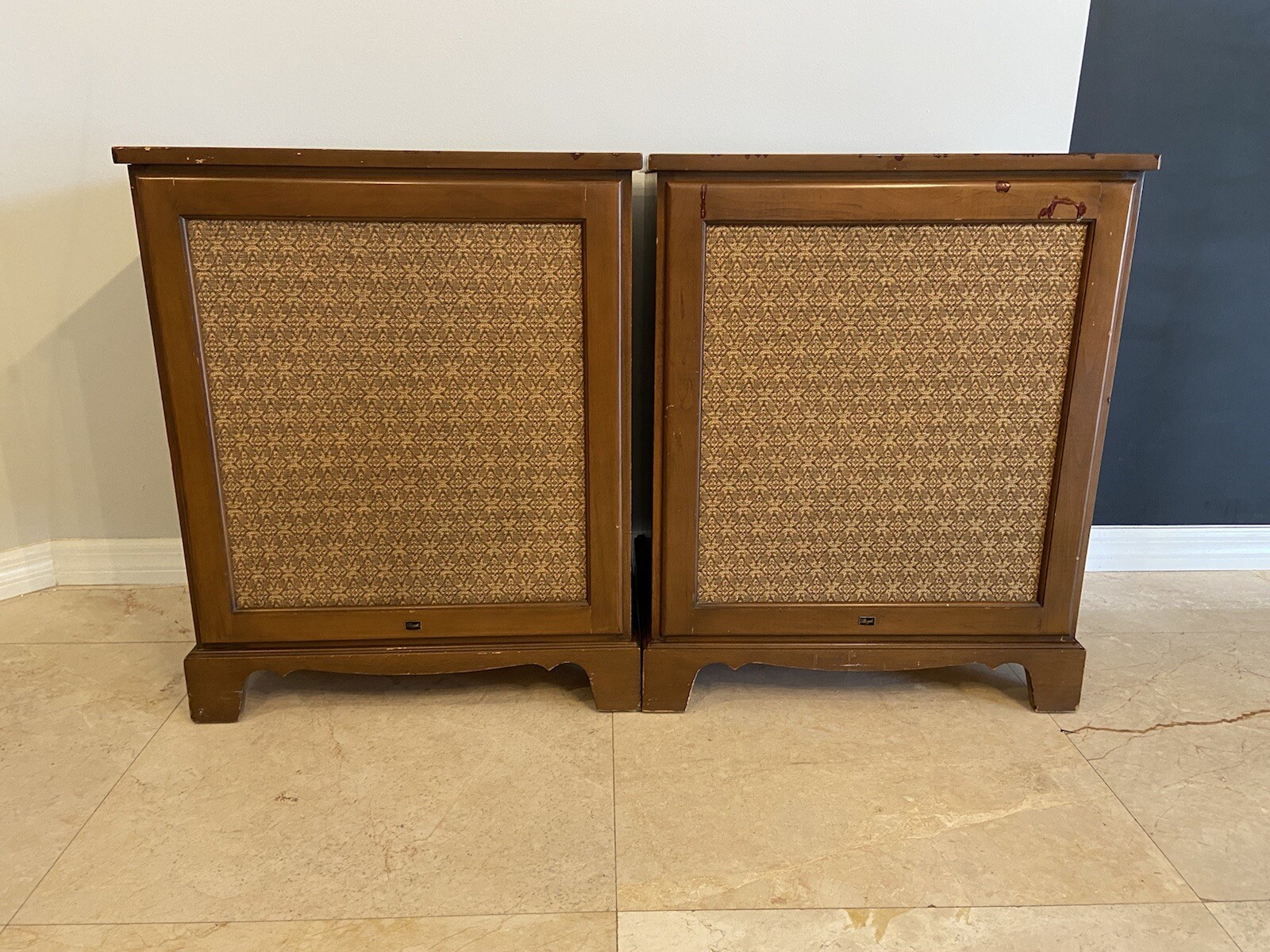
Despite its technical ambitions, the B-300 doesn’t hide behind minimalism. The exterior features an arched frame with a matte walnut oil finish, and the grille and iron decorations follow a Greco-Roman motif—ornate, even baroque, by today’s standards. This is high fidelity as furniture, as art object, as heirloom. Yet beneath the styling lies a no-nonsense acoustic suspension design: the enclosure is hermetically sealed, avoiding the tuning quirks of ported cabinets in favor of tighter, more predictable bass. The system uses three drivers in a two-way configuration: a single 30 cm (12 inch) B-199A cone woofer handling lows and mids, and two 5 cm (2 inch) B-200Y cone tweeters tasked with high-frequency dispersion. The dual tweeters aren’t a gimmick—they’re mounted on a foam rubber platform specifically to dampen spurious vibrations and smooth out response peaks, a detail that reveals Bozak’s attention to resonance control.
The terminal section includes a multi-amplifier selector switch and terminals, suggesting the B-300 was designed with future expansion in mind—possibly bi-amping or integration into more complex systems. Its configuration echoes that of the B-312, but with a larger cabinet volume, allowing for deeper bass extension and improved low-frequency headroom. According to Audio magazine in 1971, the B-300 Concerto IV was “by far the finest in its class,” a bold claim that still carries weight among those who’ve heard well-restored pairs. It wasn’t just another box with drivers; it was a fully resolved system, engineered from cone to crossover to cabinet.
Specifications
| Manufacturer | BOZAK |
| Model | B-300 Concerto IV |
| Product type | Two-way speaker system, floor type |
| Configuration | 2-Way, 3-Speaker, Sealed (Bass Reflex) Type, Floor Type |
| Units Used | Woofer: 30 cm cone type (B-199A); Tweeter: 5 cm cone type x2 (B-200Y) |
| Frequency response | 40 Hz to 20 kHz |
| Impedance | 8 Ω |
| Rated input | 20W |
| Maximum input | 50W (MUSIC) |
| Power Handling Capacity | 20 watts RMS (reportedly) |
| Crossover frequency | 2.5 kHz, 6dB/oct. |
| External dimensions | Width 600 x Height 765 x Depth 500 mm |
| Weight | 41 kg |
| Sensitivity | 91.5 dB (reportedly) |
Key Features
30cm Cone Woofer with Felted Paper and Wool Composite
The B-199A woofer is central to the B-300’s authority. Its cone is made from a felted paper composite with wool mixed into the pulp—a formulation chosen for a rare balance of light weight, structural hardness, and high compliance. This blend reduces breakup modes and lowers distortion, especially in the critical midbass region. The cone also employs a variable density system, denser at the center and gradually decreasing toward the edge, which helps maintain piston-like behavior across its range and prevents internal interference that could muddy the response.
Dual 5cm Cone Tweeters on Vibration-Damping Platform
Instead of a single tweeter, the B-300 uses two B-200Y 5 cm cone units, each with a diaphragm formed using a special metal damping technique to suppress resonant peaks. Mounted together on a foam rubber platform, they’re mechanically isolated from the main cabinet structure. This dual arrangement improves high-frequency dispersion and power handling while the damping platform absorbs cabinet-born vibrations that could otherwise color the treble. It’s a thoughtful solution to a common flaw in large speakers: inconsistent off-axis response and tweeter fatigue under load.
Hermetically Sealed Acoustic Suspension Enclosure
The cabinet is a fully sealed acoustic suspension design, avoiding the tuning complexities and potential port noise of bass reflex systems. This choice prioritizes time-domain accuracy and tighter bass control over raw efficiency. The sealed volume allows the 30 cm woofer to operate with greater linearity at low frequencies, contributing to the system’s 40 Hz lower limit. While less efficient than ported designs, the trade-off is improved transient response and reduced group delay—qualities that matter in critical listening environments.
Multi-Amplifier Selector Switch and Terminal Section
The rear panel includes a multi-amplifier selector switch alongside standard terminals, suggesting the B-300 was engineered for flexibility. This switch may allow users to toggle between single-amp and bi-amp configurations or select between different input sources without external switching. It’s a rare feature for the era, indicating that Bozak anticipated advanced system integration and possibly professional or semi-pro use.
Rebuildable Crossover with Driver Balance Adjustment Potential
While the original crossover operates at 2.5 kHz with a 6 dB/octave slope, owners note it can be “completely rebuilt” and modified—some have added potentiometers to dial in precise driver balance. This adaptability is a boon for restorers, as original capacitors may degrade over time. Film capacitor upgrades are a common refinement, improving clarity and longevity. The ability to fine-tune the crossover response makes the B-300 not just a period piece but a platform for ongoing optimization.
Historical Context
The B-300 Concerto IV was developed as the standard-bearer in the TRIO-BOZAK lineup, representing the company’s vision for a fully realized home audio system. Its design shares DNA with the B-312 but benefits from a larger enclosure, enhancing bass performance. It was part of a broader family that included the B-302A, B-305, B-310A, and B-400, all aimed at different segments of the high-fidelity market. Produced from the late 1960s into the early 1970s, the B-300 arrived during a golden era of American speaker design, when brands like AR, KLH, and Advent were also pushing the boundaries of acoustic suspension and driver innovation.
Collectibility & Value
Current market prices for restored units range from $400 for refoamed pairs to $590 and $685 for those with upgraded components like film capacitors. Refoaming the woofer surrounds is a common maintenance task, with one owner reporting success after refoaming two years prior. Crossover rebuilding is also routine, often accompanied by sensitivity adjustments—though one restorer noted an “expected reduction in sensitivity” post-repair, a trade-off for improved accuracy. While most feedback is positive—“They’re beautiful speakers,” “in perfect shape in every way”—some report issues with newly acquired pairs, underscoring the need for careful inspection. Given its reputation and build quality, the B-300 Concerto IV remains a sought-after system for collectors who value both sonic integrity and vintage craftsmanship.
eBay Listings
As an eBay Partner, we earn from qualifying purchases. This helps support our independent vintage technology research.