Altec 875A Granada
1970 - 1970s
The 875A Granada came out in 1970 as part of Altec's Dynamic Force series, aimed at high-power solid-state amplifiers and changing hi-fi expectations. It shares its design with the flagship Barcelona and delivers nearly the same sound in a slightly more compact sealed cabinet. It pairs pro-grade drivers with a domestic look.
Specifications
| Type | 2-way, sealed enclosure floorstanding loudspeaker |
|---|---|
| Low Frequency Driver | 411-type 15" woofer (newly developed for Dynamic Force series) |
| High Frequency Driver | 807-8A compression driver on 811B horn |
| Crossover | N801-8A network |
| Crossover Frequency | 800 Hz |
| Nominal Impedance | 8 Ω |
| Power Handling | 60W continuous |
| Frequency Response | 20 Hz - 20 kHz |
| Dimensions | 700 mm W × 760 mm H × 610 mm D (27.6" × 29.9" × 24.0") |
| Weight | Approximately 60 kg (132 lbs) per speaker |
Driver Configuration
The Granada is built around purpose-built drivers, each engineered to push what a sealed home speaker could do in the early 1970s.
- Woofer: 411-type 15" driver—fresh from Altec’s labs, featuring a massive 7.8 kg magnet and a 7.5 cm (3") voice coil built for control and endurance
- Compression Driver: 807-8A—high-output 1.75" diaphragm unit, known for clarity and low distortion
- Horn: 811B—90° × 40° exponential sectoral horn, delivering focused dispersion and high efficiency
- Crossover: N801-8A—precision 800 Hz network designed for seamless handoff
Cabinet Design
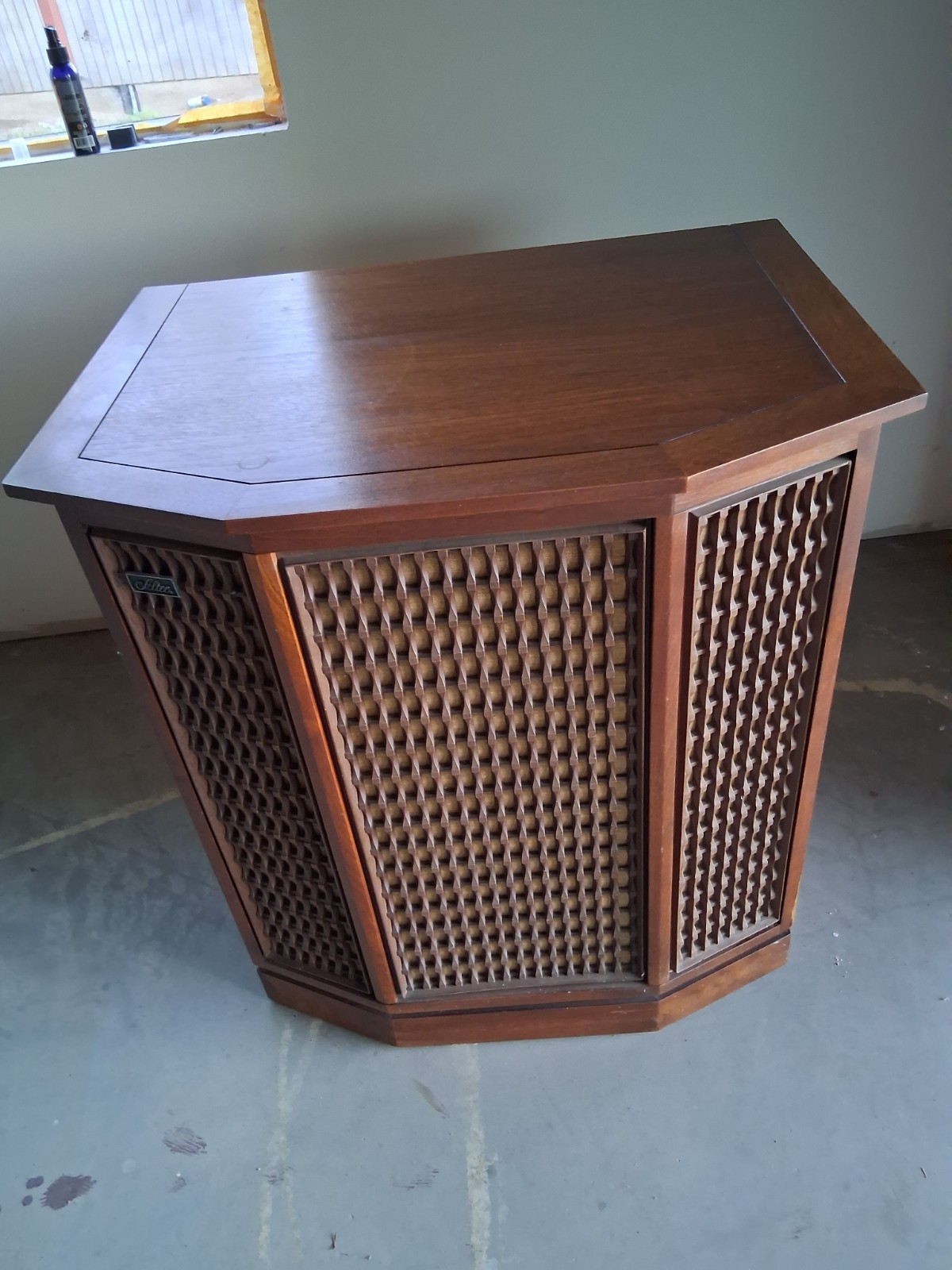
The cabinet is massive, tightly braced and sealed. At 700 mm wide, the Granada is narrower than the Barcelona's 980 mm, but it stands just as tall and deep. That keeps the internal volume needed to reach 20 Hz. Thick plywood walls and extensive internal bracing control resonance, and the walnut veneer finish dresses it for the living room.
The front baffle is clean and uncluttered, with a removable grille covering both drivers. Altec chose acoustic suspension over bass reflex for speed and control: tight transients, deep extension, and bass that stays composed at high output. The trade is efficiency for accuracy, which was the Dynamic Force approach.
Dynamic Force Series Technology
The Granada was a flagship contender built on Altec's most advanced platform. Every element served a purpose:
- Sealed Enclosure Design: Acoustic suspension for deep, clean bass without port noise or time smear
- High-Power Woofer: The 411-type 15" driver, with its oversized magnet and voice coil, was engineered to thrive under pressure
- Optimized Crossover: The N801-8A network ensures a smooth, coherent transition at 800 Hz
- Professional Horn Loading: The 811B horn delivers studio-monitor precision with high sensitivity
2875A Active Version
Altec also offered the 2875A, a self-contained version of the Granada. Built-in electronics removed the external boxes and crossovers and put everything into one system.
- Built-in 770A electronic crossover and bi-amplifier system
- Separate 60W LF and 30W HF amplifiers
- Electronic crossover at 800 Hz (12 dB/octave)
- 0.5V RMS input sensitivity
- 26 dB gain control range
- -80 dB or better hum/noise level
In the early 1970s, this was cutting-edge. The 2875A was bi-amplified and needed no external preamp or power amps.
Performance Characteristics
The 875A got attention for its performance. Its reputation rests on the following:
- Extended Bass Response: True 20 Hz output from a sealed cabinet—rare for its time
- High Power Handling: 60W continuous rating meant it could handle the surge of modern solid-state amps
- Smooth Transition: The 800 Hz crossover created a seamless blend between the horn and woofer
- High Efficiency: Horn loading preserved sensitivity, even in a lossy sealed box
- Low Distortion: Overbuilt components operated well within their limits, even at volume
Historical Context
1970 was a turning point. Solid-state amplifiers were putting out more watts than ever, and records were capturing more detail. The Granada arrived ready for both. It sat just below the Barcelona and brought flagship-grade performance in a slightly more manageable footprint, for serious listeners who wanted pro-level sound without a speaker dominating the living room.
Exact pricing is unknown, but the Granada clearly sat in the upper tier, competing with the best from JBL, Klipsch, and other elite names. It was a bridge between studio monitoring and high-end home audio.
Design Philosophy
The Granada wasn't designed to follow trends. It was built to define them:
- Hybrid Approach: Sealed bass for accuracy, horn-loaded highs for dynamics—best of both worlds
- Domestic Integration: Professional performance scaled to fit real homes
- Technical Excellence: Every driver and crossover was purpose-built, not repurposed
- Future-Proofing: High power tolerance and full-range response ensured it wouldn’t be outpaced by new gear
Amplifier Requirements
Don't underestimate it. With 8Ω impedance and 60W handling, the Granada needs capable electronics.
- Quality amplifiers in the 30–100W range for full dynamics and control
- Amplifiers with strong current delivery to manage the massive 15" woofer
- Low-distortion electronics to match the speaker’s transparency
The horn helps, but the sealed enclosure costs efficiency compared to Altec's bass-reflex designs. These speakers want clean, stable, ample power.
Legacy and Collectibility
Today, the 875A Granada is sought after by vintage Altec collectors. It is rare and technically advanced, and it commands $3,000-$6,000 per pair when original and well-kept.
- Rarity: Limited production run as a premium, high-cost model
- Technical Innovation: A sealed-cabinet Altec with pro-grade drivers—unusual and ambitious
- Performance: 20 Hz bass in 1970? That was serious engineering
- Build Quality: Thick cabinets, premium veneer, industrial-grade components
- Historical Significance: A key player in Altec’s Dynamic Force legacy
Restoration is common—and often necessary:
- Recapping the N801-8A crossover is almost standard
- Refoaming the 411-type woofer restores bass integrity
- Inspecting or replacing 807-8A diaphragms ensures clarity
- Refinishing the walnut veneer brings back its stately presence
- For 2875A owners: servicing the 770A amplifier/crossover is critical for full functionality
eBay Listings
As an eBay Partner, we earn from qualifying purchases. This helps support our independent vintage technology research.
Documentation
- Altec Granada 875A/2875A specification sheets
- Altec Dynamic Force series catalogs (1970s)
- N801-8A crossover network schematics
- 770A amplifier/crossover technical documentation
Related Models
- Altec 1803B
- Altec 23746 (1975)
- Altec 26421 (1975)
- Altec 288-16G
- Altec 288-8H/16H
- Braun AUDIO-1 (1965)
- Braun AUDIO-250 (1965)
- Magnavox Component Systems (1972)
- Acoustic Research AR (1967-1976)
- Acoustic Research 11