Allied 355 Stereo Receiver (1969)
At $349.95 in 1968, it was a premium solid-state receiver with a tuning meter and stereo lamp—praised for its warm sound, yet prone to scratchy controls.
Overview
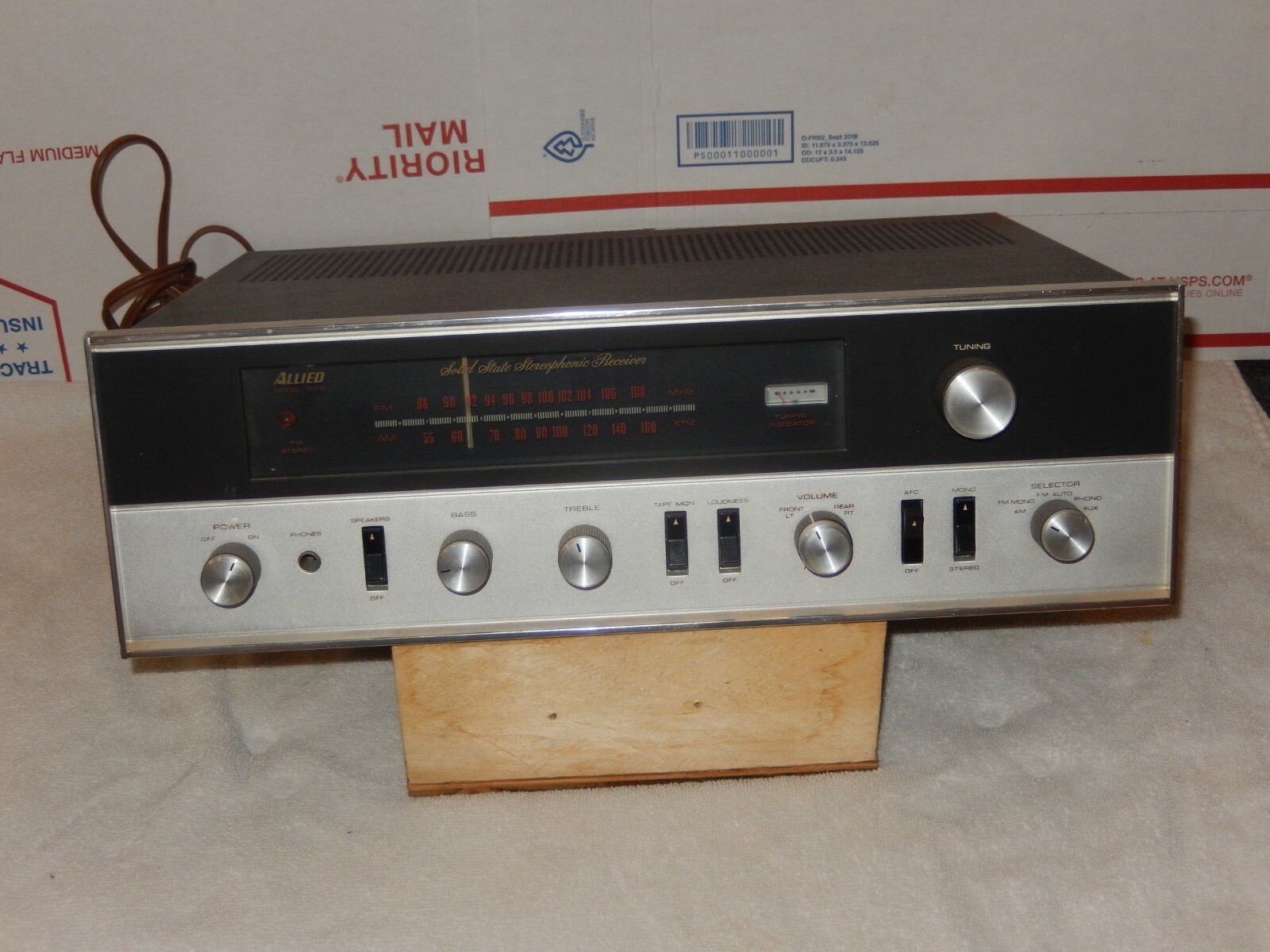
The Allied 355 Stereo Receiver wasn’t just another mid-tier component; it was positioned as a high-end offering in Allied’s 1968 catalog, retailing for $349.95—a serious investment at the time. Marketed as a solid-state FM-AM receiver, it arrived during a transitional moment in audio history, just before Allied’s absorption into Radio Shack’s Realistic brand. Built by Pioneer under private label, the 355 shares rumored DNA with models like the SX-330, SX-440, and SX-300T, though no definitive twin has been confirmed. Owners report a sound signature that defies its transistor design: warm, rich, and often described as “almost tube-like,” a quality that still draws praise from those who’ve kept one running. The front panel features a precise tuning meter and a glowing stereo indicator lamp, both functional and aesthetic touches that anchor it in the late 1960s aesthetic. Housed in a metal cabinet with a face plate, it was designed to slide into an optional wood enclosure—a common upgrade path for period installations, though those cabinets often show more wear than the electronics inside.
Specifications
| Manufacturer | Allied (built by Pioneer) |
| Product type | Solid-State Stereo FM-AM Receiver |
| Power output (RMS, per channel) | around 25 watts per channel into 8 ohms |
| Power output (peak) | 90-Watt Peak Power |
| Speaker terminals | Proprietary flat terminals / old-school Pioneer speaker plugs |
| Original price | $349.95 |
| Optional metal case price | $17.95 |
Key Features
Precise Tuning Meter
The Allied 355 includes a precise tuning meter, a feature that was not universal at its price point in the late 1960s. This analog needle display allows for fine-tuned station selection, especially useful on the FM band where adjacent channels can bleed together. Unlike simpler signal strength lights, the meter provides continuous feedback, helping users avoid drift and interference. It’s a hallmark of higher-end receivers of the era and suggests Allied aimed for a performance-oriented audience.
Stereo Indicator Lamp
A dedicated stereo lamp confirms when a stereo signal is locked in—a small but satisfying visual cue. The lamp is large and twist-locks into its holder, a design choice that simplifies replacement in theory. In practice, owners note these bulbs are uncommon today, and sourcing spares can be a challenge. When lit, the indicator adds to the receiver’s presence on a shelf or in a rack, a subtle nod to the novelty of stereo broadcasting at the time.
Solid-State Design
As a fully solid-state receiver, the 355 represented modern engineering in 1969. Transistor-based audio gear was still earning trust from audiophiles accustomed to tubes, but the 355’s warm sonic character helped bridge that gap. There is no official documentation of its internal circuit topology, but its performance suggests careful design. Unlike many budget receivers of the period that prioritized cost-cutting, the 355’s internal condition is often reported as pristine, even in un-restored units—likely due to conservative thermal design and quality build practices inherited from Pioneer.
Optional Wood Cabinet Compatibility
The metal chassis fits perfectly into an optional wood cabinet, a common aesthetic upgrade for home stereo systems in the late 1960s. While the receiver itself typically survives in good condition, the wood cabinets are frequently described as “scruffy,” with missing feet or mounting hardware. These enclosures were sold separately, and their absence or poor condition is a common caveat in today’s market. Collectors seeking a complete setup may need to hunt for both components independently.
Historical Context
The Allied 355 emerged in 1969, reportedly the final year Allied produced receivers before being acquired by Radio Shack’s parent company in 1970. Sold through Allied Radio Shack (also known as Audiokarma in some references), it occupied a premium tier in the catalog, suggesting it was intended to compete with standalone brands rather than serve as an entry-level Realistic model. Its private-label construction by Pioneer reflects a broader trend of Japanese manufacturers supplying American retailers with high-quality electronics under local branding. While Allied had a reputation for value, the 355’s price and performance indicate a push into the higher fidelity market just before the brand’s transformation.
Collectibility & Value
The Allied 355 has modest but steady collectibility, primarily among enthusiasts of vintage Japanese receivers and Radio Shack-era gear. A listing from approximately three years ago asked $124 plus $60 shipping, while another unit in tested working condition with the optional wood cabinet appeared on the market in 2022. Original condition varies: face plates and metal cabinets often show only slight imperfections, and internal components are typically clean, but the wood cabinets are frequently worn. Common issues include scratchy volume controls and noisy operation—both usually resolved with Deoxit treatment on the potentiometers. Speaker terminal plugs are often missing, a frustrating omission given their proprietary design. Replacement indicator bulbs are also difficult to source, adding to maintenance challenges. Despite these quirks, owners consistently describe it as a “terrific receiver” with standout sound quality for its era.
eBay Listings

As an eBay Partner, we earn from qualifying purchases. This helps support our independent vintage technology research.
Related Models
- Allied 333 (1960s)
- Allied 495
- Allied 435
- Allied 490
- Pioneer QX-949A (1978)
- Pioneer SX-2000 (1978)
- Pioneer SX-2500 (1978)
- Marantz 2215B (1977-1980)
- Marantz SR-2000 (1999–2001)
- Onkyo TX-1500MKII (1975)