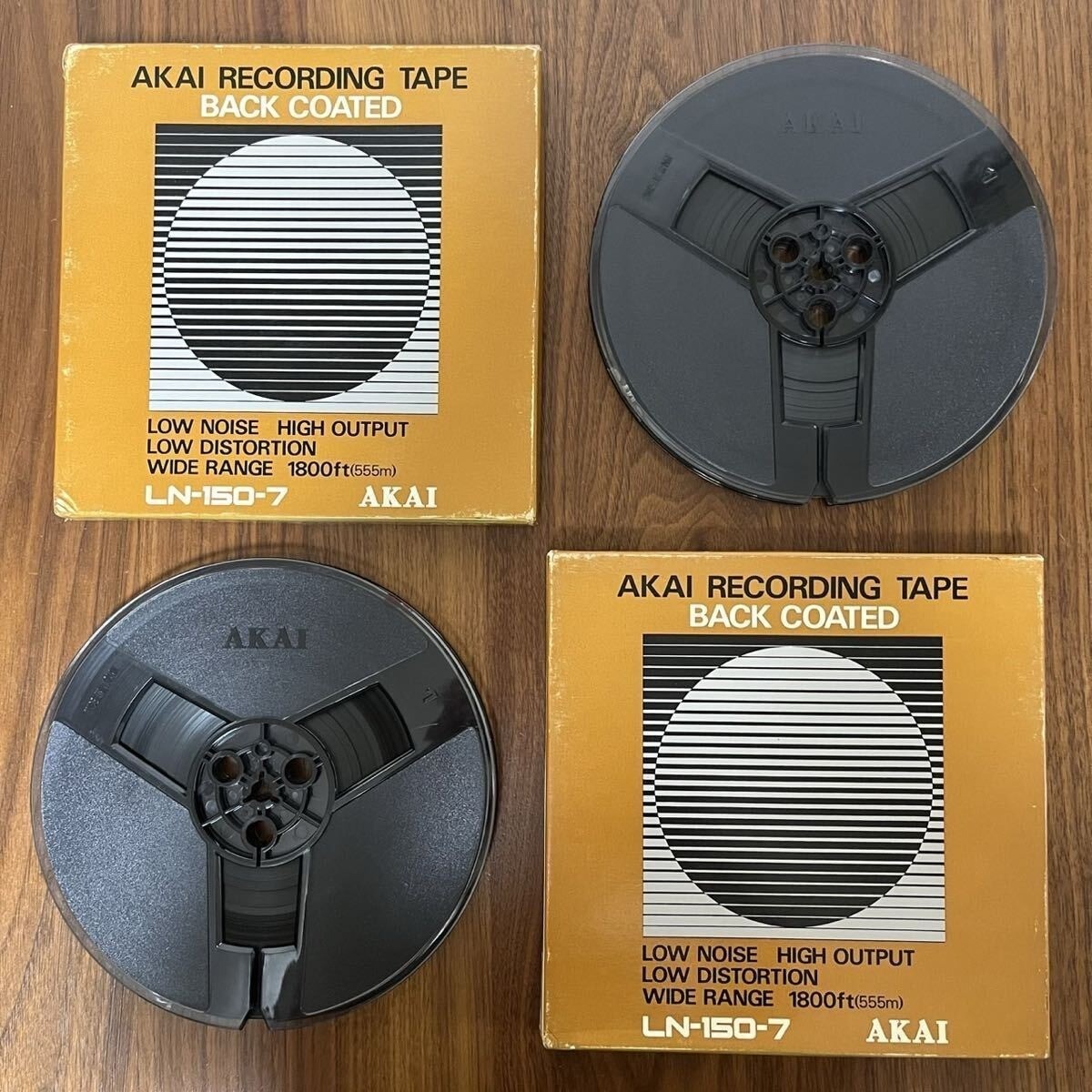
Akai LN-150-7
The reference tape Akai used to grade its own machines - the blank that every GX deck's spec sheet was measured against.
Overview
The Akai LN-150-7 is not a machine. It is the tape Akai's own manuals name as the reference medium for their open-reel decks. It is the low-noise formulation the company used for its published frequency response, wow-and-flutter, and signal-to-noise figures. When an Akai service document says "specifications determined with Akai LN-150-7 tape," the numbers on the page came from this specific product threaded through the transport.
A tape deck's published performance only means something relative to the tape it was measured with, and manufacturers routinely picked their own stock as the benchmark. Akai chose a low-noise ferric formulation, not a chrome or ferric-chrome cassette-era tape. That fits open-reel practice of the period, where the reference blank was a known quantity the factory could supply alongside the machine.
The LN-150-7 shows up in the specification footnotes in owner's manuals for Akai's GX-series decks, including the GX-270D, GX-630D, and GX-635D. It appears there as a measurement condition, not an accessory. It is the tape behind the published 30 Hz to 25,000 Hz response figures at 7-1/2 ips. In Akai's own documentation, a deck's advertised performance and this tape go together.
Key Features
The Reference Blank in Akai's Own Spec Sheets
No physical characteristic defines the LN-150-7 as much as its documented role as Akai's measurement standard. Manuals for the GX-270D, GX-630D, and GX-635D all carry the same footnote: specifications determined with Akai LN-150-7 or Scotch #211 tape unless otherwise noted. Akai treated its own tape and Scotch #211 as interchangeable references, which suggests the LN-150-7 sat in the same low-noise performance class as 3M's well-established formulation.
Low-Noise Formulation with a Dedicated Bias Setting
The tape selector switches on the decks that reference the LN-150-7 offer positions for low-noise tape and for "wide range" tape of a grade higher than low noise. The LN-150-7 is the low-noise reference. Setting the selector to that position applies the bias and equalization the factory intended for this tape, which is what lets the published frequency response and signal-to-noise figures be reproduced.
Historical Context
The LN-150-7 belongs to the era when open-reel decks were still a serious home format and manufacturers published detailed specifications measured against named reference tapes. Akai's GX-series decks - the GX-270D, GX-630D, and GX-635D among them - all cite the LN-150-7 in their technical data. That places the tape in the late 1970s and early 1980s Akai product line.
Modern Recording (August 1976, p.63) reviewed an Akai recorder and noted the tape-selector switch's low-noise and "wide range" positions, along with the recommended standard tape — a description that matches the LN-150-7's role in the Akai lineup.
The tape's significance is partly documentary. It is the medium Akai used when the company wrote down what its machines could do. A GX-630D's manual claims 30 Hz to 25,000 Hz at 7-1/2 ips, and the LN-150-7 answers the unstated question of what it was measured with.
Collectibility & Value
The LN-150-7 is a consumable, not a piece of equipment, and that shapes its collectibility. Sealed examples surface occasionally, but magnetic tape degrades. Binder breakdown, print-through, and loss of signal are all concerns with tape of this age. A sealed reel is a curiosity and a piece of Akai documentation history. A used reel is unlikely to perform to its original specification.
Owners of Akai GX-series decks who want to run the tape their machine was calibrated for may find the LN-150-7 appealing, but the more common approach is to use a modern equivalent low-noise tape and adjust the deck's bias and equalization accordingly. The LN-150-7's value is largely historical. It is the tape named in the manuals, which makes it an artifact for anyone collecting Akai open-reel gear as a system.
There is no established market price for the LN-150-7 that this archive can cite from available documentation, and collectors should treat any listing as speculative. The tape is best understood as a companion piece to the decks that reference it, not a standalone collectible.
eBay Listings



As an eBay Partner, we earn from qualifying purchases. This helps support our independent vintage technology research.