Akai GXC
A cassette deck line whose glass-and-crystal ferrite heads were guaranteed for 150,000 hours, and whose ADR circuit went after high-frequency distortion.
Overview
Akai built the GXC family of stereo cassette decks around a head that was not supposed to wear out. The company's own GX (glass and crystal ferrite) record/playback head carried a lifetime guarantee backed by a claimed 150,000 operating hours, and Akai leaned on that figure hard in its period advertising. The argument was simple. Chrome-dioxide tape is rougher on a head than normal stock, and a head that resists wear also resists the slow treble loss that plagues conventional permalloy designs. The GX head's surface was also formulated to shrug off contamination, so head cleaning became optional rather than routine.
The frequency response figures show what that head could do. With chrome-dioxide tape, Akai rated the GXC decks at 30 Hz to 18,000 Hz. Drop in a low-noise normal-bias cassette and the top end falls to 16,000 Hz. That 2 kHz spread is the cost of the cassette format's bias compromise, and Akai documented it plainly rather than quoting a single flattering number.
What set the GXC line apart was the ADR circuit, Automatic Distortion Reduction. The problem was real and widely understood. Magnetic tape saturates above roughly 8,000 Hz, and as saturation sets in, distortion rises in step with frequency. Engineers could not cut loud high frequencies to cassette without audible breakup. Akai's ADR automatically adjusted the record equalization to match the tape's actual saturation behavior, trimming the record level so that distortion stayed at a minimum. The payoff was that musical peaks and high-frequency content above 8 kHz could be captured without the gritty edge that cassette decks of the period typically put on cymbals, strings, and sibilants.
The deck's O.L.S. switch attacked the same problem from the other direction. Akai's engineers were candid about the cassette format's handicaps - a 3.81 mm track width against open-reel's 6.25 mm, and a tape speed of just 4.75 cm/sec - and the increased tape hiss that followed. Pushing record levels to overcome hiss had always meant hitting tape saturation and elevated distortion. The O.L.S. circuit let the deck run at higher record levels while holding total harmonic distortion to 1.5 percent, which is a respectable figure for a cassette machine running at 4.75 cm/sec.
Dolby noise reduction was on board, and it was not decoration. Without Dolby, Akai rated signal-to-noise at better than 50 dB. With the Dolby circuit engaged, that climbed to better than 58 dB. Akai's own manual pointed out that 58 dB was a number normally associated with open-reel machines in the normal-bias class, and Akai also built the reel-to-reel decks that comparison implies. Erase separation was rated at better than 70 dB, and the erase head ran at 60 kHz.
Wow and flutter came in at less than 0.12 percent RMS, which Akai attributed directly to a newly developed hysteresis synchronous motor. The manual describes it as an outer-rotor hysteresis synchronous design, and the company framed it as the result of years of tape-transport engineering. A C-60 cassette fast-wound in 55 seconds, and the deck could hold two full hours on a C-120. The transport stopped automatically at end-of-tape with an indicator lamp to show it.
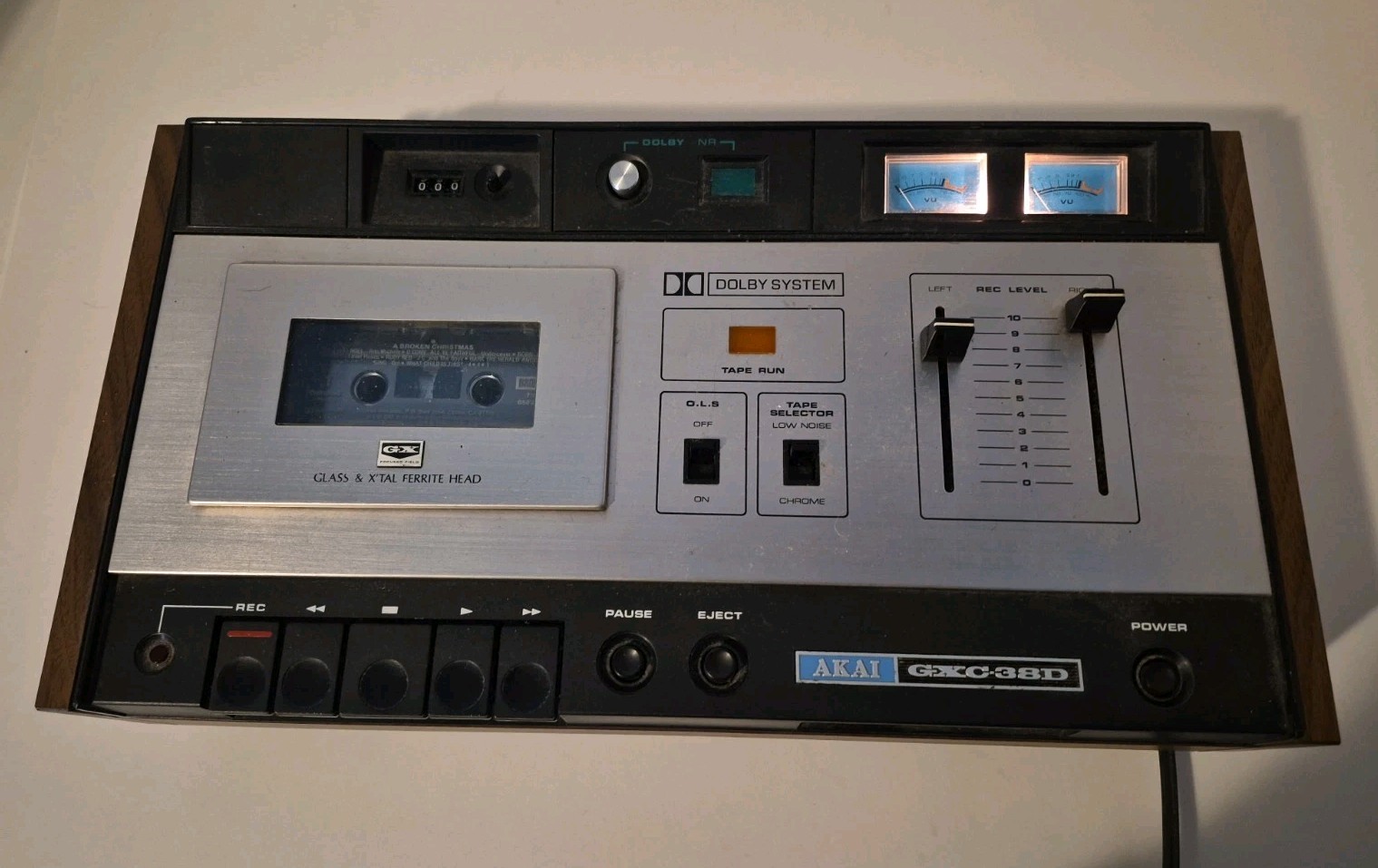
Around the mechanism, Akai put a control set for people who actually used the things. Solid slider controls handled level setting, a three-digit digital counter made locating a track easier, and a latching pause button let the user interrupt a recording without disturbing the settings. There was a headphone jack for stereo cans, and a single eject button that either opened the cassette holder or threw the cassette out, depending on how far it was pressed. The deck ran on 100 to 240 volts AC at 50/60 Hz and drew 20 VA, which was an international power supply for the period. It measured 410 mm wide, 132 mm tall, and 294 mm deep, and weighed 7.2 kg.
The circuit complement was substantial for a cassette deck: 39 transistors, 2 field-effect transistors, 34 diodes, and 2 integrated circuits. Line output was 0.775 volts at 0 dB VU into a minimum 20 kOhm load. Microphone inputs took 0.2 mV into 4.7 kOhm, line inputs 50 mV into 200 kOhm, and a DIN socket was provided alongside the standard line and headphone connections. A band selector switch moved between normal and chrome-dioxide tape. That same switch could also be used during playback of normal tape in its "special" position, where it rolled off the high frequencies by about 3 dB to suppress tape hiss. It was a blunt tool, but a free one.
Akai's advertising through the early 1970s pushed the GX head as the line's defining feature. High Fidelity (February 1972, p.109) ran a GXC-40D advertisement that opened by conceding you could find thirty cassette recorders that looked as good for less money, then argued that the GX glass-and-crystal ferrite head, described as dust-free and wear-free with a lifetime guarantee, was what separated the Akai from the cheaper competition. The same publication's August 1973 issue (p.109) carried a follow-up pitching the GXC-38D, again built around the "exciting extras" of the GX head system. These were advertisements, not independent lab tests, and should be read as marketing claims rather than measured verdicts. They do show what Akai considered the line's selling point, and they confirm the GX head across multiple GXC models.
"GXC" is a family prefix, not a single deck, and Akai spread it across a range of cassette models through the 1970s. The GXC-40D and GXC-38D appear in period advertising. The GXC-46-D is documented in Akai's own German-language manual, which is the source for the technical figures above: the 30 Hz to 18,000 Hz chrome response, the 1.5 percent O.L.S. distortion figure, the 58 dB Dolby signal-to-noise rating, the 150,000-hour head claim, the 55-second C-60 wind time, and the 7.2 kg weight. Anyone chasing a specific GXC should confirm the exact model number before assuming any given spec applies, because the family spans enough variants that the numbers do not transfer cleanly between them.
The GXC line was Akai's answer to head wear and high-frequency saturation, the two specific failure modes of the cassette format. The GX head guarantee was the headline, but the ADR and O.L.S. circuits addressed distortion rather than just promising durability. Whether that made a GXC the best-sounding cassette deck of its era is a question the period advertisements cannot answer.
eBay Listings


As an eBay Partner, we earn from qualifying purchases. This helps support our independent vintage technology research.