Akai GXC-36D: The Overlooked Gem of 1980s Cassette Engineering
In the golden era of cassette audio—roughly the late 1970s through the early 1990s—Japanese manufacturers like Sony, Technics, and TEAC dominated the high-end tape deck market. Yet nestled among these giants was Akai, a company with a long-standing reputation for professional reel-to-reel recorders and broadcast equipment. The Akai GXC-36D, released in 1983, stands as one of Akai’s most refined consumer cassette decks, blending broadcast-grade engineering with thoughtful design. Though less celebrated than its contemporaries, the GXC-36D is a hidden treasure for analog enthusiasts and cassette collectors today.
Introduction and Historical Context
By the early 1980s, cassette technology had matured significantly. The introduction of Dolby B and C noise reduction, three-head designs, and auto-reverse mechanisms had elevated the cassette from a portable medium to a serious contender in high-fidelity audio reproduction. Akai, already respected for its professional audio gear, entered the consumer cassette market with a series of well-engineered models under the GXC (Grand X-Centric) line.
The GXC-36D was positioned as a premium auto-reverse cassette deck, offering full logic control, dual-capstan transport, and high-quality tape head assemblies. It was designed for audiophiles who wanted convenience without sacrificing sound quality—particularly those building tape libraries, duplicating recordings, or seeking a reliable playback machine for pre-recorded music cassettes.
While Akai never achieved the same brand recognition as Nakamichi or Denon in the high-end cassette space, the GXC-36D reflects the company’s engineering rigor and commitment to durability. It was built during a transitional period when cassettes were at their peak fidelity, just before the CD began its ascent.
Technical Specifications
| Specification | Detail |
| Model | Akai GXC-36D |
| Year of Release | 1983 |
| Type | 3-head, auto-reverse cassette deck |
| Heads | Separate record/play, erase, and replay heads |
| Motor System | Dual direct-drive capstan motors |
| Tape Speed | 4.76 cm/s (1⅞ ips) |
| Wow and Flutter | < 0.07% (weighted) |
| Frequency Response | 20Hz – 18kHz (CrO₂/Fe), 20Hz – 16kHz (Normal) |
| Signal-to-Noise Ratio | 66dB (Dolby B), 72dB (Dolby C) |
| Total Harmonic Distortion | < 1.5% |
| Noise Reduction | Dolby B and Dolby C |
| Recording Equalization | 120μs (Normal), 70μs (CrO₂/Metal) |
| Inputs | Line In (RCA) |
| Outputs | Line Out (RCA) |
| Monitoring | Real-time analog monitoring via headphone jack |
| Display | Fluorescent VU meters, tape type indicators |
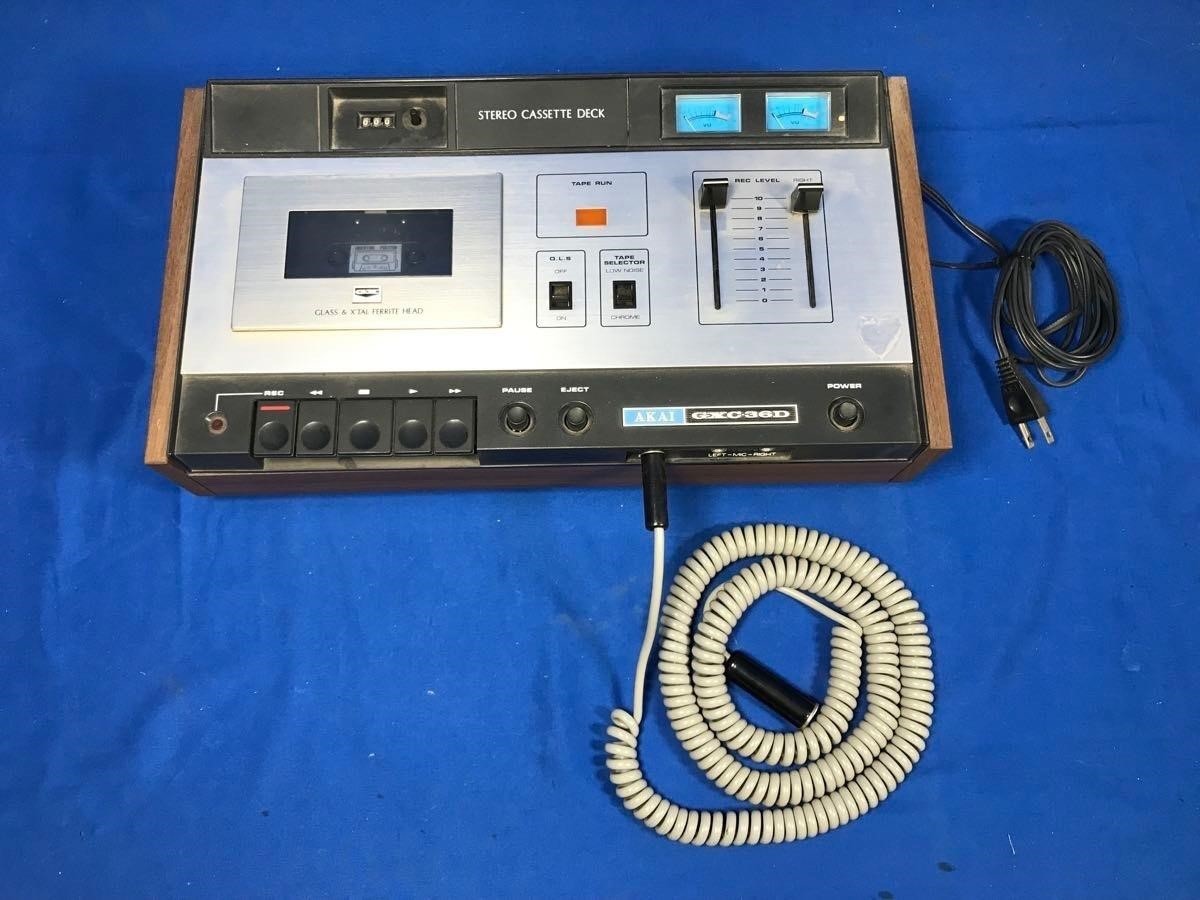
| Build Quality | Metal chassis, rubberized faceplate, mechanical logic controls |
| Dimensions | 430 × 135 × 310 mm |
| Weight | 9.5 kg (approx.) |
Sound Characteristics and Performance
The Akai GXC-36D delivers a balanced, detailed, and dynamic sound that holds up remarkably well against other high-end decks of its era. Its three-head configuration allows for independent optimization of record, playback, and erase functions, resulting in excellent tracking accuracy and minimal crosstalk.
With dual capstan drive systems, the GXC-36D ensures stable tape tension and consistent speed on both sides of the cassette, a critical factor in maintaining low wow and flutter. The result is a smooth, natural presentation—especially noticeable in vocal and acoustic recordings.
The deck supports all major tape types: Type I (Normal), Type II (CrO₂), and Type IV (Metal), with manual tape bias and equalization selection. This flexibility allows users to fine-tune recording performance based on tape stock, a feature appreciated by serious tapers and home recordists.
Dolby B and C noise reduction are implemented cleanly, with minimal artifacts. When paired with high-quality CrO₂ or metal tapes, the GXC-36D achieves a signal-to-noise ratio and frequency response that rivals early CD players in perceived warmth and musicality.
Notable Features and Innovations
The GXC-36D is packed with features that were cutting-edge in the early 1980s:
- Auto-reverse with full logic control: The deck automatically detects the end of the tape and reverses direction without manual intervention. The logic system prevents misoperation and ensures smooth transitions.
- Real-time VU meters: The large fluorescent display provides accurate visual feedback of recording levels, essential for avoiding distortion and under-modulation.
- Dual capstan transport: Enhances tape stability and reduces wow and flutter, contributing to superior sound quality.
- Manual tape bias adjustment: Allows users to optimize recording performance for different tape brands and types—a rare feature in consumer decks.
- Direct-drive motors: Provide precise speed control and long-term reliability.
- Head cleaning cycle: Some units include an automatic head cleaning function when the cassette is removed, prolonging head life and performance.
The build quality is exceptional: a heavy-gauge steel chassis, rubberized front panel, and precision mechanical controls give the GXC-36D a professional feel uncommon in consumer gear.
Common Issues and Maintenance
Like all vintage cassette decks, the Akai GXC-36D requires periodic maintenance to perform at its best. Common issues include:
- Worn pinch rollers: These degrade over time, becoming sticky or hardened. Replacement with new rubber rollers is essential for proper tape speed and tension.
- Dried-up lubrication: The auto-reverse mechanism and capstan gears rely on lubricants that dry out after decades. A full mechanical service with synthetic grease is recommended.
- Dirty or misaligned heads: Tape heads should be cleaned regularly with isopropyl alcohol. Over time, head alignment can drift, affecting stereo imaging and high-frequency response.
- Capacitor aging: Electrolytic capacitors in the power supply and audio circuits may leak or fail. A recapping service can prevent future damage.
- Worn belts (if applicable): While the GXC-36D uses direct-drive motors, some internal mechanisms may still rely on small belts that can degrade.
Servicing the GXC-36D is feasible thanks to its modular design and availability of service manuals online. Many parts are interchangeable with other Akai models, making repairs more accessible than with some proprietary designs.
Current Market Value and Collectibility
The Akai GXC-36D remains undervalued in the vintage audio market, typically selling for $150–$300 in working condition. This is a bargain compared to similarly equipped decks from Nakamichi or Revox, which often command $500–$1,000+.
Its collectibility is growing among cassette revivalists, DIY audio tapers, and lo-fi musicians. With the resurgence of analog formats and interest in tape saturation, the GXC-36D offers a cost-effective entry into high-quality cassette recording.
Units in excellent cosmetic and mechanical condition—especially those with clean heads, responsive meters, and smooth auto-reverse—are becoming harder to find. As awareness increases, prices may rise, making now a smart time to acquire one.
Conclusion and Legacy
The Akai GXC-36D is a testament to Akai’s engineering philosophy: precision, durability, and sonic integrity. While it may not have the cult status of a Nakamichi Dragon, it delivers 90% of the performance at a fraction of the price. For audiophiles, archivists, and analog lovers, it represents one of the best-kept secrets of 1980s cassette technology.
Its combination of three-head design, dual capstan transport, Dolby C support, and robust build makes it a serious tool for both playback and recording. With proper maintenance, the GXC-36D can continue delivering warm, engaging sound for decades to come.
If you're exploring vintage cassette decks and want performance without the premium price tag, the Akai GXC-36D deserves a spot on your shortlist. It’s not just a relic of the past—it’s a fully capable analog machine that still has something meaningful to say.
eBay Listings


As an eBay Partner, we earn from qualifying purchases. This helps support our independent vintage technology research.
Related Models
- Akai CS-F33R (1985)
- Akai DX-59 (1983)
- Akai GX-280D-SS (1979)
- Akai DX-57 (1978)
- Akai AA-5200 (1978)
- Sony TC-2050SD (1978)
- Aiwa AD-F990 (1993)
- Kenwood KX-3060 (1982)
- Sony TC-2130A (1974)
- Sony TC-2220 (1972)