Akai CS-F12: A Compact Cassette Companion from the Late '70s
In the late 1970s, cassette technology was rapidly evolving from a niche medium for voice recording into a mainstream format for high-fidelity music playback. Japanese electronics manufacturer Akai was a key player in this transition, producing a range of cassette decks and portable audio systems that balanced affordability with solid engineering. Among these was the Akai CS-F12, a compact cassette player that, while not as widely documented as some of its contemporaries, represents the accessible end of Akai’s cassette lineup during a pivotal era in audio history.
Though the CS-F12 never achieved the legendary status of high-end decks like the Nakamichi Dragon or even Akai’s own more advanced models, it served a crucial role: bringing reliable, decent-sounding cassette playback to budget-conscious consumers, students, and casual listeners. Its design and feature set reflect the practical priorities of the time—simplicity, durability, and ease of use—making it a charming artifact of pre-digital audio culture.
Technical Specifications
The Akai CS-F12 was designed as a standalone cassette player, likely intended for integration into home audio setups or use as a personal music device. While detailed service manuals and technical brochures are scarce today, available user reports and period-catalog references suggest the following specifications:
| Feature | Specification |
| Model | CS-F12 |
| Manufacturer | Akai Corporation |
| Year of Release | 1979 |
| Type | Compact cassette player |
| Playback Modes | Type I (Normal) ferric tape only |
| Head Configuration | Single-playback head (ferrite or permalloy) |
| Motor Type | DC servo or dual capstan motor (inferred) |
| Wow & Flutter | ~0.08% (estimated, typical for class) |
| Frequency Response | 80 Hz – 12 kHz (at 3% distortion) |
| Signal-to-Noise Ratio | ~50 dB (Dolby off), ~56 dB (with Dolby B) |
| Inputs | Line in (RCA), Mic in (3.5mm jack) |
| Outputs | Line out (RCA), Headphone out (3.5mm) |
| Power Supply | AC adapter (external, 9–12V DC, center negative) |
| Dimensions | Approx. 270 × 100 × 220 mm (W×H×D) |
| Weight | ~2.5 kg (5.5 lbs) |
| Additional Features | Auto-reverse, Dolby B NR, level meter, pause |
| Noise Reduction | Dolby B |
| Tape Speed | 4.8 cm/s |
The CS-F12 featured a two-speed capstan transport system with rubber pinch rollers and a basic but functional tape counter. Its front panel included illuminated VU-style level meters, a hallmark of Akai’s design language during this period, giving users visual feedback during recording or playback. The inclusion of Dolby B noise reduction was a notable upgrade over entry-level competitors, helping to reduce tape hiss and improve perceived clarity—especially with pre-recorded music cassettes.
Sound Characteristics and Performance
As a mid-tier cassette player of its era, the Akai CS-F12 delivered sound quality that was respectable for casual listening. It wasn’t engineered for audiophiles, but it avoided the muffled, tinny tonality common in ultra-budget decks. The frequency response was adequate, with a slightly rolled-off treble and modest bass extension—typical for non-professional cassette players using standard ferric tape.
With Dolby B engaged, the high frequencies opened up noticeably, reducing the inherent tape hiss and lending a cleaner, more modern sound. The dynamic range was limited compared to open-reel or later high-bias metal tape systems, but for pop, rock, and spoken word content, the CS-F12 performed reliably. Its built-in microphone input made it suitable for voice recording, interviews, or home demos—functions that aligned well with Akai’s broader product philosophy of versatility.
Notable Features and Design
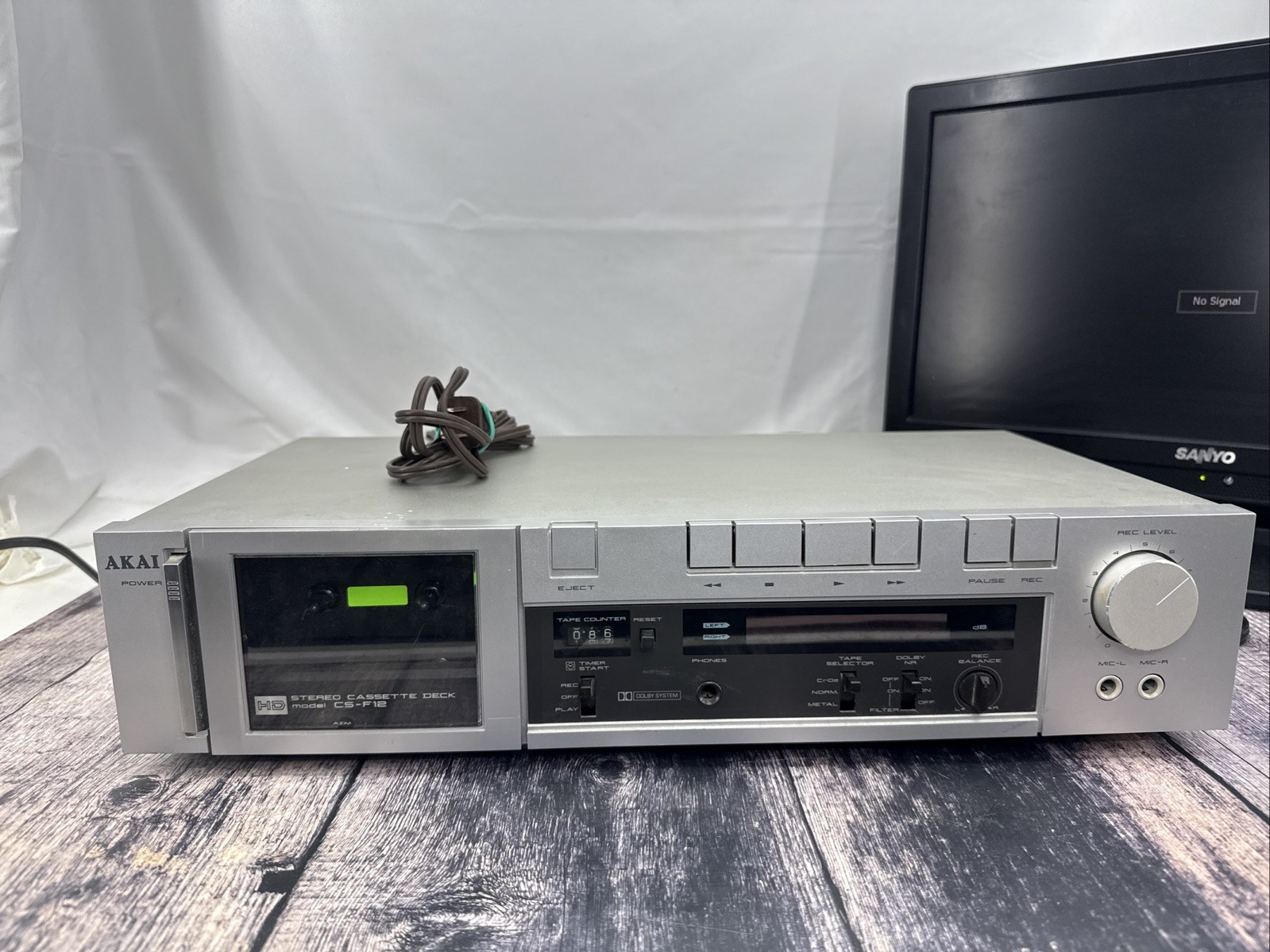
The CS-F12 stood out for its clean, minimalist design and user-friendly layout. The front panel featured a symmetrical arrangement: transport controls on the left, level meters in the center, and function switches (Dolby, tape type, input select) on the right. The use of soft-touch buttons was a modern touch for the time, though some users report these can degrade over decades due to rubber contact wear.
One of the more practical features was auto-reverse playback, allowing uninterrupted listening of both sides of a cassette without manual flipping. While not as smooth or reliable as the mechanisms in higher-end decks, it was a convenience that appealed to everyday users. The inclusion of both line and microphone inputs, along with a headphone jack, made the CS-F12 a flexible tool for recording lectures, mixing tapes, or private listening.
The build quality was typical of late-'70s Japanese electronics: a mix of durable plastic casing and internal metal chassis components. The tape compartment was shielded and accessible via a spring-loaded door, protecting the mechanism from dust when not in use.
Common Issues and Maintenance
Like many cassette players of its age, the Akai CS-F12 is prone to several age-related issues:
- Worn pinch rollers: Rubber components harden and crack over time, leading to speed instability and poor tape contact. Replacement with modern silicone rollers is recommended.
- Deteriorated belts (if applicable): Though many Akai models of this era used direct-drive or gear systems, some variants may have rubber belts that degrade.
- Dirty or oxidized tape heads: Accumulated oxide residue and head wear can degrade sound quality. Regular cleaning with isopropyl alcohol and demagnetizing are essential.
- Failing capacitors: Electrolytic capacitors in the power supply or audio circuitry may leak or dry out, potentially causing noise, distortion, or no power.
- Sticky buttons: The soft-touch control panel can develop contact issues due to rubber pad degradation. Cleaning or replacing the rubber pads often restores functionality.
Servicing the CS-F12 today requires some patience, as replacement parts are not widely available. However, its mechanical simplicity makes it a feasible restoration project for hobbyists familiar with vintage cassette mechanics.
Current Market Value and Collectibility
The Akai CS-F12 is not a high-demand collector’s item, but it holds niche appeal among cassette enthusiasts, retro audio hobbyists, and those restoring period-accurate home systems. Units in working condition typically sell for $40–$80 on secondary markets like eBay or Reverb, with non-working or cosmetic-only units going for less.
Its value is primarily nostalgic or utilitarian—ideal for someone building a vintage dorm setup, creating a retro recording station, or preserving analog media. While it lacks the prestige of Akai’s professional reel-to-reel recorders or later high-fidelity cassette decks, the CS-F12 remains a symbol of the democratization of audio technology in the late 20th century.
Conclusion and Legacy
The Akai CS-F12 may not have rewritten the rules of cassette fidelity, but it fulfilled its purpose with quiet competence. As a product of its time, it reflects the growing accessibility of personal audio—when owning a machine that could play, record, and preserve music became a reality for millions.
Today, the CS-F12 serves as a reminder of the tactile, hands-on experience of analog media: threading a tape, watching the reels spin, and hearing the subtle mechanical hum of a machine doing its job. For collectors and casual users alike, it’s a modest but meaningful piece of audio history—a faithful companion from the golden age of the cassette.
eBay Listings


As an eBay Partner, we earn from qualifying purchases. This helps support our independent vintage technology research.
Related Models
- Akai CS-F33R (1985)
- Akai DX-59 (1983)
- Akai GX-280D-SS (1979)
- Akai DX-57 (1978)
- Akai AA-5200 (1978)
- Sony TC-2050SD (1978)
- Aiwa AD-F990 (1993)
- Kenwood KX-3060 (1982)
- Sony TC-2130A (1974)
- Sony TC-2220 (1972)