Akai CS-707D: The Precision Cassette Deck from Akai’s Golden Era
In the early 1980s, as the compact cassette format matured from a portable convenience into a serious medium for high-fidelity audio, Japanese manufacturers raced to push the boundaries of analog tape performance. Among them, Akai stood out—not always for flashy marketing, but for engineering integrity and meticulous attention to mechanical design. The Akai CS-707D, released in 1981, represents one of the brand’s most sophisticated cassette decks, blending precision engineering with audiophile-grade features. Though less celebrated than contemporaries from Nakamichi or Sony, the CS-707D is a hidden gem for collectors and analog enthusiasts who appreciate robust build quality and thoughtful design.
Technical Specifications
The CS-707D was positioned as a high-end cassette deck, featuring a dual-capstan transport system designed to minimize tape flutter and ensure consistent tape-to-head contact. It supported both Dolby B and Dolby C noise reduction systems, making it compatible with a wide range of pre-recorded and user-made tapes. Its circuitry emphasized low distortion and wide frequency response, hallmarks of Akai’s pursuit of sonic accuracy.
| Specification | Detail |
| Model | CS-707D |
| Manufacturer | Akai |
| Year of Release | 1981 |
| Type | 3-head, dual-capstan cassette deck |
| Tape Speed | 1⅞ ips (4.76 cm/s) |
| Heads | Separate record, playback, and erase heads (Ferrite) |
| Motor System | Dual direct-drive motors (capstan and reel) |
| Wow and Flutter | < 0.065% (weighted, JIS) |
| Frequency Response | 20Hz – 20kHz (with CrO₂ tape, Dolby C) |
| Signal-to-Noise Ratio | 68 dB (Dolby B), 72 dB (Dolby C) |
| Total Harmonic Distortion | < 1.5% |
| Input Level | 120 mV (line), 2 mV (mic) |
| Output Level | 120 mV (line) |
| Noise Reduction | Dolby B, Dolby C |
| Tape Types Supported | Type I (Normal), Type II (Chrome), Type IV (Metal) |
| Bias & EQ Selection | Manual (Normal, CrO₂, Metal) |
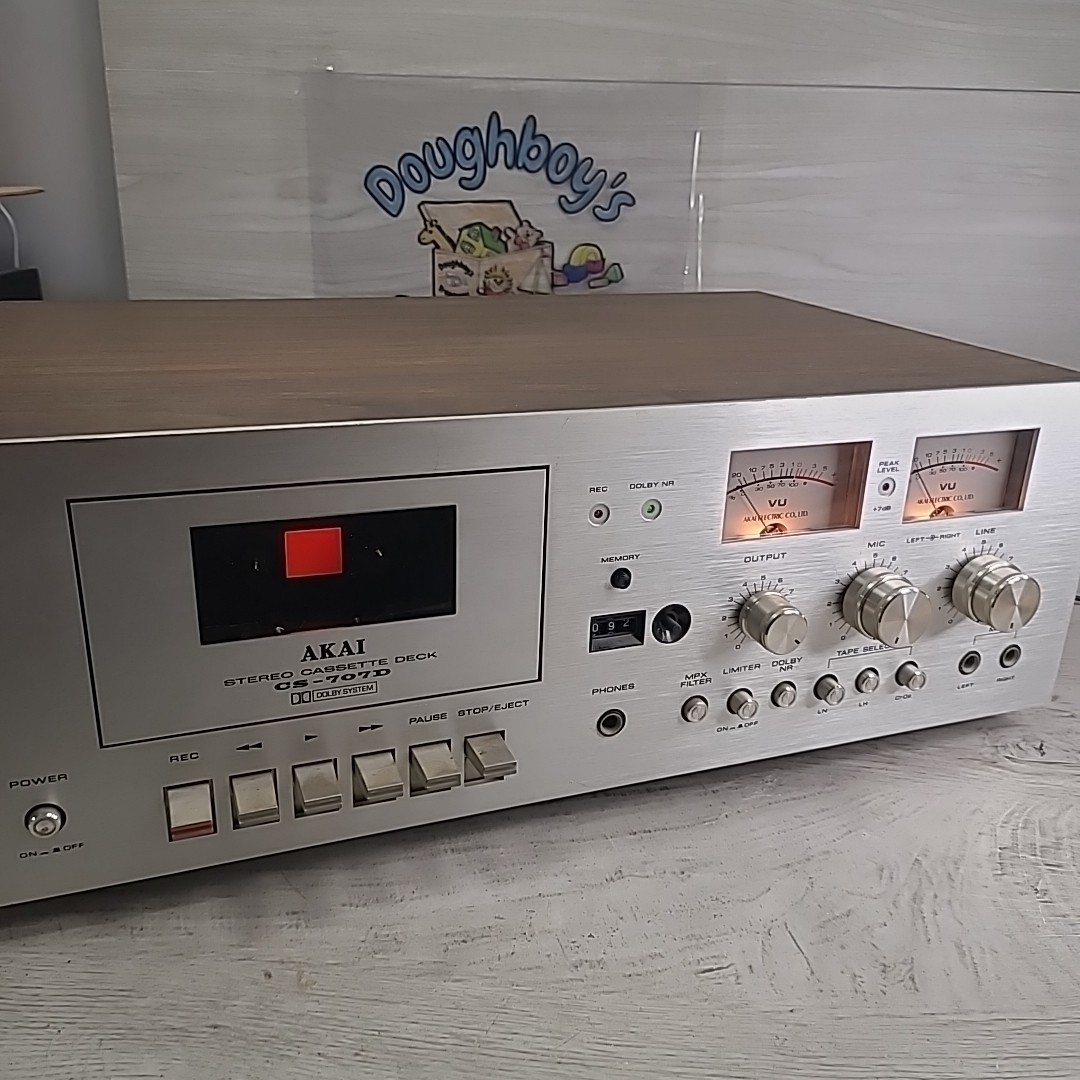
| Monitoring | Real-time analog VU meters, stereo headphone output |
| Dimensions | 430 × 140 × 330 mm (W×H×D) |
| Weight | 10.5 kg |
| Power Requirement | 120V AC, 50/60 Hz |
Sound Characteristics and Performance
The CS-707D was engineered for transparency and neutrality, avoiding the overly bright or "etched" sound some cassette decks exhibited in pursuit of high-frequency extension. Its three-head configuration allowed for true separate record and playback paths, enabling precise monitoring during recording—a feature prized by home tapers and semi-professional users.
With chrome or metal tapes and Dolby C engaged, the CS-707D delivered a remarkably wide frequency response and low noise floor. Its dual-capstan transport ensured minimal speed variation, contributing to a stable stereo image and low flutter—critical for preserving the integrity of acoustic and classical recordings. Bass response was tight and well-controlled, avoiding the flabbiness common in lesser decks, while midrange clarity made vocals and instruments sound lifelike.
Though not quite reaching the legendary status of the Nakamichi Dragon in terms of raw performance, the CS-707D held its own in comparative listening tests of the era. Reviewers at the time noted its excellent channel separation (over 50 dB) and low crosstalk, contributing to a spacious soundstage.
Notable Features and Innovations
What set the CS-707D apart was its blend of professional-grade mechanics and user-friendly operation:
- Dual Capstan Transport: Unlike most consumer decks that used a single capstan with a pinch roller, the CS-707D employed two capstans—one on each side of the tape path—to maintain constant tape tension and speed. This reduced mechanical stress on the tape and minimized wow and flutter.
- Three-Head System: With dedicated erase, record, and playback heads, the CS-707D allowed for accurate monitoring of recordings in real time, a feature typically found in studio equipment.
- Manual Tape Type Selection: Users could manually select Normal, CrO₂, or Metal bias and equalization, giving advanced users control over tape optimization. This was essential for extracting the best performance from high-coercivity tapes.
- Large VU Meters: The front panel featured oversized analog VU meters with peak hold function, allowing for precise level setting during recording.
- Direct Drive Reel Motors: Each reel had its own motor, eliminating the need for belts and reducing mechanical wear. This contributed to the deck’s long-term reliability.
- Headphone Monitoring and Line Output: The inclusion of a dedicated headphone amplifier and independent line output made the CS-707D suitable for integration into larger audio systems or for private listening.
Common Issues and Maintenance
Like all high-performance cassette decks from the 1980s, the CS-707D requires careful maintenance to remain in top condition. Over time, rubber components such as idler tires and pressure pads can degrade, leading to speed instability or poor tape contact. The dual-capstan system, while advanced, relies on precise alignment and clean capstan shafts.
Common issues include:
- Worn pinch rollers: Can cause speed fluctuations. Replacement with modern silicone rollers is recommended.
- Dirty or misaligned heads: Regular cleaning with isopropyl alcohol and demagnetizing are essential for optimal performance.
- Capacitor aging: The internal power supply and audio circuits may suffer from dried-out electrolytic capacitors, leading to hum or channel imbalance.
- Mechanical binding: Due to the complex transport, dust accumulation can impede smooth operation. Periodic cleaning and lubrication of critical points (by a technician) are advised.
Because the CS-707D was not produced in the same quantities as models from Sony or Pioneer, replacement parts can be harder to source. However, the modular design and use of standard components make repairs feasible for experienced technicians.
Current Market Value and Collectibility
The Akai CS-707D remains a niche collectible. While it doesn’t command the premium prices of a Nakamichi Dragon or even a Revox B77, well-maintained units in good working order typically sell for $300–$500 on the secondary market, depending on condition and accessories.
Its value is driven by several factors:
- Strong mechanical design and durability
- Dual-capstan system, rare in consumer decks
- Three-head configuration with real-time monitoring
- Growing interest in analog tape among audiophiles and musicians
Collectors of vintage Japanese audio gear, especially those focused on under-the-radar performers, often seek out the CS-707D for its engineering integrity and understated elegance. Units with original boxes, manuals, and unmodified internals are particularly desirable.
Conclusion and Legacy
The Akai CS-707D may not have been the most famous cassette deck of its era, but it exemplifies Akai’s commitment to precision and reliability. In an age when many manufacturers cut corners to reduce costs, Akai invested in advanced transport systems and high-quality components, resulting in a machine that could rival the best from its competitors.
Today, the CS-707D appeals to a specific kind of enthusiast: those who appreciate mechanical sophistication, analog warmth, and the tactile experience of tape. Whether used for digitizing vintage recordings, creating new analog masters, or simply enjoying music with a nostalgic touch, the CS-707D stands as a testament to the golden age of cassette technology.
For those exploring the upper echelons of vintage cassette decks, the Akai CS-707D is a rewarding discovery—a quiet achiever that deserves a place in any serious analog collection.
eBay Listings


As an eBay Partner, we earn from qualifying purchases. This helps support our independent vintage technology research.
Related Models
- Akai CS-F33R (1985)
- Akai DX-59 (1983)
- Akai GX-280D-SS (1979)
- Akai DX-57 (1978)
- Akai AA-5200 (1978)
- Sony TC-2050SD (1978)
- Aiwa AD-F990 (1993)
- Kenwood KX-3060 (1982)
- Sony TC-2130A (1974)
- Sony TC-2220 (1972)