Akai S900 (1986–1990): The 12-Bit Workhorse That Put Sampling in Reach of the Rest of Us
With 32-note polyphony, real-time editing, and floppy-based reliability, the Akai S900 wasn’t just a sampler—it was a studio revolution in a 12.5 kg chassis.
Overview
If the Fairlight CMI was the exotic supercar of 1980s sampling, the Akai S900 was the rugged, no-nonsense pickup truck that actually got the job done. Introduced in 1986, the Akai S900 wasn’t the first digital sampler on the market—machines like the E-mu Emulator II and even Akai’s own Akai S612 had already carved niches—but it was the first to offer a complete, professional-grade package at a price that didn’t require a record label advance. Priced at $3,000 at launch (roughly $8,500 today), it was still a serious investment, but suddenly, sampling wasn’t just for Prince or Peter Gabriel. It was for the working studio musician, the touring keyboardist, the emerging hip-hop producer with a day job.
What made the S900 so transformative was its balance of power, durability, and usability. With 32-voice polyphony—double what many competitors offered—it could handle complex multisampled instruments without choking. Its 12-bit resolution with Akai’s proprietary companding (a form of dynamic range compression during recording and expansion on playback) delivered a surprisingly warm, punchy sound that became a hallmark of late-’80s pop, electro, and early house. Artists like Depeche Mode, A Guy Called Gerald, and countless underground beatmakers relied on the S900 not just for drum hits, but for entire instrumental beds. It was the machine that let you sample your neighbor’s flute, pitch it down, loop it, filter it, and turn it into a haunting pad—all in real time, without rebooting or waiting for SCSI transfers that didn’t exist yet.
Specifications
| Sample Resolution | 12-bit |
| Sample Rate | 40 kHz maximum |
| Frequency Response | 20 Hz - 20 kHz |
| Dynamic Range | 90 dB |
| Signal-to-Noise Ratio | 90 dB |
| Total Harmonic Distortion | 0.02% |
| Polyphony | 32 voices |
| Memory | 750 kB RAM (expandable to 1.5 MB) |
| Storage | 3.5-inch DSDD floppy disk |
| Inputs | 2 x 1/4-inch TRS (line/mic switchable) |
| Outputs | 2 x 1/4-inch TRS (main left/right), 1 x 1/4-inch TRS (headphones) |
| Input Impedance | 10 kΩ |
| Output Impedance | 120 Ω |
| Phantom Power | 48 V |
| MIDI | In, Out, Thru |
| Dimensions | 483 mm × 445 mm × 88 mm |
| Weight | 12.5 kg |
| Country of Manufacture | Japan |
| Original MSRP | $3000 (1986) |
Key Features
- 12-bit sampling with Akai companding: While 12-bit resolution might sound primitive today, Akai’s implementation was anything but. The companding system (similar to dbx noise reduction) compressed the dynamic range during sampling and expanded it on playback, effectively boosting the usable dynamic range to 90 dB—rivaling some 16-bit systems. This gave the S900 its distinctive “warmth” and punch, especially on drums and vocals. It wasn’t clean—it was characterful.
- 32-voice polyphony: In 1986, this was massive. The E-mu Emulator II offered only 8 voices, and even the Fairlight CMI Series III maxed out at 16. The S900 could handle full orchestral multisamples, layered synth patches, or a dozen drum hits at once without voice stealing. For producers building dense arrangements, this was a game-changer.
- Real-time sample editing: Unlike earlier samplers that required external computers or tedious menu diving, the S900 let you trim, loop, reverse, and pitch-shift samples directly from the front panel. The 16-character LCD wasn’t much, but with the data wheel and dedicated function buttons, you could dial in a perfect loop point in seconds. This immediacy made it stage-worthy—a rarity for samplers of the era.
- Time-variant filters: Yes, a sampler with a filter. The S900 featured a resonant low-pass filter with envelope control, allowing you to shape the brightness of a sample over time. Want your sampled brass hit to start bright and then mellow out? Done. This wasn’t just playback—it was synthesis with real-world sounds.
- Floppy disk reliability: While SCSI was emerging, Akai stuck with 3.5-inch DSDD floppies—a smart move. They were cheaper, more durable than 5.25-inch disks, and universally compatible. You could swap sounds between S900s, back up your samples, or load factory libraries without a SCSI terminator war. In a world before USB, this was plug-and-play.
Historical Context
The mid-1980s were a battleground for digital audio dominance. The E-mu Emulator II (1984–1987) had already proven that sampling could be musical, not just a novelty, but it was expensive and limited to 8 voices. The Fairlight and Synclavier were prohibitively costly—tens of thousands of dollars—and required dedicated technicians. Akai, already known for high-quality tape decks, saw an opening: build a sampler that was robust, expandable, and actually usable in a real studio.
The Akai S612, released in 1985, was a 12-bit, 6-voice rackmount unit with MIDI but no display—more of a proof of concept. The S900 was the full realization: a standalone instrument with a proper keyboard-friendly interface, real-time controls, and studio-grade I/O. It arrived just as hip-hop was moving from drum machines to sampled breaks, and as electronic pop embraced sonic collage. The S900 didn’t just ride that wave—it helped create it.
Its successor, the Akai S950 (1988), improved on the formula with 16-bit sampling and better filtering, but the S900 remained in demand for its raw, gritty character. Later, the Akai S1000 (1992) would become the new standard, but the S900 was the foundation. It proved that sampling didn’t have to be perfect to be powerful—it just had to be musical.
Collectibility & Value
Today, the Akai S900 is uncommon but not rare—around 10,000 units were reportedly produced—and highly desirable among vintage synth collectors and producers seeking that authentic late-’80s texture. In 2025, a working unit in good condition typically sells for $800–$1500 USD, with mint, fully expanded models (1.5 MB RAM) commanding the higher end. Cosmetic condition matters less than functionality—this was a tool, not a showpiece.
However, caution is essential. The S900 is now nearly 40 years old, and two issues plague most units: capacitor leakage on the power supply and audio boards (which can damage circuitry if not addressed), and failure of the floppy drive mechanism due to dried lubricants or worn belts. When buying, insist on a unit that powers on, reads a disk, and outputs clean audio. Many sellers now retrofit units with floppy emulators (like the Gotek drive), which not only improves reliability but allows loading samples from USB—highly recommended for practical use.
If you’re lucky enough to find a serviced S900 with expanded memory and a modern drive solution, you’re not just buying a sampler—you’re acquiring a piece of music history that still sounds incredible. And if you’ve ever tried to replicate that gritty 12-bit snare in software, you’ll understand: some things just don’t translate. The S900 wasn’t perfect, but it was alive.
eBay Listings


As an eBay Partner, we earn from qualifying purchases. This helps support our independent vintage technology research.
Service Manuals & Schematics
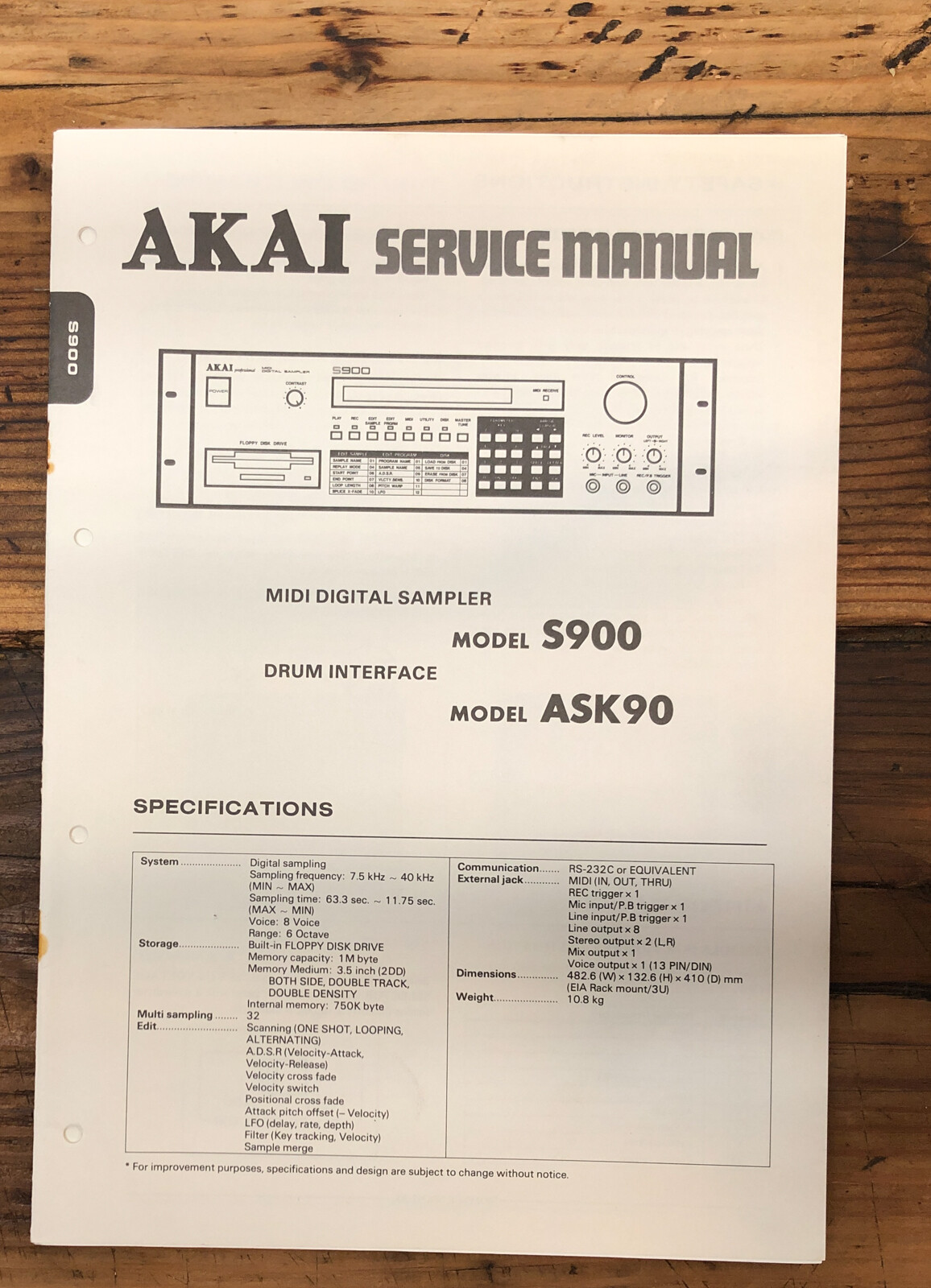
- Manual — archive.org
- Service Manual — archive.org