Akai GXR-82D (1980)
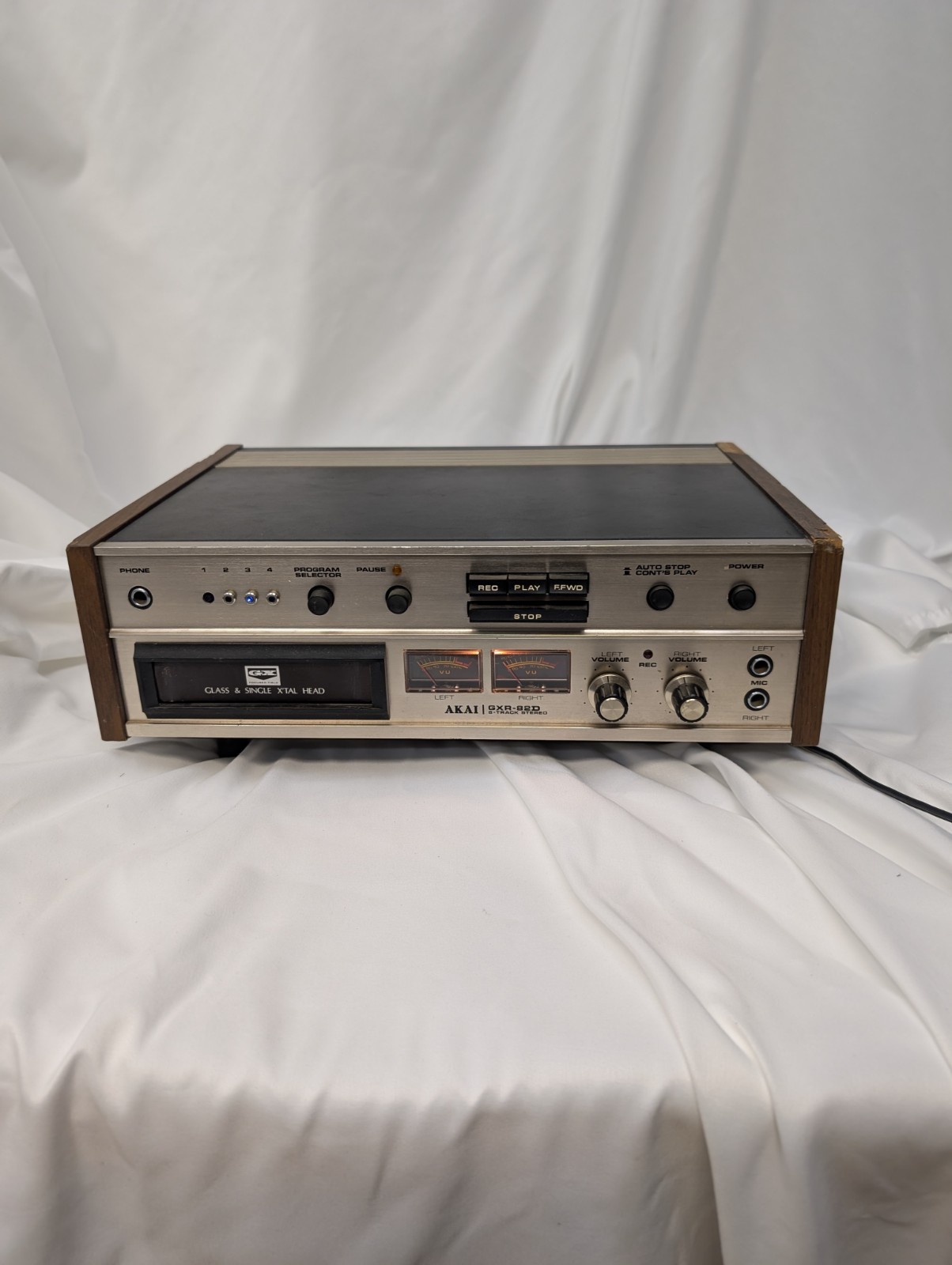
Step into any well-appointed living room around 1980, and you might’ve spotted the Akai GXR-82D anchoring a modest but serious stereo setup. Built by Akai Electric Co., Ltd.—a Japanese innovator better known for reel-to-reel recorders and early VCRs—this receiver arrived at a turning point in audio history. It’s the sound of analog warmth meeting the clean precision of early digital-era engineering. While it never grabbed headlines like models from Pioneer or Kenwood, the GXR-82D delivered honest, no-frills performance with a build that’s stood the test of time. For today’s vintage audio fans, it’s a sleeper hit: unpretentious, capable, and quietly charming.
Design and Build Quality
Sleek but never flashy, the GXR-82D wears its 1980s pedigree with pride. A brushed aluminum faceplate stretches across a black steel chassis, framed by a recessed analog tuner dial and a symmetrical array of knobs and switches. Everything feels deliberate—the large frequency window, the tactile input selectors, the bold loudness toggle. At 430 mm wide, 140 mm tall, and 330 mm deep, it fits snugly in any classic rack, a true double-width workhorse of its day.
The build? Solid, not spectacular. The powder-coated steel chassis offers decent shielding and heft without pretending to be exotic. But where it counts—the controls—the GXR-82D shines. Volume and tone pots turn smoothly, with a mechanical resistance that feels reassuring. The tuning knob connects directly to the analog capacitor, delivering that satisfying, precise glide across the FM band. No digital shortcuts here—just honest, hands-on tuning.
Audio Performance and Power Output
Rated at 45 watts per channel into 8 ohms (both channels driven, 20Hz–20kHz, under 0.5% THD), the GXR-82D sits comfortably in the mid-tier power bracket of its era. It won’t shake walls, but it’ll drive most bookshelf or floor-standing speakers of the early ’80s with authority. The amplifier uses discrete transistor circuitry and a dual-rail power supply—no cost-cutting IC amps here—giving it a clean, dynamic punch that still impresses.
Frequency response is flat across the audible spectrum (20Hz–20kHz ±1.5dB), delivering a neutral, uncolored sound. The signal-to-noise ratio hits 80dB—modest by today’s standards, but more than enough for living room listening. Bass and treble controls offer ±12dB adjustment at 100Hz and 10kHz, letting you shape the sound to your room or taste. It’s not flashy, but it’s flexible.
Tuner Section
The analog FM/AM tuner is where the GXR-82D quietly outperforms its price tag. The FM band (87.5–108 MHz) pulls in stations with a sensitivity of about 1.8 µV for 26dB quieting—respectable for a non-synthesized design. The mirrored tuning scale and stereo indicator light make dialing in stations a tactile pleasure. No digital readout, no PLL synthesis, just a smooth mechanical knob and a well-calibrated dial.
AM covers 530–1600 kHz (or up to 1710 kHz in some regional versions), using a built-in ferrite bar antenna. Reception is reliable in strong-signal areas, and the stereo/mono switch helps tame noise on weak FM stations. Out back, a 75-ohm coaxial or 300-ohm twin-lead FM antenna terminal lets you hook up an outdoor antenna for even better clarity.
Input and Output Options
Connections are straightforward but thoughtful. The rear panel hosts a phono (MM) input with RIAA equalization—ideal for turntables of the era, though MC cartridges will need external help. Two line inputs (Aux, Tape 1) and a full tape loop make cassette recording a breeze. Speaker A/B terminals let you switch between two sets of speakers, while a preamp output opens the door to external amplification.
A rare touch for its time: a subwoofer output, likely a filtered low-level feed. Up front, a ¼-inch headphone jack drives a dedicated amplifier stage—no passive splitting here. That means real volume, tight control, and a listening experience that doesn’t degrade when you go solo.
Additional Features
Convenience meets simplicity. The loudness contour switch boosts bass and treble at low volumes, compensating for how our ears hear in quiet settings. The speaker A/B selector lets you toggle between pairs—or run both, if your amp can handle the load. A mute button kills the sound instantly, and the direct input bypasses tone controls for a purer signal path when you want it clean.
Missing are the digital luxuries that would soon flood the market: no remote, no digital tuning, no graphic EQ. But that’s part of its appeal. No menus, no glitches—just knobs, switches, and sound.
Market Position and Legacy
Priced to compete with mid-range models from Yamaha, Sansui, and Sharp, the GXR-82D targeted buyers who wanted a complete stereo system without overspending. Akai never chased the high-end spotlight like Marantz or Harman Kardon, but they built things to work—and work well. This receiver was part of that quiet mission: a solid, no-nonsense performer for everyday listeners and budding audiophiles alike.
Today, it’s a cult favorite among vintage builders. Not a trophy piece, but a reliable cornerstone. Its neutral sound, durable construction, and clean aesthetic make it a go-to for period-correct setups. Plug it in, turn the knob, and you’re not just hearing music—you’re feeling a moment in audio history.
Maintenance and Restoration
After 40+ years, some TLC is expected. Electrolytic capacitors in the power supply often dry out—replacing them can revive sagging performance and prevent future failure. Worn potentiometers may crackle; a shot of contact cleaner usually brings them back to life. The tuning mechanism, though robust, can stiffen over time—re-lubrication restores that buttery-smooth glide.
Check speaker impedance before powering up. The GXR-82D handles 8-ohm loads with ease, but prolonged use with 4-ohm speakers can strain the amp. For best tuner performance, ensure clean antenna connections and consider an outdoor FM antenna—especially in weak-signal areas.
Conclusion
The Akai GXR-82D is a snapshot of early 1980s Japanese audio engineering: practical, dependable, and musically engaging. It doesn’t dazzle with specs or status, but it delivers where it matters—clean power, reliable tuning, and a sound that feels alive. Decades later, it remains a smart choice for collectors, restorers, and anyone who appreciates the tactile joy of analog controls and honest circuitry. In a world of digital noise, the GXR-82D speaks softly—and plays beautifully.
eBay Listings



As an eBay Partner, we earn from qualifying purchases. This helps support our independent vintage technology research.
Related Models
- Akai AA-1010
- Akai AA-A25
- Akai AA1150
- Akai AM-15 (1965)
- Pioneer QX-949A (1978)
- Pioneer SX-2000 (1978)
- Pioneer SX-2500 (1978)
- Marantz SR-2000 (1999–2001)
- Onkyo TX-1500MKII (1975)
- Pioneer QX-646 (1978)