Aiwa CS-80: The Precision Cassette Deck from Japan’s Golden Age of Audio
In the late 1970s, as the compact cassette format matured from a portable dictation medium into a serious contender for high-fidelity audio reproduction, Japanese manufacturers raced to refine the technology. Among them, Aiwa stood out—not always for being the loudest in marketing, but for its quiet commitment to engineering excellence. The Aiwa CS-80, introduced in 1978, was one of the company’s flagship cassette decks during this pivotal era. Though overshadowed in popular memory by titans like Nakamichi and Revox, the CS-80 represented Aiwa’s pursuit of precision, durability, and sonic clarity in a compact and elegant package.
Historical Context: Aiwa’s Rise in the Cassette Era
By the late 1970s, Aiwa had already established itself as a serious player in the consumer audio market. Known for sleek designs and meticulous build quality, the company positioned itself between mass-market brands and ultra-premium audio houses. The CS-80 was part of Aiwa’s CS series—Cassette Stereo—which targeted serious audiophiles and home recording enthusiasts. Released during the same period as the legendary Sony TC-800B and TEAC’s A-2300S, the CS-80 competed in the upper echelon of cassette decks, offering features typically found in professional or semi-professional gear.
Unlike many of its contemporaries that focused on flashy design or gimmicks, Aiwa emphasized mechanical precision, low wow and flutter, and excellent tape tracking. The CS-80 was engineered for reliability and accuracy, making it a favorite among users who valued consistency and long-term performance.
Technical Specifications
The Aiwa CS-80 was built around a dual-capstan, three-head design—features that placed it firmly in the high-end category of its time. It supported both standard Type I (ferric) and Type IV (metal) tapes, with selectable bias and equalization settings for optimal performance across tape formulations.
| Specification | Detail |
| Year Introduced | 1978 |
| Format Support | Compact Cassette |
| Head Configuration | 3-head (Record, Playback, Erase) |
| Capstan System | Dual capstan, direct-drive |
| Tape Speed | 1⅞ ips (4.76 cm/s) |
| Wow and Flutter | < 0.055% (measured, RMS) |
| Frequency Response | 30Hz – 18kHz (Type IV, ±3dB) |
| Signal-to-Noise Ratio | 66 dB (Dolby B), 72 dB (Dolby C) |
| Total Harmonic Distortion | < 1.5% |
| Input/Output | Line In/Out (RCA), Mic In (3.5mm) |
| Recording Bias | Adjustable (Normal, High, Metal) |
| Equalization Time Constants | 120 μs (Normal), 70 μs (Metal) |
| Dolby Noise Reduction | Dolby B and C (switchable) |
| Power Requirement | 120V AC, 50/60 Hz |
| Dimensions (W×H×D) | 430 × 140 × 310 mm (17 × 5.5 × 12.2 in) |
| Weight | 9.8 kg (21.6 lbs) |
The CS-80’s dual-capstan transport was a standout feature, minimizing tape slippage and ensuring consistent tape-to-head contact. This system, combined with a direct-drive motor, contributed to its impressively low wow and flutter—critical for maintaining pitch stability and clarity, especially during classical or acoustic recordings.
Sound Characteristics and Performance
The Aiwa CS-80 was engineered for accuracy and neutrality, avoiding the overly bright or warm colorations common in some cassette decks of the era. Its three-head design allowed for true separate record and playback heads, enabling real-time monitoring during recording with no compromise in fidelity.
With Dolby C noise reduction, the CS-80 achieved a remarkably quiet background, rivaling early digital formats in perceived clarity. When paired with high-quality metal tapes—such as Sony’s HF-X or TDK’s MA—the deck could reproduce a wide dynamic range and detailed treble response, making it suitable for archiving vinyl or creating high-quality mix tapes.
Many users report that the CS-80 excels in midrange clarity, rendering vocals and acoustic instruments with lifelike presence. Bass response is tight and well-controlled, though not as extended as some larger reel-to-reel systems. Overall, the sonic signature is balanced—faithful to the source without artificial enhancement.
Notable Features and Innovations
The CS-80 packed several advanced features that reflected Aiwa’s engineering philosophy:
- Three-Head Configuration: Enabled superior recording monitoring and precise azimuth alignment.
- Dual Capstan Transport: Reduced tape wear and improved speed stability.
- Selectable Bias and EQ: Allowed users to optimize performance for Type I (ferric), Type II (chrome), and Type IV (metal) tapes.
- Dolby B and C Compatibility: Provided flexibility in noise reduction, with Dolby C offering significantly improved high-frequency noise suppression.
- Front-Panel Level Meters: Large, easy-to-read VU meters for precise level setting during recording.
- Microprocessor-Controlled Transport: Advanced for its time, ensuring smooth operation and consistent tape handling.
- Solid Chassis Construction: A heavy, rigid metal frame minimized vibration and external interference.
One of the more subtle but important design choices was the modular head assembly, which allowed for easier alignment and servicing—a boon for technicians and DIY enthusiasts alike.
Common Issues and Maintenance
Like all high-end cassette decks from the 1970s and 1980s, the Aiwa CS-80 requires periodic maintenance to perform at its best. Common issues include:
- Deteriorated Rubber Components: The pinch roller and drive belts (if present in certain submodels) can harden or crack over time. Replacement with modern equivalents is essential.
- Head Oxidation: Playback and record heads may develop oxide buildup, especially if the deck has been idle. Cleaning with isopropyl alcohol and demagnetizing are recommended.
- Capstan Shaft Gumming: Lubrication can dry out, leading to speed irregularities. Light re-lubrication with synthetic oil may be needed.
- Worn Slide Pots: The volume and balance controls may develop crackling. Contact cleaner or pot replacement can resolve this.
Regular use and proper storage (in a dry, dust-free environment) go a long way in preserving the CS-80’s performance. When serviced, the deck remains remarkably reliable—even by modern standards.
Current Market Value and Collectibility
The Aiwa CS-80 is not as widely collected as some of its more famous contemporaries, but it has developed a dedicated following among cassette enthusiasts and vintage audio purists. Units in excellent working condition typically sell for $250 to $450, depending on completeness (original remote, manual, box) and cosmetic condition.
Its value is bolstered by its rarity, solid build, and excellent performance—particularly when compared to more common models like the Sony TC-K615 or TEAC A-2300. While not a “showstopper” in the collector’s market, the CS-80 is increasingly recognized as a sleeper hit—a high-end deck that delivers performance close to Nakamichi’s offerings at a fraction of the price.
Conclusion and Legacy
The Aiwa CS-80 stands as a testament to the craftsmanship and innovation that defined Japan’s golden age of audio. While it may not have the brand cachet of a Nakamichi Dragon or the minimalist elegance of a Revox B77, the CS-80 delivers exceptional performance, thoughtful engineering, and enduring reliability.
For the modern audiophile, the CS-80 offers a window into a time when analog tape was pushed to its limits—where every fraction of a percent in wow and flutter mattered, and where mechanical precision was as important as electronic design. Whether used for digitizing rare recordings, creating high-fidelity cassettes, or simply enjoying the tactile ritual of analog playback, the Aiwa CS-80 remains a worthy addition to any vintage audio setup.
In an era rediscovering the warmth and character of analog, the CS-80 reminds us that true high fidelity isn’t just about specs—it’s about soul, precision, and the quiet confidence of well-made machinery.
eBay Listings


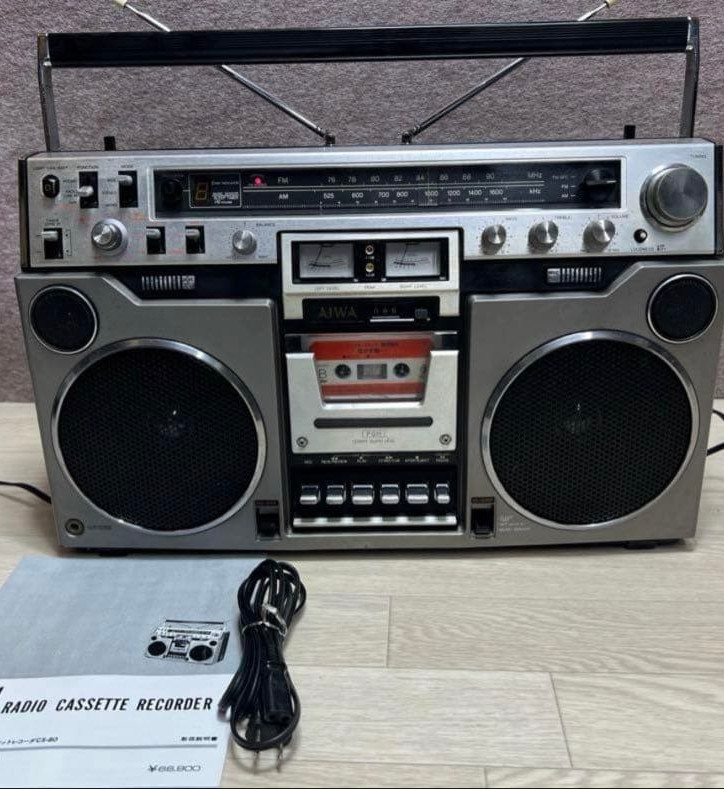

As an eBay Partner, we earn from qualifying purchases. This helps support our independent vintage technology research.
Related Models
- Aiwa AD-F990 (1993)
- Aiwa AA-8700 (1981)
- Aiwa AA-8900 (1982)
- Aiwa AD-1200 (1980)
- Aiwa AD-1250 (1982)
- Sony TC-2050SD (1978)
- Kenwood KX-3060 (1982)
- Sony TC-2130A (1974)
- Sony TC-2220 (1972)
- Sony TC-FX6 (1982)