Aiwa AD-F990U: The Precision Cassette Deck from the Late Analog Era
In the mid-1990s, as the digital revolution began to reshape the audio landscape with the rise of CDs and early MP3 players, cassette decks were often seen as relics of a fading analog era. Yet, for many audiophiles and tape enthusiasts, this period actually marked the pinnacle of cassette technology. Among the final generation of high-performance cassette decks, the Aiwa AD-F990U stands out as a sophisticated, feature-rich machine that exemplifies Aiwa’s commitment to precision engineering and user-focused design.
Released in 1994, the AD-F990U was positioned as a premium dual cassette deck aimed at serious home tapers, music archivists, and those who still valued the warmth and accessibility of analog tape. While not as widely celebrated as some of its contemporaries from Nakamichi or Tandberg, the AD-F990U carved out a loyal following thanks to its reliable performance, clean design, and thoughtful feature set—making it a quiet gem in the final chapter of the cassette deck’s golden age.
Technical Specifications
The AD-F990U was engineered for both convenience and fidelity. As a dual-deck unit, it was designed primarily for high-speed dubbing, but its internal components ensured that it could also deliver solid playback and recording quality when needed.
| Specification | Detail |
| Model | AD-F990U |
| Year of Release | 1994 |
| Type | Dual Cassette Deck |
| Recording System | 2-head, 3-motor |
| Tape Speed | 4.76 cm/s (1⅞ ips) |
| HS Dubbing | Yes (2x speed copying) |
| Noise Reduction | Dolby B, Dolby C |
| Frequency Response | 40Hz – 14,000Hz (Typical) |
| Signal-to-Noise Ratio | >60 dB (Dolby C On) |
| Wow and Flutter | <0.08% (WRMS) |
| Head Type | Ferrite (Record/Playback), Fixed erase |
| Display | Fluorescent dual VFD (Vacuum Fluorescent Display) |
| Inputs | 1x Line In (RCA) |
| Outputs | 1x Line Out (RCA) |
| Dimensions | 430 × 135 × 295 mm (W×H×D) |
| Weight | 6.5 kg (14.3 lbs) |
| Power Supply | AC 120V, 60Hz (North American version) |
| Impedance | 47k ohms |
| Years Produced | 1989-1992 |
One of the AD-F990U’s most practical features was its High-Speed (HS) dubbing capability, which allowed users to copy tapes at double the normal speed—effectively halving the time required for duplication. This was a major selling point in an era when people were still actively curating mixtapes, backing up rare recordings, or transferring vinyl and radio broadcasts to cassette.
Sound Characteristics and Performance
While the AD-F990U was not marketed as a "high-end" audiophile deck in the same league as the Nakamichi Dragon or even the Aiwa’s own AD-F5900, it delivered respectable audio performance for a mass-market dual deck. Its ferrite heads were durable and consistent, though not as refined as the pure permalloy or Sendust heads found in higher-tier models. Still, with proper alignment and tape selection (particularly Type II chrome or metal tapes), the AD-F990U could produce warm, balanced sound with decent high-frequency extension and tight bass response.
The inclusion of Dolby B and C noise reduction helped minimize tape hiss, especially on longer recordings or when using lower-grade tapes. Dolby C, in particular, offered improved high-frequency noise reduction over Dolby B, and its presence on a dual-deck unit like the AD-F990U was a sign of Aiwa’s attention to audio quality even in convenience-oriented models.
The 3-motor transport system ensured stable tape tension and smooth operation, reducing wow and flutter to acceptable levels. While not studio-grade, the measured <0.08% wow and flutter performance was more than adequate for home use and ensured that pitch stability remained consistent during playback.
Notable Features and Innovations
The AD-F990U was packed with user-friendly features that reflected the practical needs of 1990s consumers:
- HS (High-Speed) Dubbing: The standout feature, allowing fast and efficient tape copying—ideal for building music libraries before the digital age.
- Auto Reverse (on both decks): Enabled continuous playback and recording across both sides of a cassette without manual flipping.
- Program Play and Recording: Users could skip unwanted tracks and record only selected segments, useful for radio time-shifting or editing compilations.
- Tape Selector Dial: Simplified tape type selection (Type I, II, IV) for optimal bias and equalization settings.
- Fluorescent VFD Display: Bright, clear, and easy to read in low-light environments, showing time, mode, and function status.
- Direct Access Buttons: Dedicated controls for play, record, stop, rewind, and fast-forward on both decks, minimizing menu diving.
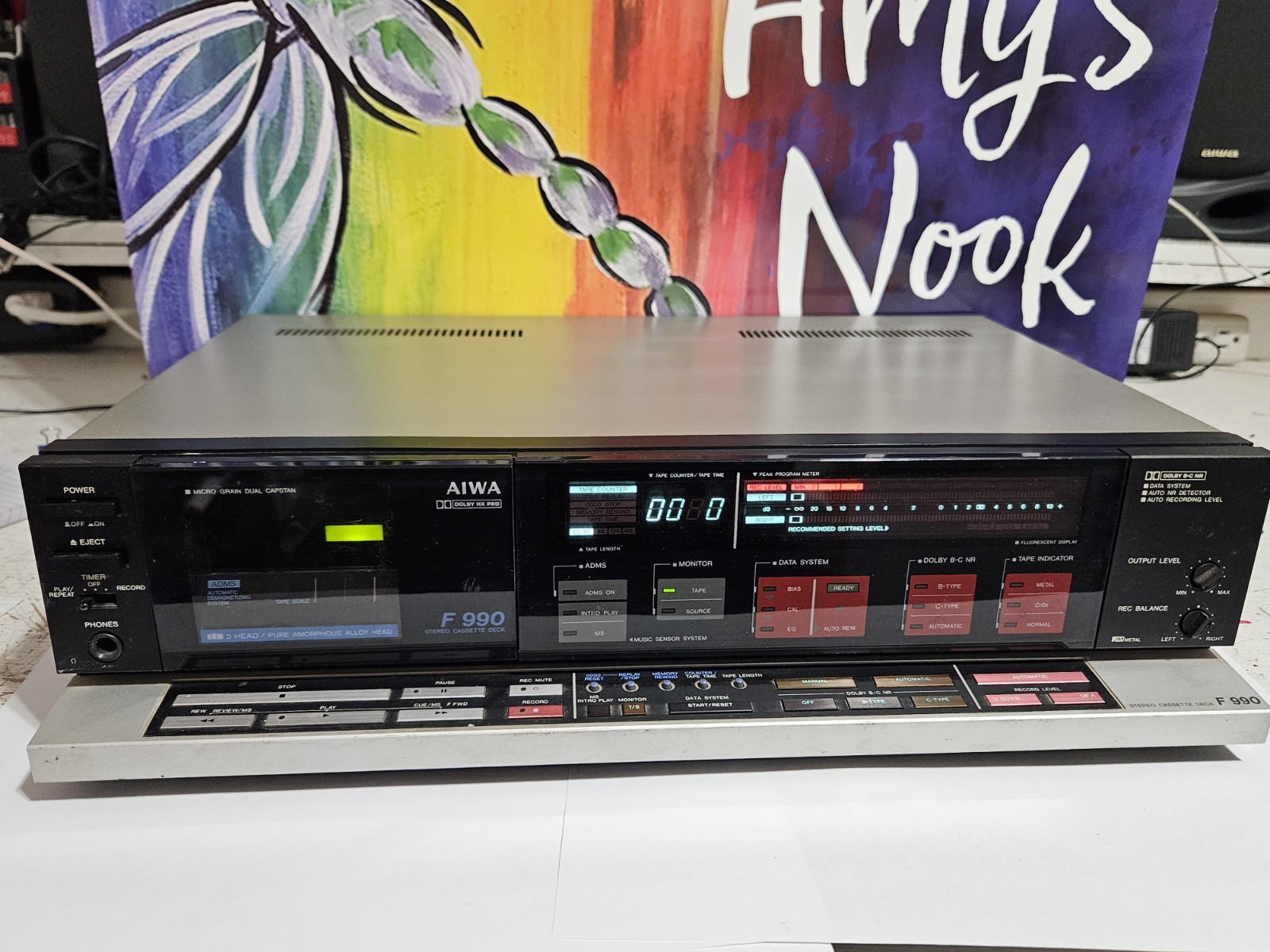
The front panel design was clean and intuitive, with a symmetrical layout that made operation straightforward. Aiwa avoided cluttering the interface with unnecessary buttons, focusing instead on core functionality. The build quality, while not luxurious, was solid—typical of Aiwa’s mid-to-high-end models of the period.
Common Issues and Maintenance
Like all vintage cassette decks, the AD-F990U requires some care to remain in working order. Common issues include:
- Worn pinch rollers: Over time, rubber pinch rollers can harden or become glazed, leading to speed instability or tape slippage. Replacement with new rubber rollers is recommended.
- Deteriorated belts: Though the AD-F990U uses a 3-motor system (reducing reliance on belts), some internal belts may still degrade. These should be inspected and replaced if cracked or stretched.
- Dirty or misaligned heads: Accumulated oxide buildup can degrade sound quality. Regular cleaning with isopropyl alcohol and a lint-free swab is essential. Head alignment should be checked periodically, especially if dubbing quality declines.
- Capstan corrosion: The chrome-plated capstan shaft can corrode if exposed to humidity. Light corrosion can be gently polished; severe cases may require replacement.
- Sticky mode buttons or transport mechanisms: Dust and aging lubricants can cause mechanical sluggishness. A professional cleaning and relubrication can restore smooth operation.
For long-term preservation, storing the unit in a dry, dust-free environment is crucial. If used regularly, demagnetizing the heads every few months will help maintain optimal performance.
Current Market Value and Collectibility
The Aiwa AD-F990U is not a rare or highly sought-after collector’s item like some Nakamichi or Revox decks, but it holds steady appeal among cassette enthusiasts, DIY tapers, and those restoring vintage audio systems. In good working condition, the AD-F990U typically sells for $80 to $150 on secondary markets like eBay or audio forums.
Its value is driven more by functionality than rarity—buyers are usually looking for a reliable, no-frills dual deck for practical use rather than display. Units with clean tape paths, responsive mechanics, and intact rubber components command higher prices. Fully serviced and calibrated decks may fetch closer to $200, especially if sold with original packaging or accessories.
While not a "holy grail" of cassette decks, the AD-F990U represents a well-engineered endpoint in the evolution of consumer tape technology—a machine built for real-world use at a time when analog was still relevant.
Conclusion and Legacy
The Aiwa AD-F990U may not have the prestige of flagship decks from rival brands, but it embodies the quiet excellence of late-era consumer audio engineering. It was designed for people who valued convenience, reliability, and decent sound quality—bridging the gap between mass-market appeal and technical competence.
Today, as cassette culture enjoys a nostalgic revival among analog lovers and younger generations discovering tape’s tactile charm, the AD-F990U remains a practical and capable tool. Whether you're digitizing old mixtapes, creating new ones, or simply appreciating the ritual of analog audio, the AD-F990U delivers a satisfying experience with minimal fuss.
In the final act of the cassette era, Aiwa didn’t aim for the spotlight with this model—but they built something enduring, useful, and quietly impressive. For that, the AD-F990U deserves a place in the pantheon of dependable vintage audio gear.
eBay Listings



As an eBay Partner, we earn from qualifying purchases. This helps support our independent vintage technology research.
Related Models
- Aiwa AD-F990 (1993)
- Aiwa AA-8700 (1981)
- Aiwa AA-8900 (1982)
- Aiwa AD-1200 (1980)
- Aiwa AD-1250 (1982)
- Sony TC-2050SD (1978)
- Kenwood KX-3060 (1982)
- Sony TC-2130A (1974)
- Sony TC-2220 (1972)
- Sony TC-FX6 (1982)