Advent 201 (1971–1978)
The machine that made cassettes respectable — not flashy, not fussy, just honest tape sound that rewired how we thought about portable fidelity.
Overview
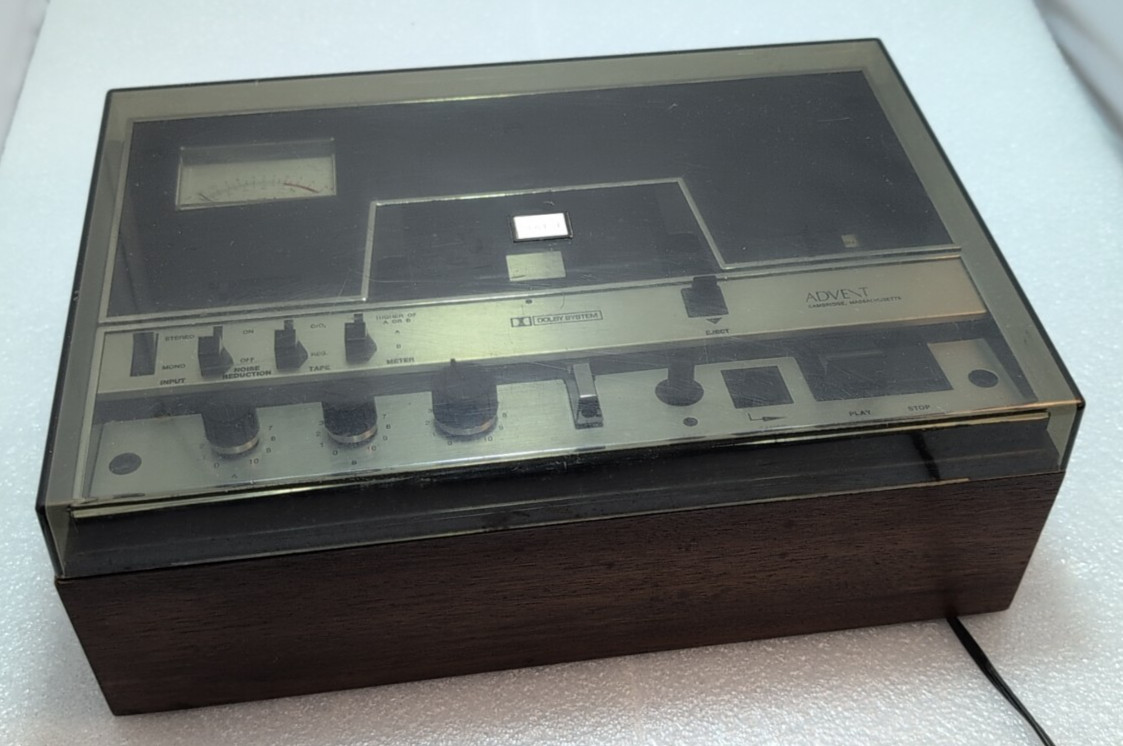
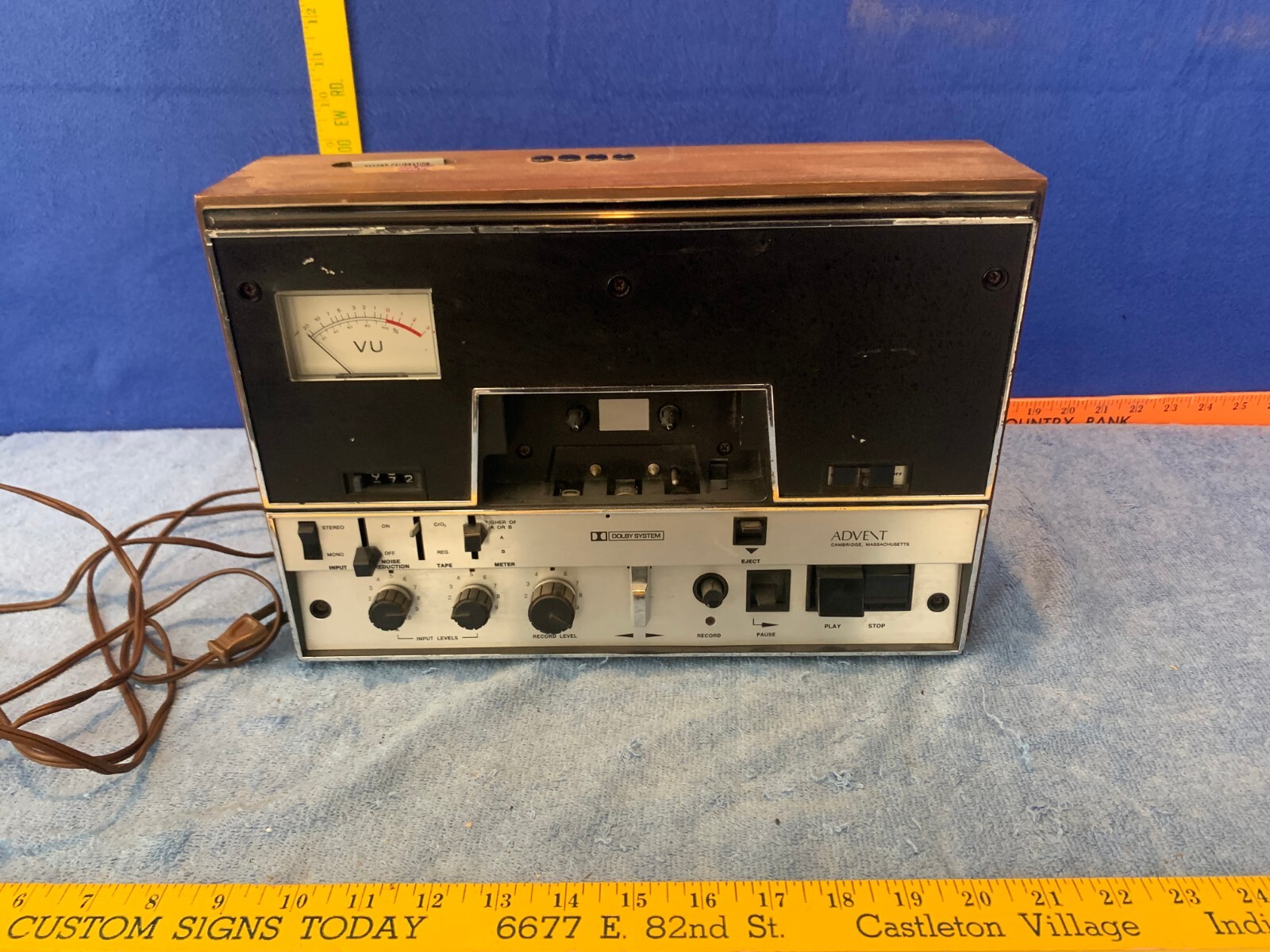
Turn the power on, drop the cassette in, and that single off-center VU meter swings to life like a heartbeat — green glass glowing, needle twitching with the first whisper of signal. There’s no fanfare, no digital display, no chrome trim screaming “audiophile.” The Advent 201 doesn’t announce itself. It just works. And in 1971, when most people thought of cassettes as flimsy little cartridges for voice memos or car radios, that quiet competence was revolutionary. This wasn’t just another tape deck. It was the first cassette machine built from the ground up to deliver real high fidelity, the one that proved magnetic tape in a plastic shell could rival open-reel recorders and even pressings on vinyl when done right.
Designed under the vision of Henry Kloss — the same mind behind Acoustic Research and KLH — the 201 wasn’t about gimmicks. It was about engineering discipline. At a time when most cassette decks were still chasing classroom durability or portability, Advent went the opposite direction: they built a serious, no-nonsense transport with performance that matched the best reel-to-reel gear of the era, but in a format anyone could use. The magic wasn’t just in the transport or the electronics — though both were meticulously executed — it was in the timing. The 201 arrived just as Dolby B noise reduction was becoming viable for consumer gear, and Advent didn’t just license it — they integrated it thoughtfully, making it a core part of the signal path rather than an afterthought. The result? A cassette deck that could record and play back music with a dynamic range and signal-to-noise ratio that had never been seen outside professional studios.
It helped that Advent wasn’t starting from scratch. The 201 used a Wollensak 4760 transport, a rugged, belt-driven, single-capstan mechanism originally designed for industrial and educational recorders. Advent engineers refined it, added their own high-performance three-head assembly (record, playback, erase), and wrapped it in a minimalist chassis that prioritized function over form. The layout is unusual by modern standards: the cassette well sits on top, not the front, flanked by chunky buttons and a row of toggle switches. The solitary VU meter, mounted in the upper-left corner, serves both channels via a selector switch — a cost-saving move that confused some into thinking it was a mono deck, but one that didn’t compromise actual performance. This was gear for listeners, not show-offs.
Specifications
| Manufacturer | Advent Corporation |
| Production Years | 1971–1978 |
| Original Price | $295 (equivalent to ~$2,200 today) |
| Speed | 1.875 ips |
| Wow and Flutter | < 0.15% DIN weighted |
| High Speed Wind Time | 45 seconds for C-60 |
| End of Tape Shut Off | Fully automatic, disengages pinch roller and heads |
| Heads | 3-head system (record, playback, erase) |
| Head Type | Ferrite (early models), later upgraded to more durable alloy |
| Tape Speed | 1.875 inches per second |
| Number of Motors | 1 (AC motor with idler drive) |
| Transport Type | Belt-driven, single capstan with flywheel |
| Tape Type Selection | Manual: Normal, CrO₂ |
| Noise Reduction | Dolby B |
| Frequency Response | 35–15,000 Hz ±2 dB (with CrO₂ tape); 35–14,000 Hz ±2 dB (normal tape) |
| Signal-to-Noise Ratio | >54 dB (CrO₂, Dolby off); 48 dB (normal tape, Dolby off) |
| Noise Reduction Effect | 10 dB at 4,000 Hz and above; 9 dB at 2,400 Hz; 6 dB at 1,200 Hz; 3 dB at 600 Hz |
| Input Sensitivity | 35 mV (0 VU) / 50 kΩ nominal |
| Output Level | 580 mV (maximum, from 0 VU tape level) |
| Minimum Recommended Load Impedance | 2 kΩ |
| Distortion | < 0.1% (up to and beyond tape saturation) |
| Bias Frequency | 110 kHz |
| Power Requirements | 120 V AC, 60 Hz |
| Power Consumption | 25 watts |
| Weight | 11.5 lbs (5.2 kg) |
| Dimensions | 17.5" W × 5.75" H × 12.5" D (44.5 × 14.6 × 31.8 cm) |
| Inputs/Outputs | RCA line in/out, 1/4" microphone input (with optional mic preamp) |
| Tape Counter | Analog 3-digit mechanical counter |
Key Features
The Transport That Refused to Quit
The Wollensak 4760 transport inside the 201 wasn’t designed for audiophiles — it was built for schools, offices, and dictation machines that needed to run for hours without failing. That industrial DNA is exactly what made it perfect for Advent’s mission. Belt-driven with a single capstan and a hefty flywheel, it delivers exceptional speed stability, which translates directly into low wow and flutter — under 0.15% DIN weighted, a number that still impresses today. The pinch roller retracts automatically at the end of tape, and the whole mechanism is engineered for longevity. Service technicians observe that when these decks fail, it’s rarely the transport — it’s the rubber belts, idlers, or dried-out capacitors in the power supply. The transport itself? Bulletproof. Wollensak even sold near-identical units under their own name (the 4760 and 4760A), and Advent confirmed in internal correspondence that they were directly involved in the design, ensuring the OEM chassis met their audio-grade standards.
Dolby B Done Right
The Advent 201 wasn’t the first to use Dolby B, but it was the first to treat it as a foundational element of the design rather than a bolt-on feature. The noise reduction circuitry is fully integrated, with calibration points accessible for alignment. When Dolby is engaged, the improvement is immediate: tape hiss melts away without the “breathy” artifacts that plagued lesser implementations. The 201 was also one of the first decks to support chromium dioxide (CrO₂) tape, which Advent sold under their own “Advocate Crolyn” brand. With the right tape and proper bias adjustment, the frequency response extends cleanly to 15 kHz, and the signal-to-noise ratio jumps to over 54 dB — numbers that matched or exceeded many open-reel decks of the time. It’s no exaggeration to say that the 201 helped create the market for high-grade pre-recorded cassettes, proving that the format could be more than just a convenience.
Minimalist Interface, Maximum Control
There’s nothing flashy about the 201’s front panel — just toggles, buttons, and that lone VU meter. But beneath the austerity is thoughtful design. The manual tape type switch (Normal/CrO₂) lets users optimize bias and equalization, a level of control most competitors reserved for higher-end models. The meter selector switch allows monitoring of either channel, and the record level is adjustable via front-panel knobs. The tape counter, while analog and non-resettable, is surprisingly accurate for cueing and editing. And despite its utilitarian look, the 201 was never intended as a classroom recorder — Advent leveraged the Wollensak transport for its reliability, but everything else — the heads, the electronics, the calibration — was tuned for music. Collectors note that early models had softer head materials that wore faster, a flaw corrected in the 201A with harder, more durable alloys.
Historical Context
In 1971, cassettes were still widely seen as a low-fidelity format — fine for voice recordings or car stereos, but laughable compared to vinyl or reel-to-reel. That changed with the Advent 201. While Philips had invented the cassette, and several companies had tried to improve it, Advent was the first to treat it as a serious medium for music. Henry Kloss, known for his work on acoustic suspension speakers, understood that convenience didn’t have to mean compromise. The 201 arrived at a pivotal moment: Dolby Labs had just made noise reduction viable for consumers, and tape manufacturers like DuPont were developing higher-performance formulations like chromium dioxide. Advent didn’t just react to these trends — they accelerated them.
The 201 wasn’t a luxury item. At $295, it was expensive for a cassette deck, but it undercut most serious open-reel recorders by thousands. It found a home among audiophiles who wanted archival-quality recording without the hassle of threading tape, and among music lovers who wanted portable fidelity. Its success forced the entire industry to rethink the cassette. Suddenly, Nakamichi, TEAC, and Sony were racing to build high-end decks of their own. The 201’s legacy is visible in every high-performance cassette machine that followed — including the legendary Nakamichi Dragon, which some enthusiasts jokingly call the 201’s “spiritual descendant.” Without the 201 proving that cassettes could be hi-fi, that lineage might never have existed.
Collectibility & Value
Today, the Advent 201 is a landmark machine — not just for what it is, but for what it started. As a collectible, it occupies a unique space: not as flashy as a Nakamichi, not as rare as a Revox, but universally respected for its historical significance. Prices vary widely based on condition and functionality. A non-working unit with cosmetic wear might go for $50–$100, while a fully serviced, clean example with aligned heads can fetch $250–$400. Units with original boxes, manuals, or promotional materials — like the rare CrO₂ demonstration tapes — can command premiums, especially among completist collectors.
But ownership comes with caveats. These decks are over 50 years old. The rubber belts and idler tires are almost certainly perished, and the electrolytic capacitors in the power supply are dried out. A 201 that “powers on” is not a 201 that plays well. Service records show that the most common failure points are the capstan belt (a simple replacement) and the power supply filter caps (which should be replaced to prevent damage to the rest of the circuit). The early ferrite playback heads are also prone to wear, especially if the deck was used heavily with abrasive tapes. A head replacement or resurfacing can cost $100–$200, but it’s often worth it for a clean chassis.
Before buying, check for signs of previous service — clean solder joints, replacement belts, and alignment notes inside the lid are good signs. Avoid units with sticky buttons, seized mechanisms, or visible corrosion. And be wary of “mint” decks that haven’t been used in decades — tape path lubricants dry out, and gummed-up mechanisms can cause tape jams or head damage. The 201 was built to last, but it wasn’t built to sit. It wants to be played.
eBay Listings


As an eBay Partner, we earn from qualifying purchases. This helps support our independent vintage technology research.