Adcom GFA-565 (1989 – c. 1992)
Adcom's "no compromise" monoblock - a GFA-555 stretched to 850 watts into 2 ohms, and the rare Adcom that asks you to buy two.
Overview
Two of them. That's the first thing a prospective GFA-565 owner has to get straight. A few eBay listing titles and even the Archive's own earlier notes have called it a stereo amp. It isn't. The GFA-565 is a monaural power amplifier, a single-channel block, and the only way to hear one in stereo is to own a matched pair. The service manual opens its circuit description by naming the GFA-565 a "monaural power amplifier," and every serious source treats it as a monoblock. The confusion is understandable. The chassis is the same size as a stereo GFA-555, so a single 565 on a shelf looks like half of a stereo amp rather than half of a pair.
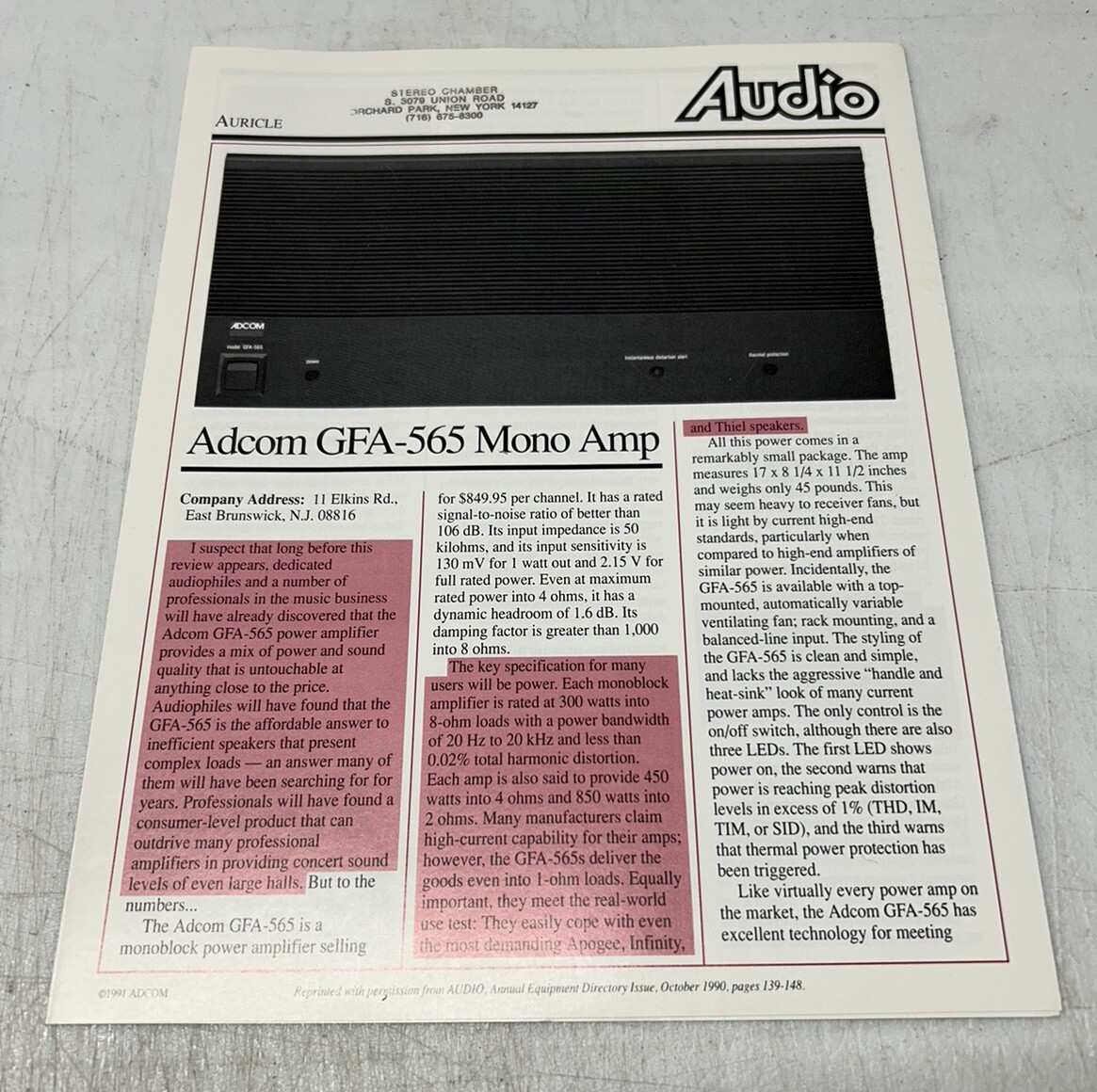
Adcom rated the single channel at 300 watts into 8 ohms, 450 watts into 4 ohms, and 850 watts into 2 ohms, all across 20 Hz - 20 kHz at under 0.02% THD. Those figures appeared in the company's period advertising - Audio (October 1990, p.362) and HiFi-Stereo (December 1989, p.66) both ran the copy - and the FTC-requirement power rating in the service manual repeats the same 300-watt/8-ohm, 450-watt/4-ohm, 850-watt/2-ohm numbers with the same 0.02% THD ceiling. The output stage is documented as capable of delivering greater than 60 amps into low-impedance loads. That's the number that explains why anyone bought a pair of these. Sixty amps is a welder's current, and it lets a 300-watt amp stay composed when a speaker's impedance curve dives toward two ohms.
The 565 evolved directly from the GFA-555. Adcom's own advertising described it as extending the design of the "critically acclaimed GFA-555," and the service-manual circuit description bears that out. The front end is a discrete dual-differential cascode Class-A stage feeding a dual cascode Class-A voltage-gain stage, which in turn drives a high-current triple-Darlington-follower output stage. Adcom's literature put the current multiplication at roughly 50,000. That topology is why the amp tolerates difficult loads, and why the 2-ohm rating isn't marketing fiction.
The standard version came with unbalanced inputs. The manual also documents an optional balanced input board built around a Neutrik XLR jack and a pair of Adcom's own op-amps. Input impedance is 50k ohms, sensitivity is 2.15V for rated output, and signal-to-noise is quoted at greater than 106 dB A-weighted at full output. Frequency response is the one spec nobody agrees on. HiFi Engine lists 10 Hz to 20 kHz, while Stereophile's published figures list it as unspecified. Treat the bottom-end extension as a reasonable assumption, not a measured fact.
Key Features
300/450/850 Watts Into 8/4/2 Ohms
The headline numbers are the whole reason the 565 exists. The 2-ohm figure is the one to pay attention to, because it's the number most amplifiers of the era simply couldn't produce — and the one Adcom's advertising pushed hardest. The service manual's FTC-conformance rating confirms all three figures hold across the full 20 Hz–20 kHz band at under 0.02% THD, not just at 1 kHz.
Greater Than 60 Amps of Output Current
Adcom's service documentation states the output stage is capable of greater than 60 amps into low-impedance loads. That's the spec that matters for electrostatic panels or low-sensitivity multi-way speakers with ugly impedance dips. It's the difference between an amp that merely survives a difficult load and one that drives it cleanly.
Dual Cascode Class-A Front End and Triple-Darlington Output
The circuit description lays out a serious topology for the money: a discrete dual-differential cascode Class-A input stage, a dual cascode Class-A voltage-gain stage, and a high-current triple-Darlington-follower output stage. The manual also documents an anti-saturation feedback network. When the voltage-gain stage approaches clipping, diodes steer current through the front-panel "Instantaneous Distortion Alert" LED and force the input stage to back off the drive. Most amplifiers in this price class never documented anything like it.
Monoblock Chassis Sized Like a Stereo Amp
The 565 measures 17 inches wide, 8.25 inches high, and 11.5 inches deep, the same footprint as the stereo GFA-555. A pair stacks on a shelf or sits side-by-side on an amp stand. Shipping weight is listed at 45 lbs per unit, so a stereo pair arrives as roughly 90 lbs of transformer and heat sink.
Optional Balanced Input Board
The standard version shipped with unbalanced inputs, but the service manual documents an optional balanced input PCB built around a Neutrik XLR connector and Adcom's own ICs. It's worth seeking out on the used market for owners running long cable runs from a preamp. It's a factory option, not an aftermarket hack.
Historical Context
The GFA-565 arrived in 1989 as Adcom's step up from the GFA-555, which had built the company's reputation for performance that undercut typical high-end pricing. Adcom's advertising leaned hard on that reputation. The copy repeatedly used the phrase "no compromise" and framed the 565 as the amp for listeners who needed to drive the most demanding speakers. Production is generally placed from 1989 into the early 1990s, though no confirmed end year appears in the record. The "circa 1989-1992" dating is inferred from advertising appearances, not a documented production run.
Original pricing is murky. Holt Hill Audio lists the standard unbalanced version at $1700 per pair, while an owner recollection on Audioreview cites $400 each or $800 a pair. Neither is confirmed as an official contemporaneous MSRP, and the gap between them is large, so original pricing stays unresolved.
Collectibility & Value
An Audioreview user reported pairs running about $1000 on eBay, though the date of that observation isn't stated and current pricing should be verified against live listings. The Audioreview aggregate sits at 4.8 out of 5.
Reception was warm but not uncritical. Stereophile's Tom Norton found the 565s turned in a fine performance with all of his test loudspeakers, but felt their openness and transparency were a cut or two below the best, and a cut or two below their own solid credentials in other respects. One Audioreview owner put the value case more bluntly, arguing the 565s just about maximize the return-to-cost ratio.
Parts support is unusually good for a discontinued monoblock. Restoration recap service kits appear regularly on eBay, Hoppe's Brain sells circuit board kits for Adcom amplifiers, and multiple service manuals are in circulation. skyfiaudio listings describe units as serviced and ready, some with new driver boards fitted. That ecosystem matters: a pair of 565s is a long-term ownership proposition, and the fact that recap kits and driver boards exist means these amps can be kept running rather than retired. Buyers should confirm whether a given pair has been serviced, and should expect to budget for a recap if it hasn't.
eBay Listings



As an eBay Partner, we earn from qualifying purchases. This helps support our independent vintage technology research.