Accuphase P-300 (1973)
At 25 kg (55.1 lb), it arrives like a declaration—this is not an amplifier built to fade into the background.
Overview
The Accuphase P-300 isn't a tentative first step; it’s a full-throated statement from a company arriving with intent. Released in August 1973, it marked Accuphase Laboratory, Inc.’s debut as a power amplifier manufacturer under the Kensonic brand, and from the outset, the engineering signaled serious ambition. This was no rebranded design or budget offering—it was a flagship-caliber stereo power amplifier built to handle both the finest gradations of musical nuance and the sudden, explosive demands of dynamic range without flinching. It was developed explicitly for this dual mandate: precision at low levels and iron-fisted control at high output. Housed in a chassis that combines a gold-tone top panel, black sub-panel, and natural persimmon wood sideboards, the P-300 balances industrial presence with warm, organic touches. It was often paired with the C-200 preamplifier, forming a flagship separates stack that defined high-end audio in its era. The design lineage is clear—variants like the P-300S, P-300X, P-300L, and P-300V followed, each refining the original’s formidable foundation.
Specifications
| Manufacturer | Accuphase Laboratory, Inc. |
| Product type | Stereo power amplifier |
| Production years | Released in August 1973 |
| Original price | ¥ 195,000 |
| Rated output (0.01% THD, Stereo) | 180W/ch (8 Ω), 280W/ch (4 Ω), 90W/ch (16 Ω), 350W/ch (2 Ω) |
| Monaural output (Bridge connection, 0.01% THD) | 560W (8 Ω), 700W (4 Ω), 360W (16 Ω) |
| Harmonic distortion factor (20 Hz to 20 kHz, at rated output) | 0.01% or less |
| IM distortion factor | 0.003% (at rated output) |
| Frequency response (at rated output, 8 Ω) | 20 Hz ~ 20 kHz +0, -0.2 dB |
| Frequency response (at 1W output) | 1 Hz ~ 250 kHz +0, -3 dB |
| Gain | 28.0 dB |
| Load impedance (Stereo) | 2 Ω ~ 16 Ω |
| Load impedance (Monaural/bridge) | 4 Ω ~ 16 Ω |
| Damping factor | 300 (Stereo, 8 Ω load) |
| Input sensitivity / impedance (Stereo, 8 Ω, rated output) | 1.5V / 100k Ω |
| S/N ratio (IFF-A curve, at rated output) | 115 dB or more |
| Audio bandpass filter | 17 Hz / 24 kHz, 18dB/oct. |
| Power limiter | Full, 1/2, 1/4 power switch |
| Output meter | Logarithmic compression type, -40dB to +3dB (0 dB corresponds to 150W into 8 Ω) |
| Power consumption (No signal) | 100W |
| Power consumption (Rated output, 8 Ω) | 510W |
| Dimensions (W x H x D) | 445 x 152 x 355 mm |
| Weight | 25 kg |
Key Features
Pure Complementary DC Servo Circuit Topology
The P-300’s entire signal path is direct-coupled and operates in a pure complementary push-pull configuration across all stages, eliminating coupling capacitors that can color or slow the signal. This DC servo design ensures exceptional stability and tight control over the output stage, contributing directly to its low distortion and ruler-flat frequency response. The topology isn't just a technical flourish—it’s the core of the amplifier’s ability to render transients with precision and maintain coherence across the entire bandwidth.
Triple Push-Pull Output Stage with Six Power Transistors per Channel
Each channel employs a triple push-pull configuration, utilizing six high-output power transistors. This dense, robust output stage delivers massive current reserves, enabling the P-300 to drive difficult speaker loads—including 2 Ω—with authority. The design allows for 350W into 2 Ω in stereo mode and up to 700W in bridged monaural operation, making it one of the few amplifiers of its time capable of such extremes without compromising stability.
MOS FET Cascode Driver Stage in Class A
The driver stage uses MOS FETs in a cascode push-pull arrangement, operating in Class A. This configuration offers high input impedance, wide bandwidth, and low noise—critical for cleanly amplifying the signal before it reaches the output stage. Running in Class A ensures the drivers are always conducting, eliminating crossover distortion and contributing to the amplifier’s exceptionally low IM distortion of 0.003% at rated output.
Independent Dual-Channel Power Supply with Massive Filtering
The power supply is a centerpiece of the design: a large transformer feeds independent rectification circuits for the left and right channels, minimizing crosstalk and ensuring each channel has dedicated current reserves. A separate winding powers the pre-driver stage, further isolating sensitive circuitry. The use of 40,000 μF x2 filter capacitors provides immense energy storage, supporting the amplifier’s high power consumption (510W at full output) and enabling instantaneous response to dynamic peaks.
Relay-Based Speaker Protection with Error Indication
Protection is handled by a relay circuit that disconnects the speakers in the event of DC offset, short circuits, or internal faults. While some later commentary notes that relay protection is relatively slow compared to solid-state alternatives, its presence was a significant reliability feature at the time. An error condition is indicated via the power meter lamp, giving users immediate feedback without requiring additional diagnostic tools.
Front Panel Attenuators and Logarithmic Output Meter
The front panel includes left and right independent attenuators, allowing fine volume adjustment in 1 dB steps down to -20 dB—unusual for a power amplifier and suggesting integration flexibility. The logarithmic compression-type output meter spans -40 dB to +3 dB, with 0 dB calibrated to 150W into 8 Ω. This provides a realistic, non-peaking indication of output level, helping users monitor performance without being misled by transient spikes.
Balanced XLR and Dual Unbalanced Inputs
With three inputs—one balanced via XLR and two unbalanced—the P-300 accommodates a range of preamplifiers. The balanced input has an impedance of 40k Ω, while the unbalanced inputs present 100k Ω, ensuring compatibility with both high- and low-output sources. This flexibility made it a natural partner for the C-200 preamplifier and other high-end separates of the era.
Historical Context
The P-300 was Accuphase’s first power amplifier, introduced under the Kensonic brand in August 1973. It set the tone for the company’s engineering philosophy: uncompromising build quality, innovative circuit design, and a focus on both micro-detail and macro-dynamics. Positioned as the flagship power amplifier, it was part of a high-end separates system that included the C-200 preamplifier. Its success paved the way for a series of variants—P-300S, P-300X, P-300L, and P-300V—each refining the original’s architecture while maintaining its core performance ethos.
Collectibility & Value
The P-300 remains a sought-after piece among collectors of vintage Japanese high-fidelity equipment, particularly those focused on early Accuphase designs. While no current market prices are documented in the source material, one commentary notes that replacing a P-300 with a modern equivalent like the Accuphase P-4500 would cost approximately $14,000 AUD, underscoring its enduring performance relevance. However, survival rate is a concern—common issues include “no output,” capacitors out of specification, and evidence of prior repairs that may have compromised the original circuitry. Units described as “for parts or repair” and those “butchered a bit” suggest that finding a fully functional, unmodified example is increasingly rare. Service manuals and schematics are available from sources like hifiengine.com, Elektrotanya, and Emanuals, aiding restoration. An optional wood case, the A-2, was available for ¥15,000 at launch, offering protection and display enhancement.
eBay Listings

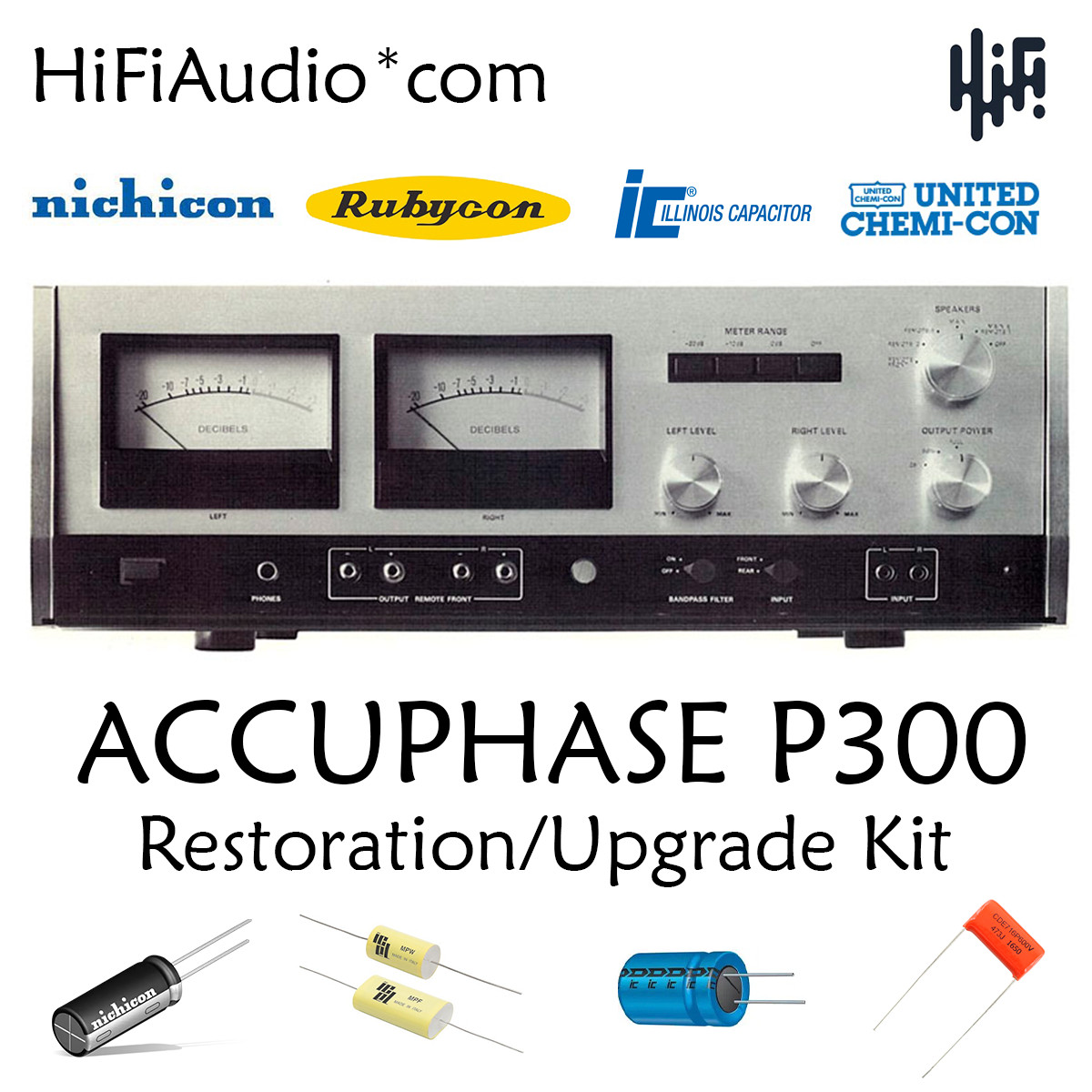


As an eBay Partner, we earn from qualifying purchases. This helps support our independent vintage technology research.
Service Manuals, Schematics & Catalogs
- Catalog (1996) — archive.org
- Catalog — archive.org
- Catalog (1992) — archive.org