ADC RSQ34
That moment when your vintage ADC cartridge sings again — all it needed was the right needle.
Overview
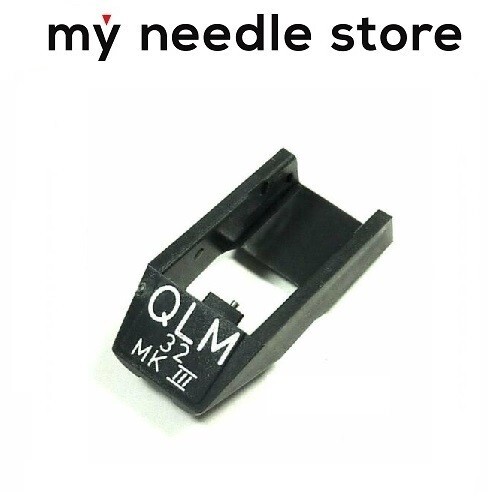
The ADC RSQ34 isn’t flashy. It doesn’t have glowing tubes or a machined aluminum body. But if you own an ADC QLM 34 MkIII — or any of the older ADC cartridges it fits — this little stylus is the difference between hearing your records and truly knowing them. It’s a replacement needle, yes, but not just any needle: it’s a precision elliptical diamond tip, engineered to glide through the grooves of your vinyl with the kind of detail and tracking that makes you forget you’re listening to 50-year-old technology. And while it might seem odd to write passionately about a part most people never see, anyone who’s spun records with a worn stylus knows the stakes. A bad needle doesn’t just sound dull — it can wreck your collection. The RSQ34, when fresh, brings back the sparkle, the depth, the subtle textures that make analog worth the hassle.
Manufactured by ADC and built by Pfanstiehl — a name that appears across high-end replacement styli — the RSQ34 is specifically designed for the QLM 34 MkIII, though it’s listed as compatible with a range of older ADC models including the RSQ-31, RSQ-32, RSQ-33, RSQ-36, RKSE, QLM30, and QLM32. It’s not a cartridge upgrade or a mod — it’s maintenance, pure and simple. But good maintenance on vintage gear isn’t just upkeep; it’s preservation. This stylus is crafted in Japan, where the elliptical diamond is highly polished and mounted nude (meaning the diamond is directly attached to the cantilever without a metal shank), reducing mass and improving responsiveness. The cantilever itself is made from a low-mass, high-strength alloy, which helps maintain accurate contact with the groove walls, especially in complex passages where cheaper styli might skip or distort.
What’s striking isn’t just the build quality, but the quiet confidence of its design. It doesn’t try to do everything — it just does one thing exceptionally well. It’s compatible with both mono and stereo records, spinning at 33 and 45 RPM, but it’s not meant for 78s. That’s not a limitation; it’s focus. This is a stylus built for the LP era, for the kind of listening where you care about channel separation, harmonic completeness, and groove tracing. And while there’s no official production date or original price on record — those details seem lost to time — what remains is its reputation among those who still use these cartridges: it works. One Amazon reviewer, Phil, put it plainly in January 2026: “worked as expected. no disappointments here.” High praise, in its own understated way.
Specifications
| Manufacturer | ADC |
| Product type | Replacement stylus (needle) for cartridge |
| Stylus tip shape | elliptical diamond |
| Stylus tip radii | .0003 x .0007 inch |
| Stylus tip size | 0.7 mil |
| Diamond mounting | Nude |
| Cantilever material | low-mass high strength alloy |
| Tracking force range | 1.5 - 3 grams |
| Compatible speeds | 33 & 45 RPM |
| Not compatible with | 78RPM |
| Compatibility | Mono or Stereo ready |
| Compatible cartridge | QLM 34 MkIII |
Key Features
Highly Polished Elliptical Diamond
The elliptical tip isn’t just a shape — it’s a compromise between longevity and fidelity. Unlike a conical tip, which has a single radius and makes broader contact with the groove, the elliptical profile (.0003 x .0007 inch) allows for tighter contact with the high-frequency modulations etched into the inner walls of the record. This means better high-end extension, improved stereo separation, and more accurate tracing of complex transients. The fact that it’s highly polished matters too: a smoother surface reduces friction and wear, both on the stylus itself and on your records. Over time, a rough or degraded tip can act like sandpaper, gradually erasing the music you’re trying to hear.
Nude Diamond Construction
The “nude” mounting — where the diamond is directly bonded to the cantilever — is a step up from bonded tips, which use a metal shank to attach the diamond. That extra metal adds mass, which can dull transient response and increase tracking error. By going nude, the RSQ34 keeps moving mass low, allowing the stylus to follow rapid groove movements with less inertia. It’s a detail that might seem minor on paper, but in practice, it contributes to the sense of immediacy and clarity that owners report. This isn’t just a replacement part — it’s a performance upgrade, even if it’s doing the same job as the original.
Precision Cantilever Design
The cantilever, made from a low-mass, high-strength alloy, plays a critical role in translating groove motion into electrical signal. A stiff yet lightweight cantilever resists bending under tracking force while remaining responsive to subtle vibrations. This balance helps maintain consistent contact across the record’s surface, reducing distortion and inner-groove compression. Combined with the elliptical tip and nude mounting, it forms a system optimized for accuracy — not hype, not coloration, but faithful reproduction of what’s in the groove.
Collectibility & Value
The ADC RSQ34 isn’t collected for its rarity or nostalgia — it’s sought after because it still works, and because replacements are getting harder to find. Manufacturers have been phasing out production of replacement styli for decades, and while the RSQ34 is still available through specialty retailers, the price varies significantly. LP Gear lists it at $74.95, Amazon shows a listing at $28.99, and SNVINYL offers it for £49.99 (including VAT). The disparity reflects regional pricing, retailer markup, and possibly differences in packaging or included accessories — though the core product appears identical. Used or open-box units have appeared on eBay for as little as $19.99, but buyers should exercise caution: a used stylus is a gamble, since wear is invisible to the naked eye and can cause irreversible record damage.
The most important advice from the fact sheet is simple: buy two. One for now, one for later. Because when your current stylus wears out — and it will — you don’t want to be scrambling to find a replacement while your cartridge sits idle. A worn stylus doesn’t just sound bad; it degrades your records with every play. That’s not hyperbole — it’s physics. Once the diamond tip loses its precise shape, it starts dragging across the groove instead of riding it, carving away detail that can never be recovered. So while the RSQ34 might seem like a small expense in the world of high-end audio, it’s one of the most consequential. It’s not just protecting your gear — it’s protecting your music.
eBay Listings


As an eBay Partner, we earn from qualifying purchases. This helps support our independent vintage technology research.