ADC QLM30 MKIII (1976–1984)
A six-gram cartridge with a 0.7 mil conical tip and a three-to-five-gram tracking window. It came bolted to the tonearm whether you asked for it or not.
Overview
The ADC QLM30 MKIII arrives inside something else. It was never sold as a standalone retail item. Audio Dynamics Corporation built it as an OEM component for console stereos and automatic turntables, so most of them left the factory mounted in the headshell of a BSR or Dual record changer and stayed there. That explains its unglamorous reputation, its absence from hi-fi shop shelves, and why surviving examples turn up in the bottom of a drawer rather than a display case.
It was the entry-level model in ADC's QLM series, a lineup that ran through the 31, 32, and 35 across MKI, MKII, and MKIII iterations. The QLM30 MKIII sat at the bottom. ADC positioned the whole QLM family as its mass-market line during the late 1970s and early 1980s, in contrast to the higher-end XLM and VLM models. The QLM30 MKIII was never meant to compete with those. It was meant to track. Owners who find one with a clean, intact original stylus report a balanced, surprisingly engaging sound - warm without being muddy, detailed enough, and stable enough to track through warped records.
The cartridge weighs six grams, which is mid-weight for a moving magnet design and gives it enough mass to sit still on the less-damped arms it was built for. It connects to standard MM phono preamp inputs and wants only the standard RIAA curve. No step-up transformers, no unusual loading.
Key Features
Conical 0.7 mil Diamond Stylus
The stylus is a conical diamond with a 0.7 mil (0.018 mm) tip radius. That geometry was chosen for durability and groove compatibility rather than fine detail retrieval, and it is the biggest single factor in how the QLM30 MKIII sounds. A conical tip makes broad contact with the groove, which reduces wear on older pressings and forgives the alignment slop that automatic tonearms develop. What it cannot do is resolve the high-frequency textures an elliptical or Shibata profile would pull out. Owners who expect air and shimmer will not find it here. They will find a cartridge that does not punish a slightly off-angle headshell or a pressing that has seen better decades.
Styli in the QLM MKIII series were interchangeable across all five models. The LP Gear RSQ30 replacement is reportedly still in production, manufactured in Japan as a special run for this cartridge, and sells in the $32.94 to $44.99 USD range. Some users caution against Pfanstiehl replacements, calling them "too much of a crapshoot" on account of inconsistent quality control in recent years. A Russian owner of roughly three of these cartridges reported buying original styli two or three times and receiving hardened, petrified suspensions every time, and described a couple of non-original styli as sounding bad. That is a real hazard with any NOS stylus of this vintage, so buy from a seller who will take it back.
Re-Tuned Coils and Low-Mass Stylus Assembly
The Mark III was a refinement over the Mark II, not a cosmetic revision. ADC re-tuned the coils and redesigned the stylus assembly for lower mass. The cantilever is a lightweight alloy unit, which improves transient response and reduces inertia during rapid groove excursions, like the ones an automatic changer delivers every time the arm lifts, drops, and cycles to the next record. Whether that refinement is audible on a console stereo is debatable. Whether it helps the cartridge survive a decade of changer duty is not.
Front-Mounted Ceramic Magnet — and Its Failure Mode
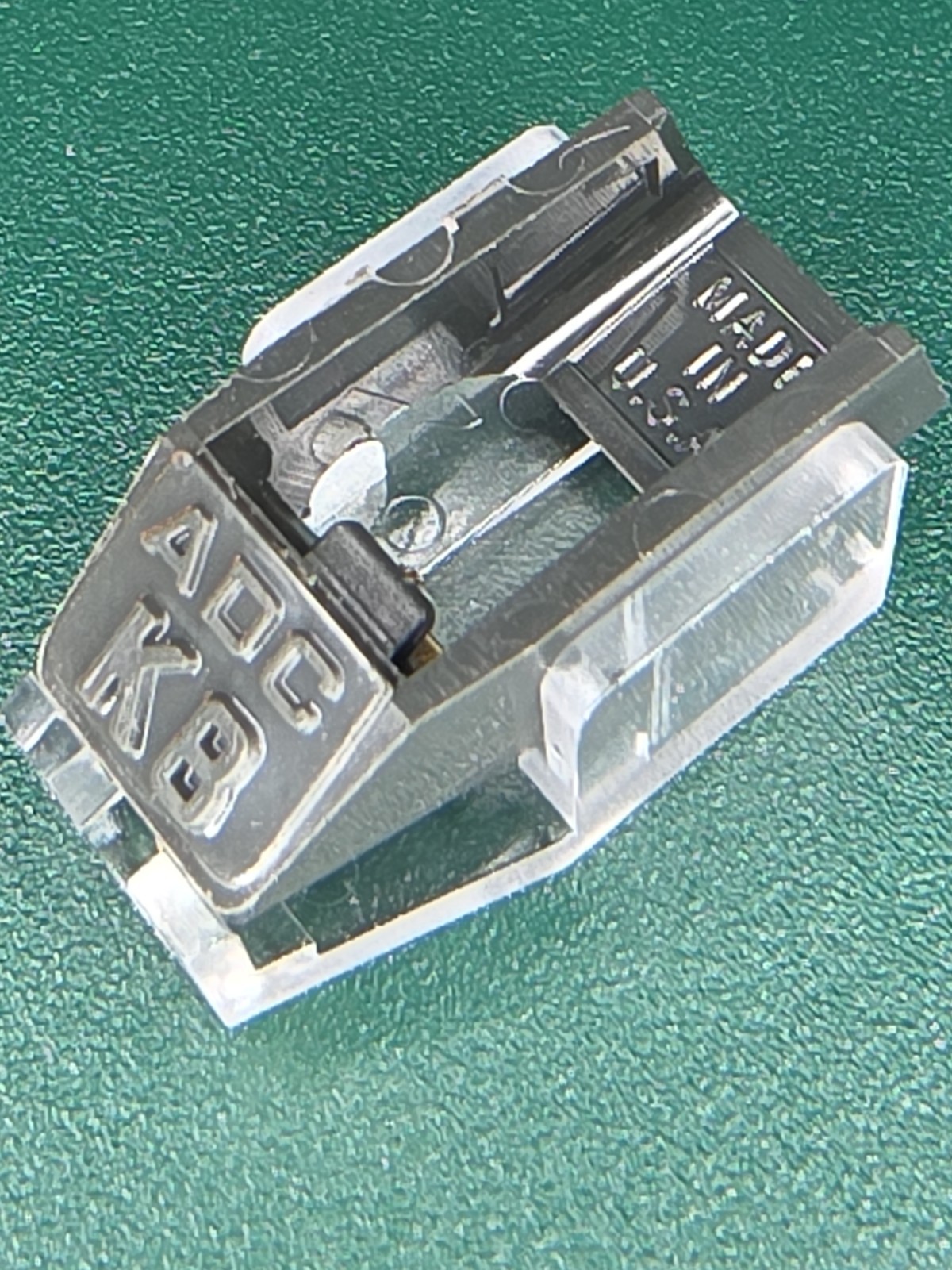
A small ceramic magnet sits near the front of the assembly. The layout aids magnetic efficiency but brings a specific vulnerability. If that magnet becomes displaced or loses magnetization, output drops substantially. Repair technicians report that a shifted magnet collapses output entirely, leaving the cartridge unusable without expert repair. The failure does not announce itself - one day the cartridge plays, the next it is a whisper - so check for it before assuming a dead channel is a wiring problem.
3.0–5.0 Gram Tracking Force for Heavy Arms
The QLM30 MKIII tracks between 3.0 and 5.0 grams, with 3.0 g the recommended figure. That range is far above modern audiophile practice and well matched to the heavy, spring-driven tonearms of 1970s automatic turntables. As High-Fidelity (July 1978, p.40) noted in its coverage of the QLM line, the sibling QLM 32 MK II was specified at a 2-4 gram tracking range with flat response out to 20 kHz ±2 dB.
The downforce keeps the stylus planted through arm lifts, drop cycles, and record stack shifts, preventing skips in high-groove-acceleration passages. Forum regulars have long debated whether to run these at the low end or the high end of the window, with the general caution that tracking too light risks mistracking and record damage. That is a fair concern for a conical stylus on a changer arm. The cost is more record wear and less micro-detail retrieval than a lighter-tracking cartridge, in exchange for stability the lighter cartridges cannot offer on a heavy arm.
Historical Context
ADC introduced the QLM30 MKIII in 1977 as part of what the company called its "ADC Quality Low Mass Series". The model's production span is generally given as 1976 to 1984, a one-year discrepancy that survives in the record. It was never a retail product. It shipped inside console stereos and automatic turntables, which is why no official original price exists and why the model is so poorly documented relative to its production volume. The QLM series as a whole was ADC's mass-market answer to the enthusiast-focused XLM and VLM lines, and the QLM30 MKIII was the cheapest way into that family.
It was not flashy and it was not sold in hi-fi shops. It was installed, forgotten, and relied upon. The interchangeable styli across the MKIII range confirm the mass-market intent: a line built to be serviced cheaply and kept running, not upgraded.
Collectibility & Value
Working complete cartridges trade in the $30 to $50 range on the secondary market, with a cartridge carrying its original stylus recently listed at $33.99 and a bare unit needing a needle at $5.95. New old stock turns up occasionally. One vendor sells NOS units with needle, needle guard, and mounting screws while supplies last, and a NOS example has listed at $83.56. A used original stylus fetched €53 in Europe in May 2024, a Polish listing offered a full system with cartridge installed for PLN 350 in October 2025, and a Russian classified listed one at 5,800 rubles. Owners estimate roughly $90 as a fair standalone value for a good example, which sits well above the typical asking prices.
The risks are specific. Broken pins and displaced internal magnets are the common failures, and the magnet issue can turn a functioning cartridge into scrap without warning. Service manuals are essentially absent, and replacement part quality is inconsistent, so treat every unit as a gamble until it is in hand and playing. The RSQ30 stylus is still being made, which most cartridges from 1978 cannot claim.
eBay Listings


As an eBay Partner, we earn from qualifying purchases. This helps support our independent vintage technology research.