Yamaha WX11
A wind controller that let saxophonists and reed players step into MIDI without abandoning everything their embouchure knew.
Overview
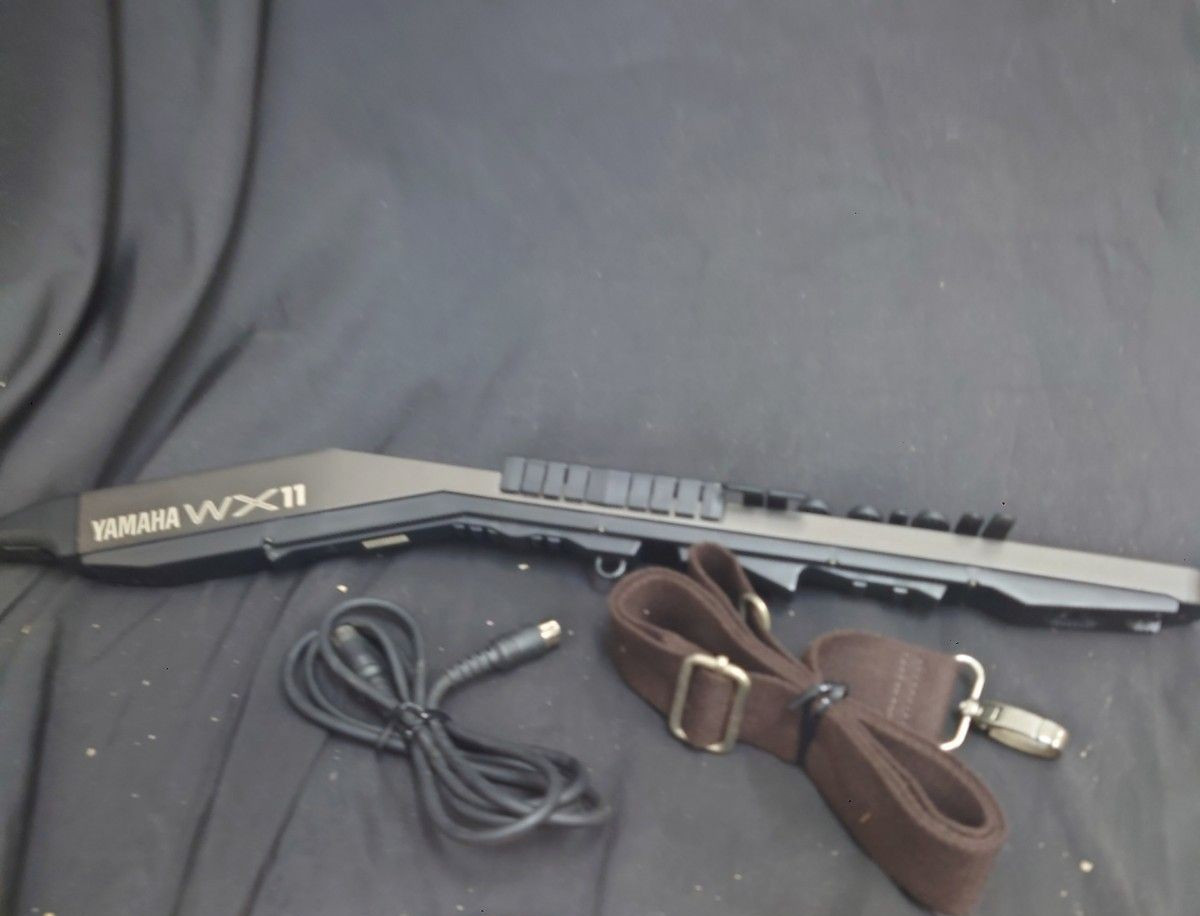
The WX11 controller on its own listed at $505. The WX11 paired with the WT11 tone generator ran $995. The tone module nearly doubled the cost, so Yamaha clearly saw the WT11 as a real part of the package and not an afterthought.
The WX11 transmitted a meaningful velocity value with each Note On, and some competitors didn't. That matters for patches like piano, bass, and percussion, where velocity sets the initial loudness. A wind controller that sends only breath control can shape sustained notes well but struggles with those. One letter-writer to Electronic Musician pointed out that the Yamaha wind controllers (the WX7 and WX11 both) send real velocity, which makes them more versatile for controlling non-windlike sounds. The same writer noted that the Akai EWI's failure to transmit meaningful velocity made it less useful for those patches.
The WX11 also offered a seven-octave range, a lot of pitch for an instrument you hold like a saxophone. Add the WT11's broader sound palette and a MIDI In port on the module, and the full setup was considerably more capable than a bare reed-triggered pitch-bend device.
eBay Listings


As an eBay Partner, we earn from qualifying purchases. This helps support our independent vintage technology research.
Reception & Real-World Use
The WX11 found its way into working players' rigs rather than staying a studio curiosity. Session saxophonist Tom Scott, writing in Recording Engineer (June 1989, p.45), described using a Yamaha WX7 in his touring rack alongside a TX81Z, TX802, SPX90, and MFC2 for large venues, but carrying a WX11 and WT11 tone generator for convenience — and he spoke about eventually making a record that featured the wind controller as a solo voice, to establish that sound in its own right. That's a useful window into how the instrument was actually deployed: the WX11 as the portable, grab-and-go option, the bigger rig for the stage.
The WX11 also turns up in unexpected places. A profile of John Barnes, the Aspen taxi driver who built a mobile recording studio into his cab, noted that when traffic stalled he'd pull out a Yamaha WX11 and WT11 to play sax and trumpet lines. It's an anecdote, but it captures something real about the instrument: it was small and self-contained enough to be genuinely portable in a way a keyboard rig never was.
For players pairing the controller with a synth, the aftermarket noticed. A small cottage industry of patch libraries and utilities sprang up around the WX11 — one vendor advertised 1,280 Yamaha four-operator patches on tape or disk covering the TX81Z, DX11, DX21, DX27, DX100, and WX11, and another offered a "Wind Tamer" box to convert controller #2 to #7, add 125 program changes, and eliminate the battery power pack. Those accessories are a decent signal of how committed the user base was.
Living With One
The WX11's appeal was always practical rather than glamorous. It was the cheaper way into Yamaha's wind controller ecosystem, and it did the core job — breath-driven MIDI with real velocity — without the flagship price. The trade-off was that the controller alone ($505) needed a sound source, and the natural partner was the WT11 module, which pushed the full setup to $995. Buyers today should think in those terms: a bare WX11 is a controller, not an instrument, and getting music out of it means having something for it to talk to.
The velocity behavior is the detail that separates a good experience from a frustrating one. Patches designed for wind control — the ones that modulate amplitude with breath control and ignore velocity — will feel natural immediately. Keyboard-oriented patches behave differently, and players coming from a saxophone background sometimes need to adjust their expectations there. The WX11 sends the velocity; whether a given patch uses it well is another matter.
Collectors and players chasing a WX11 should expect to hunt for the WT11 module separately if they want the complete original package, and should look at the aftermarket patch libraries as a genuine value-add rather than a curiosity — the community support around this controller was real, and it's part of what keeps the instrument usable decades on. The battery power pack is worth checking on any example, given that third-party solutions existed specifically to eliminate it.