Yamaha SK15 (1981)
A 61-key "Symphonic Ensemble" that stacks organ, strings, and a programmable polysynth in one analog slab — and the middle child of Yamaha's SK series that most players never think to look for.
Overview
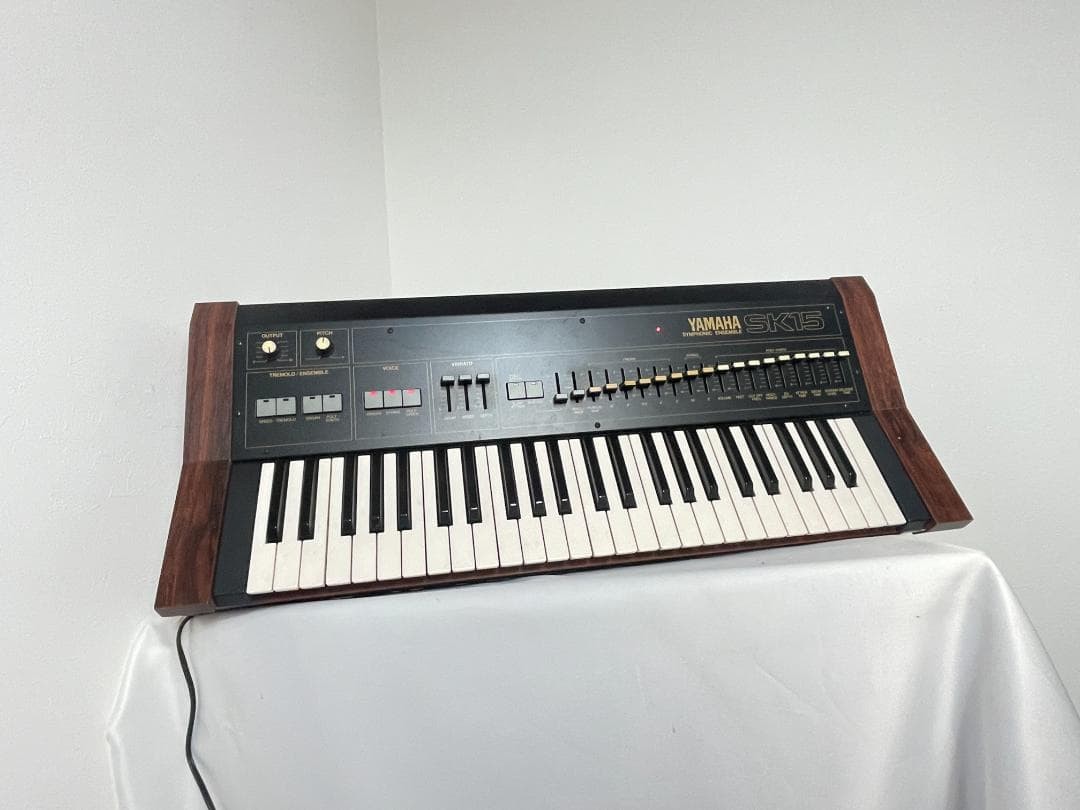
The SK15 is an analog keyboard, made in Japan, built around a 61-key keybed and three distinct voice sections: organ, strings, and a programmable polysynth. Yamaha sold it under the "Symphonic Ensemble" name, and that phrasing is the clearest description of what the instrument is trying to do — layer ensemble-style voices, use them independently, or stack them together for something bigger than any one section alone.
The organ section carries seven stops, which gives the SK15 more tonal shaping on the organ side than a bare "organ voice" would suggest. The polysynth section is programmable, which is the single most important distinction between this model and the SK10 it sits beside in the SK family. The strings section is the third leg of the tripod, and it's where the "ensemble" character comes from — the SK15 was clearly aimed at players who wanted lush, layered keyboard textures in one box rather than a rack of separate instruments.
The year of release is genuinely murky. The most commonly cited figure is 1981, and that's the date the archive uses as the working number, but 1979 also appears in sources and at least one listing describes the SK15 as a 1970s instrument. The conflict is unresolved in the available documentation, and anyone dating a specific unit should treat 1981 as an approximate anchor rather than a certainty. What's not in dispute is the basic shape of the thing: 61 keys, analog circuitry, three sections, Japanese build.
What the SK15 is not, at least according to the sources that describe it, is a full-blown programmable polysynth in the sense that a later generation of players would expect. The polysynth section is programmable, but the documentation available here doesn't specify oscillator count, filter type, envelope architecture, polyphony, patch memory, or MIDI. Those are real gaps, and the honest read is that the SK15 was a performance instrument designed around its three sections working together, not a deep programming platform. Owners who buy one expecting a Jupiter or a Prophet are buying the wrong keyboard.
Key Features
Three Sections, One Keyboard
The SK15's identity is the combination of organ, strings, and poly-synth sections in a single chassis. Yamaha's own descriptive copy frames it as a keyboard that lets players "create warm, ensemble-like effects by using the voices independently or together" — meaning the three sections can be played alone or layered. That layering capability is the whole point. A player who wants a string pad with an organ bed underneath, or a polysynth line doubled by strings, can do it without reaching for a second keyboard.
Seven-Stop Organ Section
The organ section carries seven stops. That's a meaningful number for a combo-style organ section in a multi-voice keyboard — enough stops to shape the tone rather than just switch between a couple of presets. The available documentation doesn't break down which stops are present, so the specific voicing set isn't something the archive can describe in detail. What can be said is that seven stops puts the organ section in the territory of a usable, shapeable organ voice rather than a token add-on.
Programmable Polysynth Section
The polysynth section is described as programmable, which distinguishes the SK15 from the SK10 — the SK10 has a brass section in the slot where the SK15 has the polysynth. That's the key family distinction, and it's the reason a player choosing between the two models should care which one they're looking at. The SK15's polysynth is the more flexible of the two approaches on paper, but the documentation doesn't specify how deep the programming goes. No patch count, no parameter list, no memory spec. Treat "programmable" as a real feature and a vague one.
Slow Attack Assignable to Poly-Synth and Strings
One documented performance feature is a "slow attack" effect that can be assigned to the poly-synth and strings sections. This is the kind of control that matters for the SK15's intended use — a slow attack on strings is what turns a string voice into a swelling pad, and the ability to assign it to the polysynth as well extends that shaping to the programmable section. It's a small feature on paper and a big one in practice for anyone playing ensemble textures.
Brilliance Control Affecting Organ and Strings
A "BRILLIANCE" setting affects the organ and strings sections. This is a tone-shaping control rather than a full filter section, and its scope — organ and strings, not the polysynth — is worth noting because it tells you how Yamaha thought about the instrument. The organ and strings are the "ensemble" voices and share a brightness control; the polysynth is handled separately. Whether that's a limitation or a sensible division depends on how a player uses the instrument, but it's a real architectural choice and not an accident.
Historical Context
The SK15 belongs to Yamaha's SK series, a family of keyboards that, depending on the model, combined poly-synth, mono-synth, brass, and organ sections in various configurations. The SK15's specific place in that family is defined against the SK10: the two are described as similar, with the SK15 swapping the SK10's brass section for a programmable polysynth section. That's the clearest documented relationship between any two SK models in the available sources, and it's the one the archive can state with confidence.
The release year is the historical sticking point. 1981 is the figure that appears most often and the one used here, but 1979 shows up in other sources, and the discrepancy hasn't been resolved. The SK15 was sold in the UK market — period dealer listings from Electronics & Music Maker show the SK15 alongside the SK10, SK20, SK30, and SK50D, with the SK15 advertised at £459 in one dealer's price list and listed as "in stock" by another. Those listings place the SK15 firmly in the early-1980s UK keyboard market as a mid-priced ensemble instrument sitting between the smaller SK10 and the larger SK20/SK30 models.
What the SK15 represents historically is the moment before the market split decisively between dedicated polysynths and dedicated ensemble/string machines. It's a keyboard that tries to be both, and the "Symphonic Ensemble" name is an honest label for that ambition. Players who came up on later, more specialized instruments sometimes find the SK15's three-section layout confusing; players who used ensemble keyboards of the era find it obvious.
Collectibility & Value
Market data on the SK15 is thin and inconsistent. A for-sale listing has shown the instrument at £486.28 Buy It Now, and another listing priced a unit with case at 135,190₽. A retro-gear retailer listed one at $0 marked sold out — no meaningful price signal there. The honest summary is that the SK15 trades in the low-to-mid hundreds in pound sterling when it trades at all, and that the sample size is too small to call a market.
Condition reports from sellers are positive where they exist: one unit described as "fully functional and ready to go" and "recently used for live performance," another as "exceptional, near mint condition and in perfect working order." One unit was noted as coming with its original Yamaha case, manual, and voltage adapter — accessories that matter for a vintage analog keyboard and that buyers should specifically ask about. A mention of a "complete overhaul in May 2024" appears in a pin that also references the SK50D, so the archive can't attribute that overhaul to an SK15 with confidence.
There is no documented list of common failures for the SK15, which is a genuine gap rather than a clean bill of health. Buyers should assume the usual vintage analog concerns apply and inspect accordingly. The SK15 is described as "Vintage ... Rare" by at least one retailer, and the SK series as a whole has a following, but the SK15 specifically is not a household name among collectors. It's the kind of instrument that gets discovered by players who are already deep into Yamaha's analog era and are looking for something off the beaten path — a pawnshop find, in the words of one Sonicstate user who saw an SK15 "just come out on the floor" at a local shop.
The realistic advice for a buyer is to value the SK15 on its three-section layout and its playability rather than on any documented collector premium. There isn't one yet. That could change, but the archive won't pretend it already has.
eBay Listings
As an eBay Partner, we earn from qualifying purchases. This helps support our independent vintage technology research.