Yamaha DME64N
A rack-mounted DSP engine that Yamaha pitched as a "programmable black box" — and the phrase stuck because it was accurate.
Overview
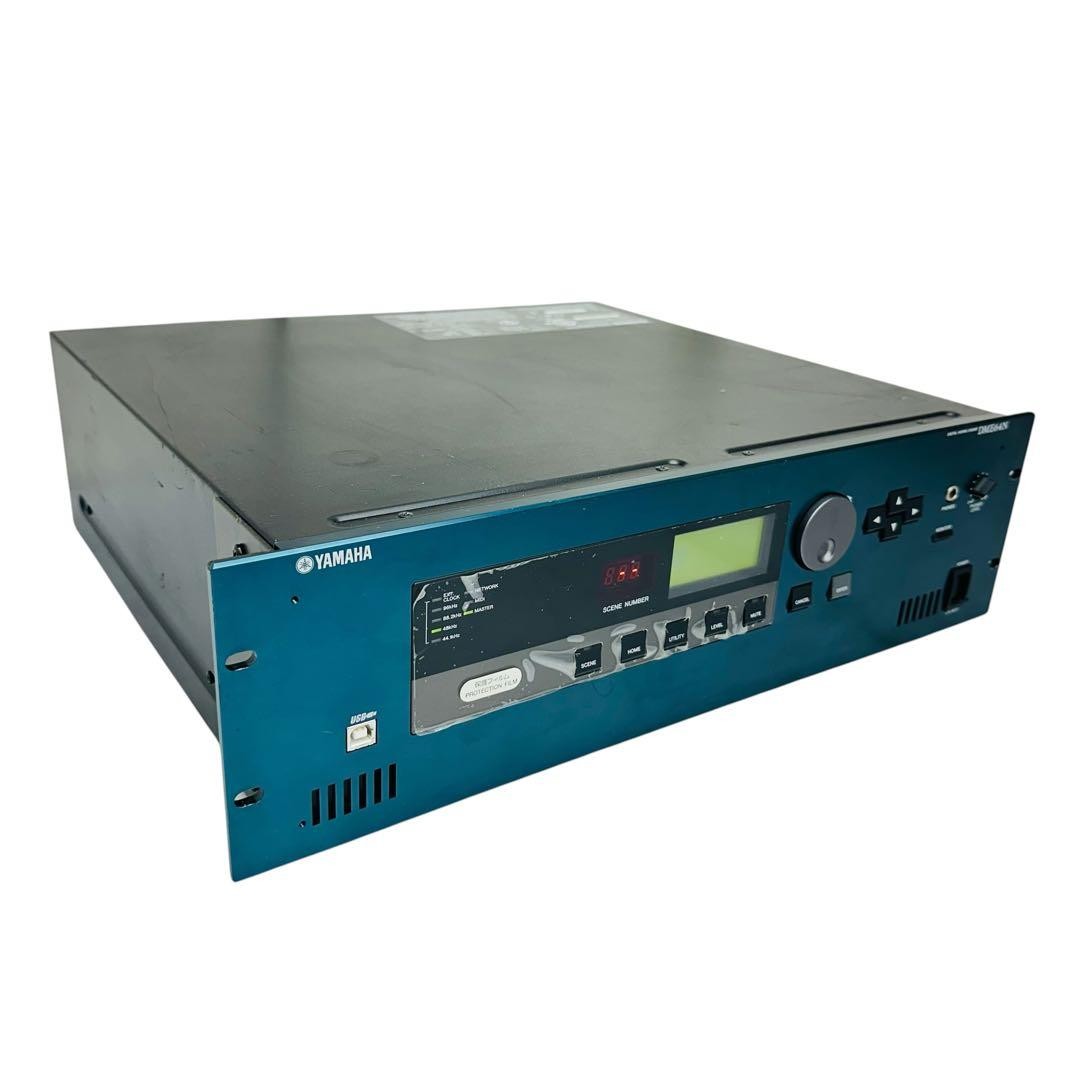
The DME64N is a digital mix engine, not a synthesizer, and the archive files it under the broader Yamaha commercial-audio umbrella for that reason. It belongs to a small family Yamaha introduced around 2004: the DME24N and the DME64N, sold as 96kHz DSP processors that could be configured as crossover, EQ, and delay processors and driven from a console or over a network. The distinction between the two is straightforward — 24 channels of I/O in the DME24N, 64 channels of I/O in the DME64N.
That I/O figure is the whole point of the larger box. Sixty-four channels in a rack unit means the DME64N was built for installs where a system designer needed a pile of processing without a pile of outboard gear — the kind of room where crossovers, EQ, and delay all had to be set, recalled, and left alone. Yamaha's own advertising in Mix (April 2004, p.73) leaned on the numbers: up to 10 of the company's newest 96kHz DSP processors, four models of remote control panels, cascade ports, GPI, and Euroblock connectors. It is a spec sheet written for the integrator, not the bedroom producer.
The connectivity is the part collectors and install techs tend to remember. Control ran over Ethernet, CobraNet, USB, RS232/422, or MIDI — a genuinely broad spread for a 2004-era processor, and a reminder that this was designed to slot into whatever control infrastructure a venue already had. The same Mix advertisement (May 2004, p.63) noted that new software allowed direct control of crossovers, EQ, and delays from the PM5D digital mixing console, which is the heart of the pitch: the DME64N was meant to be an extension of a Yamaha console system rather than a standalone island.
What the DME64N was not, at least in the marketing, was a fixed-function box. Yamaha's copy described it as "the power of Yamaha digital technology harnessed into the world of programmable black boxes," with an "intricate network of DSP" and "robust intuitive software." That is advertising language, and it should be read as such — but the underlying claim, that the unit is programmable and network-integrated rather than a hardwired crossover, is consistent across the period material.
Third-party support confirms the DME64N's place in the ecosystem rather than isolating it. Waves built the WSG-Y16 I/O card for Yamaha consoles, and its compatibility list — PM5D, DSP5D, M7CL, LS9, DM2000, DM1000, 02R96, 01V96, DME64N, DME24N — names the DME64N alongside the company's digital mixers. The card brought SoundGrid processing, letting 16 channels of audio run Waves reverbs, EQs, compressors, limiters, and delays from the host console. It is a small but telling detail: the DME64N was common enough in Yamaha installations that a plug-in vendor bothered to certify it.
The unit also turns up in Yamaha's own product literature as a Dante-network endpoint. Period coverage of the Rio Ri8-D and Ro8-D I/O racks — 1U Dante units introduced later — lists the DME64N among the compatible Yamaha products that could use those racks, alongside the CL Series, M7CL, and LS9 consoles and NEXO NXAmps. That places the DME64N in the chain of Yamaha's networked-audio evolution, still supported as a processing node years after its introduction.
For the collector, the DME64N is an odd duck. It is a pro-install processor, not a hi-fi component, and its value depends heavily on whether the buyer has a Yamaha console or a networked system to plug it into. The controls are software-driven, the I/O is Euroblock and network rather than RCA, and the whole point of the thing is integration. A unit sitting on a shelf with no console and no configuration software is a heavy rack box with a lot of unused potential. Buyers should expect to need the control software and a working understanding of the network options — Ethernet, CobraNet, USB, RS232/422, MIDI — to get anything out of it.
There is no verified production-run data, original list price, or weight and dimensions in the available documentation, so those numbers are left out rather than guessed. What is documented is the concept: 64 channels of I/O, up to 10 96kHz DSP processors, a wide spread of control protocols, and a place in Yamaha's commercial-audio ecosystem confirmed by both the company's own advertising and third-party hardware support. For an install engineer of the mid-2000s, that was a serious programmable processor. For a modern collector, it is a piece of Yamaha's networked-audio history that only makes sense in context.
eBay Listings
As an eBay Partner, we earn from qualifying purchases. This helps support our independent vintage technology research.