Sequential Circuits Prophet VS (1986–1987)
The Prophet VS fused digital wavetable oscillators with analog warmth and a joystick-driven soul, offering real-time sonic morphing like no synth before it.
Overview
The Sequential Circuits Prophet VS wasn’t just another synthesizer dropped into the mid-’80s digital deluge—it was a statement. Released in 1986, it arrived at a pivotal moment when analog warmth was being traded for digital precision, and musicians were beginning to miss the soul in their machines. The VS answered that longing with a hybrid heart: digital wavetable oscillators feeding lush, Curtis-manufactured analog filters. This wasn’t just a compromise between worlds; it was a deliberate fusion, designed to give players the best of both. With only two years of production before Sequential Circuits collapsed in 1987, the Prophet VS became one of the final—and most innovative—synths from a legendary American brand.
Used by artists like Depeche Mode, Tears for Fears, and Vince Clarke, the Prophet VS carved its niche in the soundscapes of ’80s pop, new wave, and ambient music. Its most iconic feature—the joystick for real-time vector synthesis—allowed players to dynamically morph between four different sound sources with a flick of the wrist. Imagine starting with a glassy pad in the northwest quadrant, then sweeping southeast into a gritty bass growl, all while holding a single chord. This wasn’t just modulation; it was performance. The Prophet VS turned sound design into a physical act, making it one of the most expressive synths of its era. It was also one of the first widely available vector synths, predating the more famous Korg Wavestation by four years, and laid the conceptual groundwork for dynamic, motion-based synthesis.
Specifications
| Specification | Value |
|---|---|
| Oscillator Types | Digital wavetable with 4-cycle waveforms |
| Available Waveforms | Sine, Sawtooth, Square, Pulse, Noise, User-loadable |
| Filter Type | Analog 4-pole resonant low-pass, 2-pole high-pass |
| Filter Cutoff Range | 10 Hz - 20 kHz |
| Filter Resonance | Up to 18 dB |
| Envelope Generators | 4 x ADSR (Amplitude, Filter, Pitch, Modulation) |
| LFO Count | 2 |
| LFO Waveforms | Sine, Triangle, Square, Sawtooth, Sample & Hold |
| LFO Destinations | Pitch, Filter, Amplitude, Vector X/Y |
| Keyboard | 61 keys, velocity and aftertouch sensitive |
| Polyphony | 8 voices |
| Multitimbrality | 2 parts |
| Memory | 64 user patches, 64 factory patches (ROM) |
| Vector Control | Joystick for real-time X/Y morphing between 4 sound sources |
| Effects | None (external processing required) |
| Audio Outputs | 1 x 1/4" balanced, 1 x 1/4" unbalanced |
| Audio Inputs | 1 x 1/4" external audio input (for filter processing) |
| MIDI | In, Out, Thru |
| Dimensions | 38.5" x 13.25" x 4.25" (97.8 x 33.7 x 10.8 cm) |
| Weight | 38 lbs (17.2 kg) |
| Power Requirement | 100-120 VAC, 60 Hz, 80 watts |
Key Features
- Vector Synthesis with Joystick Control: The Prophet VS’s centerpiece was its joystick, allowing real-time morphing between four sound sources arranged in a virtual X/Y plane. Move the stick northeast? You’re blending sources 1 and 2. Pull it southwest? Sources 3 and 4 take over. This wasn’t just a gimmick—it transformed static pads into evolving soundscapes, and live performers loved it for its immediacy.
- Hybrid Architecture: Unlike fully digital synths of the era (like the Yamaha DX7), the VS used digital wavetable oscillators but routed them through genuine analog filters—specifically, Curtis CEM3372 chips, the same ones found in the Sequential Circuits Prophet-5. This gave it a warmth and depth that pure digital synths couldn’t match.
- External Audio Input: A rare and powerful feature: you could route external signals (like a drum machine or another synth) through the Prophet VS’s analog filter section. This turned it into a high-quality analog processor, perfect for adding grit or sweep to digital sources.
- Velocity and Aftertouch Sensitivity: With a responsive 61-key keyboard, the VS rewarded expressive playing. Aftertouch could be assigned to control filter sweeps, LFO depth, or vector position—imagine holding a chord and twisting the sound with pressure alone.
- User-Loadable Waveforms: While it shipped with a solid set of factory waveforms (sine, saw, square, etc.), the VS allowed users to load custom 4-cycle waveforms via cassette or optional cartridge. This opened the door to truly unique timbres, though few ever explored it fully due to the era’s technical limitations.
Historical Context
The Prophet VS emerged in 1986, a time when the synthesizer market was in flux. The analog golden age—led by the Sequential Circuits Prophet-5 and Roland Jupiter-8—was fading, overtaken by the FM synthesis of the Yamaha DX7. Digital was in, analog was out, and companies scrambled to adapt. Sequential Circuits, already struggling financially, bet on innovation. The Prophet VS was their answer: not a full analog throwback, nor a cold digital machine, but a hybrid that bridged the gap.
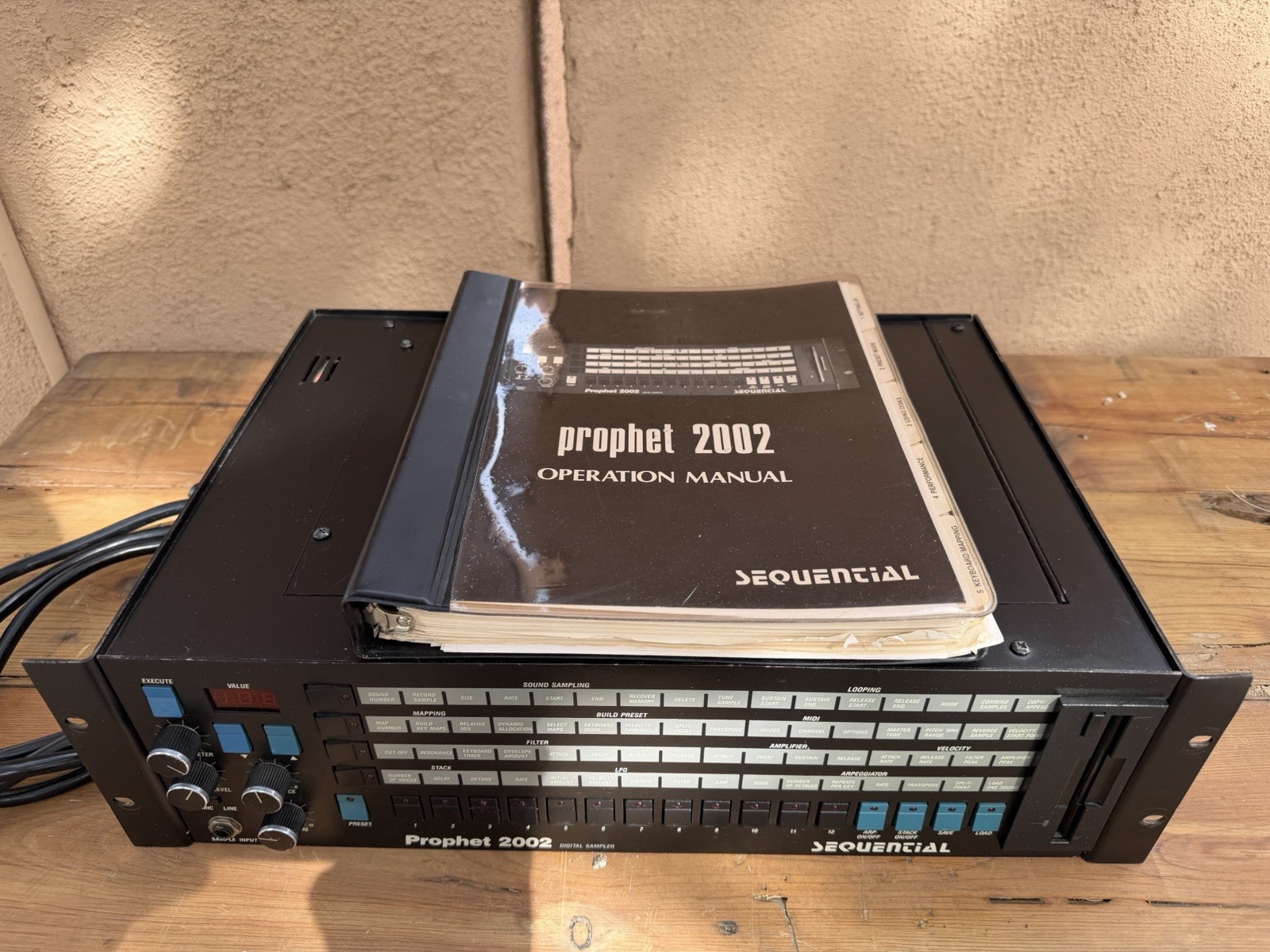
It followed the Sequential Circuits Prophet 2000, a sampler released the year before, showing the company’s pivot toward digital sound generation. But the VS was smarter—it didn’t abandon analog; it weaponized it. By keeping the filter and envelope stages analog, it preserved the musicality that made Sequential’s earlier synths legendary. The vector synthesis concept wasn’t entirely new (it was pioneered by the Yamaha GS1 and more famously used in the Sequential Circuits Prophet-5’s sibling, the Prophet T8), but the VS made it accessible and intuitive.
Tragically, it was also one of the last synths Sequential Circuits would ever make. The company filed for bankruptcy in 1987, just a year after the VS launched. Its legacy, however, lived on. The Korg Wavestation, released in 1990, took the vector concept and ran with it, adding wave sequencing and deeper modulation. But the Wavestation lacked the VS’s analog filter—proof that Sequential had struck a rare balance. The Prophet VS was a swan song: ambitious, flawed, and unforgettable.
Collectibility & Value
Today, the Prophet VS is a prized rarity. With only around 1,000 units reportedly produced during its short two-year run, finding one in working condition is a coup. Its current market value ranges from $3,000 to $5,000 USD (2025), depending on condition, mods, and included accessories. Fully serviced units with replaced capacitors and recalibrated joysticks command the higher end, especially if they include the rare optional cartridge interface or original documentation.
But ownership comes with caveats. The Prophet VS is notorious for two issues: capacitor leakage on the voice cards and joystick potentiometer wear. Over time, leaking capacitors can damage the voice board traces, leading to dead voices or unstable tuning. The joystick, while iconic, uses potentiometers that degrade with use, causing control drift or erratic vector behavior. A well-maintained VS should have had its voice card caps replaced and joystick pots cleaned or upgraded—many owners now install modern sealed pots or even optical replacements to avoid future issues.
If you’re hunting for one, prioritize units that have been serviced. Listen for consistent voice tracking across the keyboard, test aftertouch and velocity response, and verify that the vector joystick moves smoothly without jumps or dropouts. Also, check the external audio input—patch in a signal and sweep the filter to ensure the analog path is alive. Despite its quirks, the Prophet VS remains a deeply musical instrument. It’s not just a relic—it’s a living, breathing piece of synthesis history that still sounds like nothing else.
eBay Listings


As an eBay Partner, we earn from qualifying purchases. This helps support our independent vintage technology research.
Service Manuals & Schematics
- Schematic — archive.org