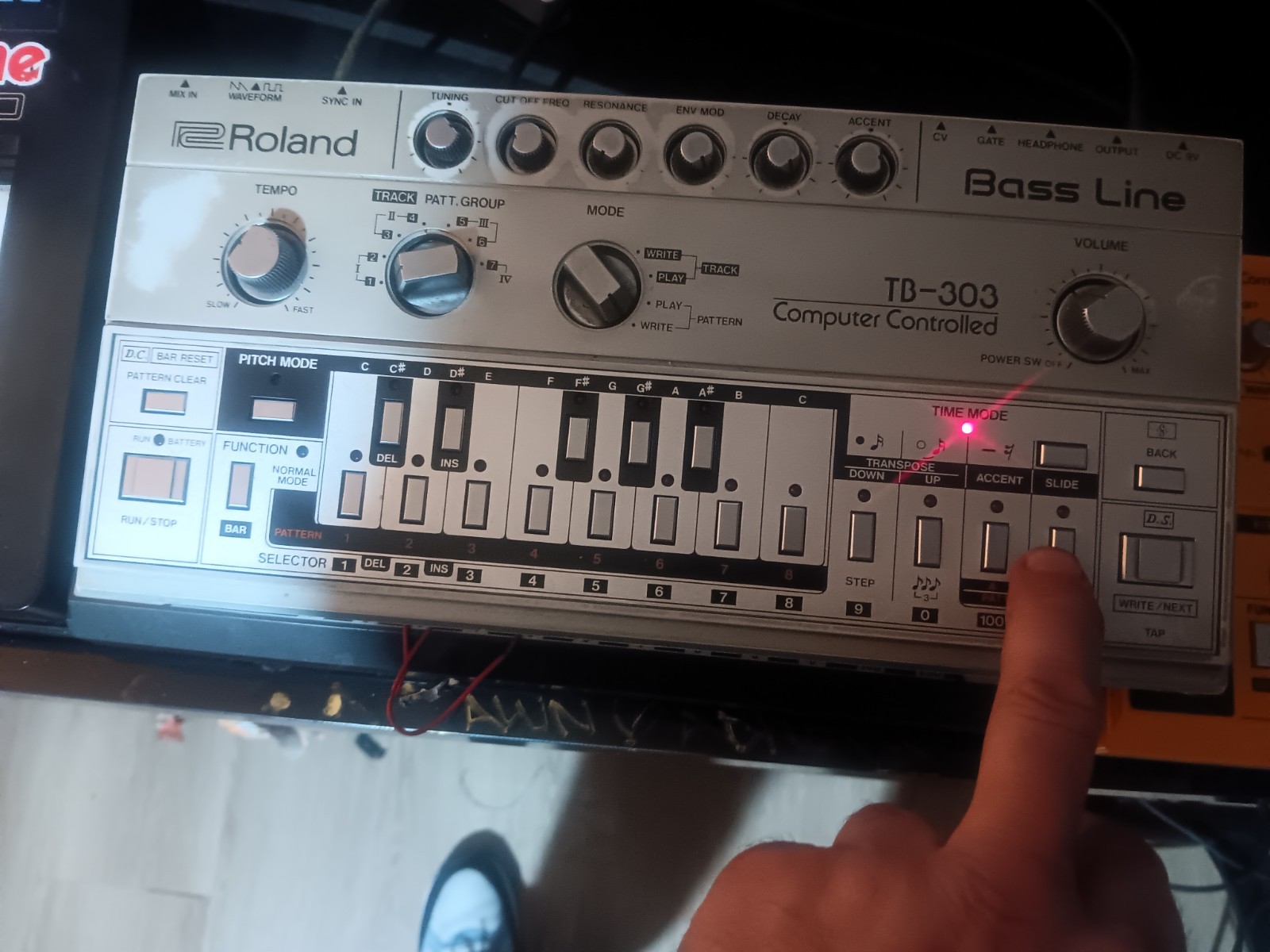
Roland TB-303 Bass Line
A little silver box that was supposed to teach guitarists bass lines and instead taught the world how to make acid.
Overview
The TB-303 Bass Line was a small desktop unit built as a companion for the TR-606 Drumatix. Roland announced both at a combined list price of $395 each in a period dealer advertisement. The idea was simple on paper. A musician who wanted to practice bass lines, or who wanted a compact bass accompaniment to run alongside the Drumatix, could program a sequence and let the 303 do the walking. What Roland shipped was a bass synthesizer with a built-in pattern sequencer - a very specific, very opinionated machine that did one job and did it in a way nobody quite expected.
The early reception was lukewarm at best. A 1984 dealer clearance listing still had the TB303 Bassline on the shelf alongside a Jupiter-6 and a Juno-106, plainly unsold. Collectors love to tell it as a commercial flop that sat in the corner of music shops until a generation of producers figured out what to do with it.
They did figure it out. By the mid-1990s, the 303 had become the go-to instrument for acid house and techno bass, and the used market had noticed. Sound on Sound (August 1996, p.82) reported that acquiring all three of Roland's "original tools of cool" - the TB303 Bassline alongside the TR808 and TR909 Rhythm Composers - would set a buyer back roughly £2,000, and noted that finding them at all was the harder problem. The same magazine, a few months earlier (May 1995, p.193), carried a classified for a 303 described as a "much sought-after acid sequencer, in perfect condition with power supply, owners manual and service notes." Listing a service manual and notes as selling points says plenty about who was buying.
The 303's sound comes from its step sequencer and its filter. It is not a synth you play so much as a synth you program, and the accidents that happen when you push a pattern slightly wrong are the sound the instrument is famous for. Sound on Sound (June 1995, p.203) noted that more than a decade after its introduction, the TB303 Bassline was still surprising people. It was discontinued long before its reputation caught up with it.
The 303 also became a reference point for later gear. Propellerhead's ReBirth software, reviewed in EQ Magazine, was built around two virtual TB-303s with pattern sequencers plus emulated 808 and 909 drum machines. A $6.99 iPhone app in the 2000s was designed to imitate the same signal path.
eBay Listings



As an eBay Partner, we earn from qualifying purchases. This helps support our independent vintage technology research.