Roland TR-606 (1981–1984): The Unlikely Heartbeat of Underground Electronics
A budget-priced, battery-corroded, analog underdog that became a cult icon in the birth of acid house and DIY techno.
The Roland TR-606 Drumatix wasn’t supposed to change music. Released in 1981 with a price tag of $495—modest even for the time—it was designed as a humble companion to the Roland MC-404 and later the Roland TB-303. Its mission? To give home musicians a programmable rhythm section that could sync via DIN sync, long before USB or MIDI ruled the studio. But like its green-synthesizer sibling the TB-303, the 606 was a commercial flop upon release, dismissed as cheesy, limited, and sonically thin compared to the punchy Roland TR-808. Yet within a decade, its brittle, lo-fi claps, sputtering cymbals, and hollow toms became the secret sauce in early Chicago house, Detroit techno, and Sheffield bleep. This wasn’t a drum machine for perfectionists—it was for tinkerers, squatters, and anyone who believed that character mattered more than fidelity.
What made the TR-606 special wasn’t what it did well, but how it failed beautifully. Its analog voice circuits—each dedicated to a single sound—were simple, even crude. The hand clap is a burst of white noise through a resonant filter, more like a wet towel snap than a stadium crowd. The cymbal is a chaotic burst of noise with no real decay control, prone to fizzling into digital silence. And yet, when looped at 110 BPM with a few flam accents and a wonky tempo wobble, it becomes hypnotic. Artists like Phuture, 808 State, and early Autechre didn’t just use the 606—they exploited its flaws. Its rigid 16-step sequencer, limited tuning range, and lack of velocity sensitivity forced rhythmic creativity. You couldn’t play around the grid; you had to embrace it. And once paired with the squelching TB-303, the 606 formed the backbone of the acid sound that defined a generation.
| Brand | Roland |
| Model | TR-606 |
| Category | drum_machines (Synthesizers) |
| Years Produced | 1981–1984 |
| Country of Manufacture | Japan |
| Original MSRP | $495 (1981) |
| Sound Generation | Analog synthesis |
| Drum Sounds | Bass Drum, Snare Drum, Low Tom, Mid Tom, Hi Tom, Rimshot, Hand Clap, Cymbal, Hi-Hat (Open and Closed) |
| Voices | 8 |
| Polyphony | 8 voices (one per sound) |
| Sequencer Tracks | 8 |
| Steps per Pattern | 32 |
| Patterns | 32 user-programmable |
| Rhythm Patterns | 16 built-in, 32 user-programmable |
| Tempo Range | 32–260 BPM |
| Inputs/Outputs | Audio Output (1/4" unbalanced), Trigger Out (for syncing external gear), Trigger In (for external sync), DC In (9V AC adapter) |
| Power Supply | 9V DC, 500 mA (external adapter) |
| Current Draw | 120 mA |
| Dimensions | 275 mm × 275 mm × 70 mm (10.8" × 10.8" × 2.8") |
| Weight | 2.3 kg (5.1 lbs) |
| Display | LED step indicators (16 red LEDs) |
| Control Interface | Push-button programming, tempo knob, slide potentiometers for tuning and decay |
- Analog Drum Synthesis with Gritty Character: Each of the 8 voices uses discrete analog circuits—no samples, no digital tricks. The bass drum is a tuned oscillator with a sharp attack; the snare blends noise and tone with a gritty decay. But it’s the limitations that define the sound: the cymbal and open hi-hat share a noise source, leading to a “choke” effect when triggered together—a quirk later exploited by producers for rhythmic tension.
- Programmable 16-Step Sequencer with Accent and Flam: Unlike preset-only drum boxes of the era (like the Korg KR-55), the TR-606 let you build custom patterns across 32 user slots. The 16 red LEDs provided visual feedback for each step, and the inclusion of accent and flam (a double-hit effect) added human-like swing—though the flam timing is fixed, giving it a mechanical stutter that became part of its charm.
- DIN Sync Integration: Long before MIDI (which didn’t exist in 1981), the 606 used Roland’s proprietary DIN sync to lock tempo with the MC-404 and TB-303. This made it a key component in early “groovebox” setups. Trigger In/Out jacks also allowed syncing with non-Roland gear, making it a bridge between analog worlds.
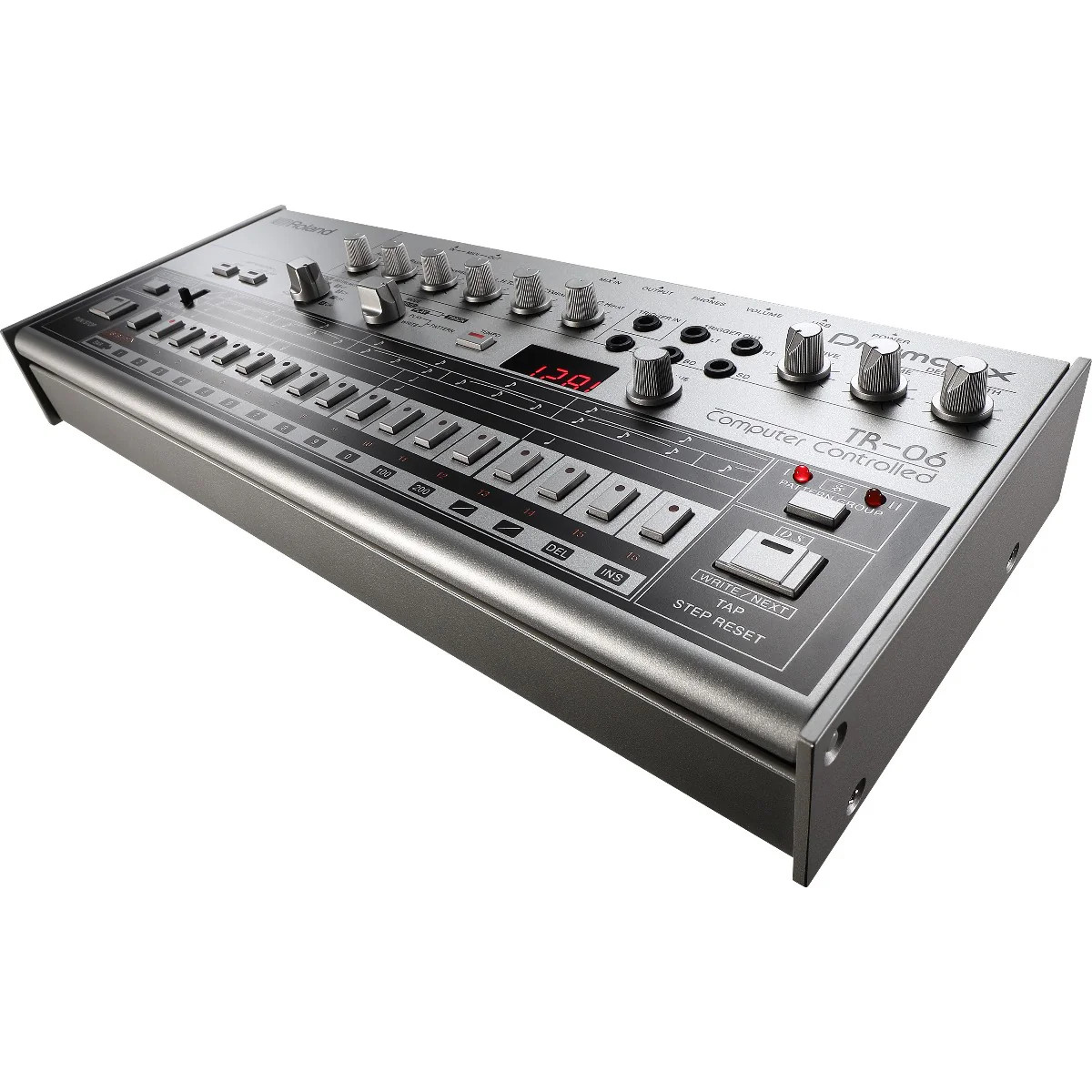
- Compact, Desktop Design: At just over 10 inches square and under 5.5 pounds, the TR-606 was built for portability. Its brushed metal faceplate and minimalist layout exude early-’80s Japanese industrial design—functional, no-nonsense, and oddly elegant in its simplicity.
The TR-606 didn’t emerge in a vacuum. It arrived during a pivotal shift: the move from preset rhythm boxes like the Roland CR-78—a machine beloved by Phil Collins and ABBA—to fully programmable, synth-based drum machines. The CR-78 offered lush, orchestrated rhythms but limited customization. The TR-808, released the same year, was Roland’s flagship: deep, punchy, and powerful, but expensive at $1,195. The 606 was the budget alternative—less polished, less powerful, but programmable and sync-capable. It was also part of Roland’s broader vision of modular home studios: the MC-404 sequencer would control the TB-303’s basslines, while the TR-606 laid down the beat, all locked in perfect time via DIN sync.
But the market wasn’t ready. Guitarists didn’t want drum machines. Studios preferred live kits. And the 606’s sounds were too thin for pop production. By 1984, it was discontinued, overshadowed by its more famous siblings. Yet in the underground, where gear was scavenged from thrift stores and repaired with duct tape, the 606 found its calling. Its lack of dynamic range and inconsistent timing became virtues in lo-fi electronic music. Unlike the TR-808, which was embraced by hip-hop and pop, the 606 remained a cult object—too quirky for mainstream, too raw for perfectionists, but perfect for those who wanted rhythm with soul, not polish.
Today, the TR-606 is a sought-after relic. With a current market value between $800 and $1,500 USD (2025), it’s not the most expensive Roland drum machine, but it’s far from cheap—especially for a unit in working condition. Its rarity is “uncommon,” not because few were made, but because so many were discarded, abused, or ruined by their own design. The internal 9V battery, used to preserve memory, is notorious for leaking and corroding the circuit board—a silent killer that has taken out countless units. Even if the battery was removed, the push-button switches are prone to failure after 40 years of use, often requiring full replacement or meticulous cleaning.
When buying a TR-606, look for signs of battery damage—green crust near the battery compartment is a red flag. Test every sound and step in the sequencer; dead voices or skipped steps often indicate failing switches or dried potentiometers. A unit with original knobs and a clean faceplate is ideal, but cosmetic wear is expected and even endearing. Some enthusiasts retrofit modern power supplies or replace the battery with a holder to prevent future damage. And while software emulations exist (Roland’s Cloud version is shockingly accurate), nothing replicates the jittery, imperfect soul of a real 606—especially when its tempo knob wobbles at 118 BPM and the hand clap sputters like a misfiring engine.
eBay Listings

As an eBay Partner, we earn from qualifying purchases. This helps support our independent vintage technology research.
Service Manuals & Schematics
- Service Manual (1982) — archive.org
- Manual — archive.org
- Service Manual — archive.org
- Service Manual — archive.org
Related Models
- Roland TR-808 (1980-1983)
- Roland TR-909 (1983-1985)
- Linn LinnDrum (1982-1985)
- Oberheim DMX (1981-1984)