Roland MKS-70 (1986)
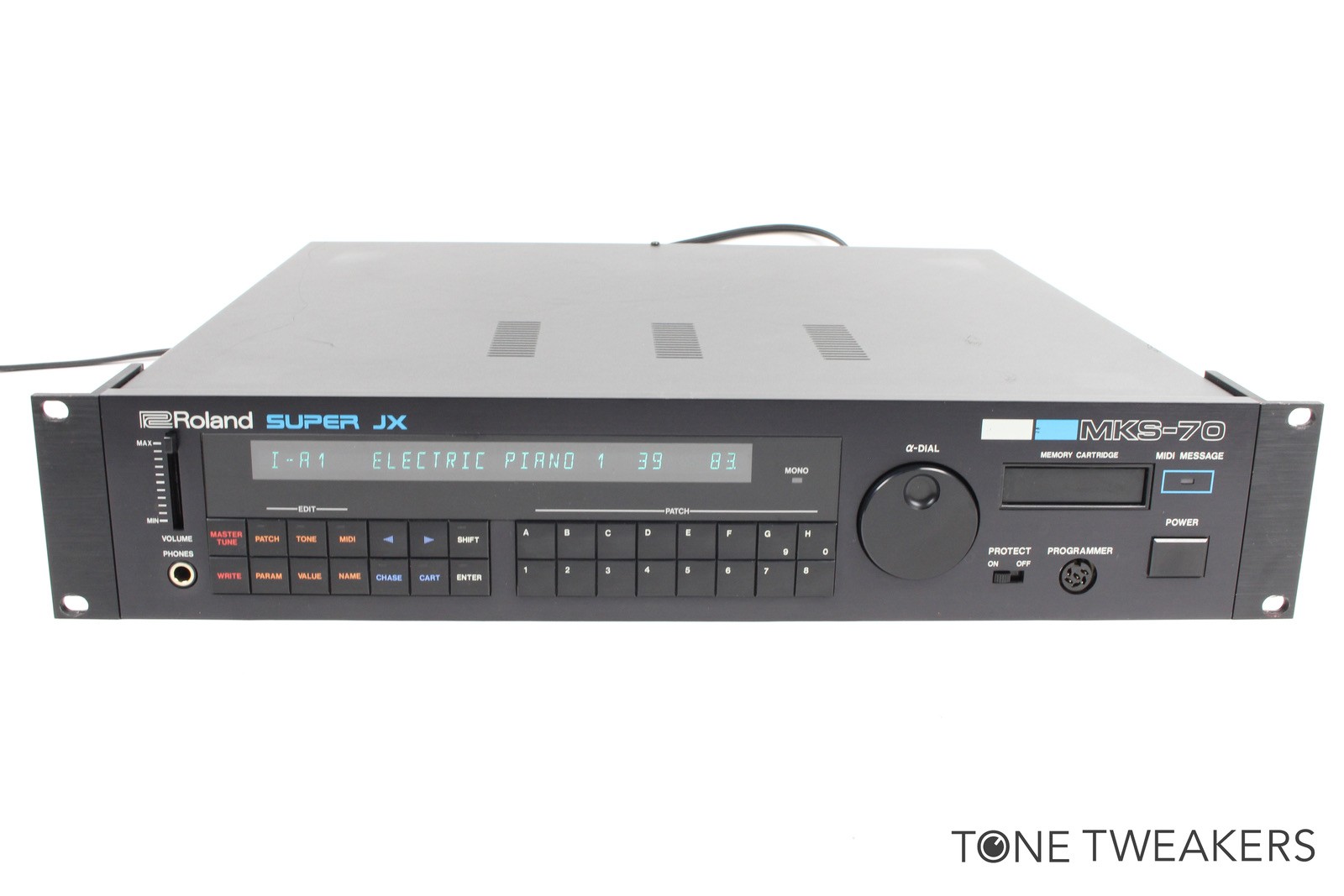
A 2U rack module that puts the Super JX-10 engine into a single rack space. Know your way around a service manual before you try to play a note.
Overview
Two rack units. Six voices of analog circuitry per sound block, two blocks total, all in a chassis that sat quietly in a working composer's rack while the keyboards got the attention. The MKS-70 was released in 1986 as the rack-mounted form of Roland's Super JX-10. The company's own literature calls it the "Super JX" engine compressed into rack space. By the account of the sources that track this lineage, it was the last flame and masterpiece of Roland's analog synthesizers.
Here is what that means in practice. There are two sound blocks, each built around a DCO fine-tune circuit, which lets the module thicken a single patch into something wider than one voice should sound. A chase function lets one block shadow the other. The manual documents chase level, chase mode, and chase time as assignable parameters, with modes that step the second block behind the first in different rhythmic patterns. Sixty-four patches of memory. A 2U rack face. That is the whole pitch, and for a certain kind of owner it was enough.
The module's reputation is tied to the JX-10 keyboard it came from. The service documentation says the two share boards and firmware only under specific conditions. Replacement module boards carry part number 22923302 04 or above, and earlier revisions are JX-10-only because they lack the hinge mounting holes the MKS-70 needs. The ROMs differ between the two models, and also between the UPPER and LOWER modules inside a single MKS-70. This is not a machine for casual parts-swapping.
Key Features
Two Sound Blocks, Twelve Voices of Analog
The MKS-70 is built around a pair of independent sound blocks, each handling six voices. Roland's service documentation describes the voicing system as two PCBs, UPPER and LOWER modules, each running six one-chip VCF and VCA ICs (the IR3R05) alongside DCOs driven by programmable interval timers. The module can run two patches at once, split or layered, with the second block available for the chase function or for straight doubling. Owners who have spent time with the JX-10 will recognize the voicing right away. It is the same engine, unchanged, in a box with no keys.
DCO Fine-Tune Circuit
The DCO fine-tune circuit is what separates the Super JX generation from the cheaper DCO designs of the same era. Each oscillator can be detuned against its partner within a voice, and the fine-tune range is wide enough to take a single patch from a tight unison to a slow, chorused drift. The module also carries two channels of chorus circuitry, which is where much of the Super JX's width comes from. The fine-tune and the chorus work together, and pushing both is how the MKS-70 gets its size.
Chase Function
The chase function is the MKS-70's most distinctive performance feature, and the one that most clearly separates it from a straight JX-10 in a rack. It lets the second sound block echo the first, with adjustable chase level (0-127), chase time (1-127), and three chase modes: A-B, A-B-B-, and A-B-A-. It works as a built-in delay-and-repeat at the voice level rather than the audio level, so the chased notes are real notes with their own envelopes, not a tape echo smeared over the top. The manual treats it as a serious compositional tool. It is also the feature most likely to be overlooked by an owner who patches the module into a rig and never opens the parameter list.
Sixty-Four Patches and the PG-800
The MKS-70 stores 64 patches internally. Programming from the front panel is possible but tedious. The module was designed to be edited with the Roland PG-800 programmer, which is compatible with the JX-8P, JX-10, JX-3P, MKS-30, and MKS-70. The Dtronics DT-800 is a modern alternative, marketed as a programmer for the JX-8, JX-10, and MKS-70. Without a programmer, the MKS-70 is a preset machine with a few editable parameters. Memory cartridges in the Roland M-64C family are referenced in MKS-70 context, though the clearest compatibility lists for that cartridge name the JX-10 rather than the MKS-70 directly.
Historical Context
The MKS-70 arrived in 1986, near the end of Roland's run of analog polysynths and just as the industry's attention was shifting toward digital. Sources describe it as the last flame and masterpiece of that analog era, and as a flagship model. That is an odd label for a rack module, until you remember that the Super JX engine was the flagship and the MKS-70 was that engine in its most compact form.
Its use is documented in rigs of the late 1980s and early 1990s. Hans Zimmer's setup, as documented in EQ (January 1992, p.14), included a Roland MKS-70 alongside three Super Jupiters, an MKS-20, a D-550, and a System 700. That is a working film composer's toolkit rather than a collector's shelf.
Used-market columns of the late 1990s show where it sat in the Roland rack hierarchy. Sound on Sound (September 1998, p.219) listed a D-550 with PG-1000 at £450 and a JD-800 at £699 in the same period, which puts the MKS-70 above the D-550 and below the JD-800 in the informal ranking those prices imply. The MKS-series itself - MKS-30, MKS-50, MKS-70, MKS-80, MKS-100 - was Roland's rack line through the mid-to-late 1980s, and the MKS-70 sat near the top of it.
Collectibility & Value
Current market listings place the MKS-70 from around $1,250. Treat that as a starting point rather than a settled price. The value depends heavily on whether the sound blocks are working and whether the ROMs are the correct revision for the model. Equipboard documents 24 professional artists using the MKS-70 and lists two user reviews, a modest footprint for a rack module of its age.
The service documentation is thorough, but it assumes a comfort with board-level repair that most modern owners do not have. Start with the test modes. Test mode 1 is entered by holding the WRITE button while powering on. It isolates the assigner board from the module CPUs and lets a technician determine whether a hang-up at startup is a display board fault, an assigner board fault, or a module board fault. The manual's diagnostic table maps specific display states to specific suspect boards, which is useful. It also means a non-working MKS-70 is a diagnostic project, not a simple repair.
The advice that circulates among owners is to buy one with a known-good module board, or budget for entering test mode 1 before you ever hear a note. The module boards are the critical part. Replacement boards must be revision 22923302 04 or later to be usable in the MKS-70, and the ROMs are not interchangeable between models or between the UPPER and LOWER modules within a single unit. A seller who cannot confirm the board revision cannot confirm the module will work.
A working example delivers the Super JX sound in the smallest possible footprint, with the chase function for composing and the PG-800 or DT-800 for the full parameter set. It is not a beginner's synth and it is not a casual purchase.
eBay Listings


As an eBay Partner, we earn from qualifying purchases. This helps support our independent vintage technology research.