Roland G-707
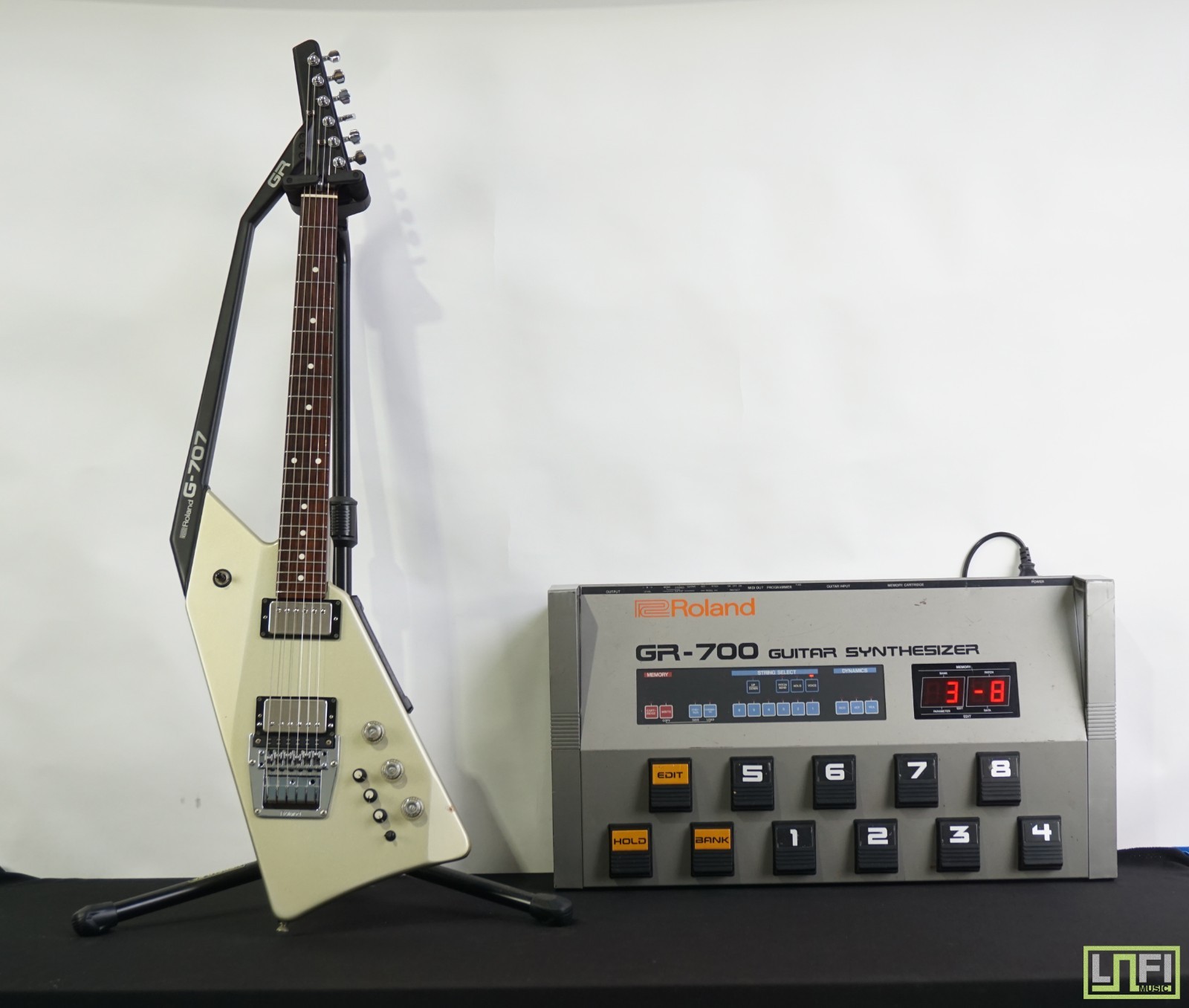
A guitar controller with a trimmer bay, a rolling tailpiece, and a humbucking pickup paired to a divided hex pickup. It is the physical half of Roland's GR-700 system.
Overview
The G-707 is a guitar controller. It is not a synthesizer on its own, just the playing surface that feeds Roland's GR-700 guitar synth. It carries two pickups: a divided pickup (part 22385610) and a humbucking pickup (part 22383612). The divided pickup does the actual work of driving the synth. The neck, the bridge, the tremolo and the trimmer bay all exist to keep that pickup reading the strings cleanly enough for pitch tracking to hold.
The setup procedure is unusually fussy for an electric guitar, and Roland's own manual treats it that way. String height at the neck is specified at 0.1-0.3 mm between the 8th fret top and the bottom of a string pressed at the 1st and 18th frets. At the bridge, the manual calls for 1.5 mm under the 1st string at the 14th fret and 2.0 mm under the 6th. The humbucking pickup sits 2.5 mm below the 1st string and 3.0 mm below the 6th, both measured with the string pressed at the 22nd fret. These are not suggestions. They are the tolerances within which the divided pickup can do its job.
The divided pickup has its own clearance requirement: at least three points of specified clearance above the pickup head, with a hard floor of 0.5 mm. If all points can't meet the spec at once, the manual says to prioritize the closest one and accept the shortfall elsewhere, because the pickup sensitivity trimmer adjustment can compensate later. It is an odd thing to find in a guitar manual - an admission that the mechanical ideal is not always reachable.
Sensitivity adjustment is the other ritual. It happens whenever the neck, fingerboard, bridge, or truss rod has been changed or adjusted, or whenever the sensitivity itself has been mis-set. The procedure requires removing the trimmer cap from the rear panel, centering the trimmers, setting the G-707 to MODE III, connecting it to a GR-700, selecting a preset with a fast attack and steady pitch, pressing DYNAMICS VCA, then giving the hardest pluck a player would use in normal playing and adjusting each trimmer for maximum volume while keeping the pitch firm. The final step is listening for the softest string and matching the others to it. It is not a set-and-forget calibration.
The tremolo arm has its own caution. Roland specifies that it must be adjusted with a full set of strings installed and tuned to playing pitch. The worm screw D is adjusted so the edge F of the rolling tailpiece sits flush with the top surface E of the base. Set that edge above the base, and the manual warns of string breakage during tremolo play if the arm is stroked excessively. The tremolo assembly itself is part 22563171, including the rolling tailpiece (22133323), a base (223533320), and the tremolo lever (2214340100).
Bridge saddle buzz gets its own remedy. If a saddle buzzes, the manual suggests preparing an alcohol-soluble adhesive of the type used for shake-proofing screws and nuts, thinning it to 50%, and applying a drop around the lower outside of the saddle with a toothpick to fill the void between bridge and saddle. Ten minutes of curing, and the buzz is gone. It is a workshop fix, not a factory one.
The parts list shows some of the production history. Screws B on the bridge are noted as "not found on early products," which is a small but useful marker for dating a G-707. The preamp board carries part number 7921702002 on a PCB marked 2291385303 for the standard instrument, and a separate preamp board (7922000000, PCB 22923152) for the left-handed version. Roland built a left-handed G-707, and it used a different preamp board, a different body (21223112), a different neck (21223113), a different stabilizer (22573190), and a different tremolo block assembly (22563178) with its own base, rolling tailpiece, and leaf spring.
The parts list also documents finish variants. The volume sheet came in two versions: 22663107 for the SILVER and RED finishes, and 22663109 for the BLACK finish. That is the only color information the manual gives, and it is enough to know the G-707 shipped in at least three finishes.
A 1989 Mix magazine studio listing for Syncro International Studio in San Anselmo, California, names the G-707 alongside a Roland GR-700 as part of a "state-of-the-art MIDI system" built around a Macintosh II+, a 20-megabyte hard disk, and a Korg KMT-60. That pairing, G-707 into GR-700, is the configuration the instrument was designed for, and the one the manual's sensitivity procedure assumes. A 1995 Sound on Sound classified section lists a Roland W30 sampling workstation among the gear being traded. The G-707 itself doesn't appear in that listing, but the surrounding gear includes D50s, MT-32s, JV-880s, and JV-1080s.
The G-707 is not a self-contained instrument. It has no synth engine, no MIDI out on its own, and no way to make a sound without a GR-700 or compatible Roland guitar synth on the other end of the cable. Buyers expecting a guitar that makes synth noises will be disappointed unless the GR-700 comes with it. The two are a system, and the manual treats them as such. The sensitivity calibration cannot be performed without a GR-700 connected.
The divided pickup is a wear item and a setup-sensitive one. The manual's insistence on re-calibrating after any neck, fingerboard, bridge, or truss rod work is not boilerplate. Change the relief, the action, or the bridge height, and the divided pickup's relationship to the strings changes with it. The trimmer bay on the rear panel is there because Roland knew owners would be back in it regularly.
The G-707 and GR-700 were Roland's attempt at the tracking latency that plagued earlier guitar synth systems. The G-707 is a dedicated controller with a hex pickup, a trimmer-based sensitivity calibration per string, and a tremolo system designed around the rolling tailpiece rather than a conventional fulcrum.
eBay Listings

As an eBay Partner, we earn from qualifying purchases. This helps support our independent vintage technology research.