2HP Loquelic Iteritas (2015–2022)
It doesn't hum, it mutters - like a circuit board learned to speak in growls, whispers, and digital stutters.
Overview
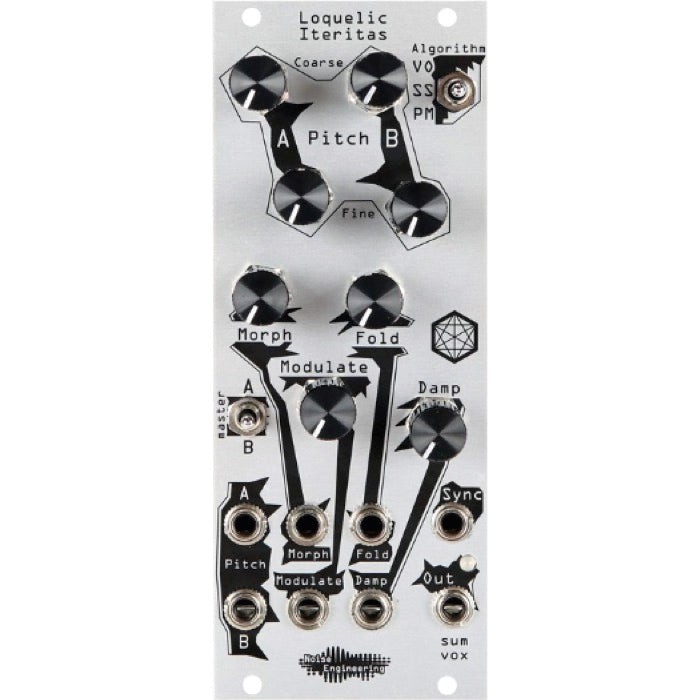
The 2HP Loquelic Iteritas is less tuned than interrogated. One moment it's a hollow wooden flute sighing through a cathedral of reverb, the next it's a chainsaw chewing through a telephone line. It's a 10HP module, and it isn't a traditional oscillator. It's a linguistic engine, built to generate textures with syntax, rhythm, and intent as well as waveforms. The name means "repetitive speech". Once it's patched, it's less about melody and more about phonemes and inflections, the way a sound can almost form a word before dissolving into noise.
The Loquelic Iteritas came out in 2015, during Noise Engineering's early golden run. Eurorack was still figuring out what digital could mean beyond clocking sequencers and mangling samples. Other makers chased analog warmth or granular clouds. Noise Engineering went sideways into algorithmic territory and revived synthesis methods most people had left in 1980s textbooks: VOSIM, summation synthesis, phase modulation. Many digital oscillators try to disappear into pristine waveforms. This one wants to be noticed, and its character borders on confrontational.
It fits into a system as a wildcard, not a workhorse. If the rack has a Doepfer A-110 or a Cwejman VCO, the Loquelic Iteritas won't blend in. It will challenge them. A clean sawtooth or a buttery sine takes some coaxing, and even then those tones feel like masks. Its sweet spot is the edge of collapse, where the algorithms glitch, fold, and stutter under CV pressure. Patch a slow LFO into the tone controls, modulate the pitch with a chaotic source, and you get a séance for dead telecom systems and forgotten mainframes.
For all its digital ferocity, it's very patchable. It has two pitch controls, four tone parameters, and three synthesis modes - VO, SS, PM - each with its own dialect. VO (VOSIM) gives throaty, vowel-like pulses, almost speech-like in their resonance. SS (summation synthesis) stacks harmonics in lumpy, organic clusters, like wind through reeds or the hum of a malfunctioning transformer. PM (phase modulation) is where it gets vicious: sharp, metallic zaps, FM-like explosions, and bell tones that sound like they were recorded inside a rusted oil drum. The sync input lets you hard-sync the two internal oscillators, which can tighten up wild patches or send them spiraling into even more chaotic territory.
It's not for everyone. If you want a stable, tracking oscillator to run filter sweeps or play classic basslines, look elsewhere. This module belongs in experimental patches and sound design, where you want the synth to feel alive, unpredictable, almost argumentative.
Specifications
| Manufacturer | Noise Engineering |
| Production Years | 2015–2022 |
| Original Price | $399 |
| Module Size | 10 HP |
| +12V Current Draw | 150 mA (80 mA if +5V is used) |
| -12V Current Draw | 5 mA |
| +5V Current Draw | 0 mA (90 mA if +5V is used) |
| Synthesis Types | VOSIM (VO), Summation Synthesis (SS), Phase Modulation (PM) |
| Oscillators | Dual digital oscillators with intermodulation |
| Controls | 2 pitch controls, 4 tone controls |
| CV Inputs | Pitch CV, Sync In, multiple CV inputs for tone and pitch parameters |
| Outputs | Sum output, individual oscillator outputs (on some firmware versions) |
| Sync Input | Hard sync for oscillators |
| Mode Selection | Three-position switch (VO, SS, PM) |
| Weight | Approx. 0.3 lbs (136 g) |
| Front Panel Options | Black, Silver, Limited Edition Pink |
| Power Connector | 10-pin Doepfer standard (includes +5V line) |
| Manual | Available online via Noise Engineering website |
Key Features
Three Algorithms, Three Personalities
The Loquelic Iteritas uses digital synthesis, and it gives you three distinct flavors of it. VOSIM (VO) was originally developed to simulate speech. Here it's repurposed into something far more abstract: pulses that swell like lungs, tones that mimic the wet click of a glottal stop. It's organic, but not warm. Summation Synthesis (SS) builds waveforms by adding sine waves at specific harmonics. Unlike additive synths that aim for purity, this implementation sounds rough, almost granular, like a dozen tuning forks struck at once and left to decay in a concrete room. Phase Modulation (PM) is the most aggressive of the three. It isn't full-on FM, but it gets into the same harmonic chaos, with metallic zings, glassy shrieks, and percussive attacks that slice through a mix like a scalpel. Switching modes is like changing the language the module speaks.
CV-Driven Mutation
What sets the Loquelic Iteritas apart from static digital oscillators is how much modulation it takes. Every tone control has CV input, and the two pitch parameters are equally patchable. This isn't a module you set and forget. It wants to be twisted, bent, and destabilized in real time. A slow random voltage into one of the tone inputs can turn a steady drone into a breathing, pulsing organism. Patch a sequencer into the pitch CV and the melodies change character, timbre, even perceived source, along with pitch. The sync input adds another layer. Hard-syncing the oscillators resets the phase, and it can also generate new harmonics, create rhythmic gating effects, or trigger sudden timbral shifts when modulated.
Sum Output Quirk
One design choice divides owners: the sum output. Unlike many dual-oscillator modules, the Loquelic Iteritas doesn't always expose individual oscillator outs on the front panel. In earlier firmware versions you only get the mixed output, so you can't easily filter or process the oscillators separately. Some users report getting at individual outs via internal jumpers or firmware updates, but out of the box you're often stuck with the blend. For many, this is a feature, not a bug. It forces you to treat the module as a single sound source rather than two components. If you're used to routing oscillators through different filters or effects, the lack of outs can feel limiting.
Historical Context
The Loquelic Iteritas landed in 2015, right as Eurorack was moving beyond boutique analog gear and into digital experimentation. Before this, digital oscillators in modular were either expensive (Pittsburgh's microSynth) or obscure (early Mutable Instruments modules). Noise Engineering, still a young company, saw an opening: what if digital wasn't about clean precision, but about controlled instability? The Iteritas series - Basimilus, Manis, Loquelic - became their manifesto. These weren't polite digital emulations. They were digital instruments with their own rules, their own flaws, their own voices.
At the time, modules like the MakeNoise Morphagene were pushing granular synthesis, and Mutable Instruments' Braids offered a buffet of digital tones. The Loquelic Iteritas stood apart by focusing on underused algorithms. VOSIM in particular was a deep cut - a 1970s Finnish speech synthesis method that most synth designers had forgotten. Noise Engineering revived it and paired it with summation and phase modulation. Competitors like the Cyclebox II or the Qu-Bit Electronix Pulsar were making waves with wavefolding and digital oscillators, but the Loquelic Iteritas felt more academic, more intentional.
It also arrived at a price within reach of serious hobbyists. $399 wasn't cheap for 10HP. Compared to the $600+ Basimilus Iteritas Alter, the Loquelic was the "entry point" into the Iteritas family, though "entry" is misleading. This wasn't a beginner module. It demanded engagement, experimentation, and patience.
Collectibility & Value
As of 2026, the Loquelic Iteritas is no longer in production. It was quietly discontinued around 2022 as Noise Engineering shifted focus to newer platforms and firmware ecosystems. That's given it a quiet collectibility - not the frenzy around a limited synth, but the steady respect of a module that punched above its weight. On the used market, prices range from $300 to $400 depending on condition and color. The standard black and silver models trade near the $325 mark in good condition. The rare pink "Case of Steel" benefit edition, released to support the Macaw Recovery Network, can fetch $450 or more from collectors who value both rarity and the philanthropic backstory.
Common failures are minimal. There's no mechanical wear - no pots that crackle with age, no jacks that loosen - and the digital core is stable. The biggest risk is power. The module can draw significant current from the +12V rail (150 mA), and if the case's power supply is already stressed, the Loquelic Iteritas might push it over the edge. Some users report issues when the +5V line isn't properly supplied, since the module can switch power modes and behave unpredictably. There are no known firmware-crippling bugs or widespread hardware defects. The most frequent "failure" is user error: people expecting stable tuning or classic waveforms and walking away disappointed.
When buying used, check the firmware version. Early units may benefit from updates that unlock additional features or stabilize CV response. Also verify that the mode switch clicks cleanly between VO, SS, and PM. Some users report switch wear after heavy use, though it's rare. The module ships without screws, so confirm whether the seller includes mounting hardware. Listen to demos if possible.
For owners, the real cost isn’t maintenance—it’s opportunity cost. That 10HP could hold a filter, a utility, a second oscillator. But if you’re building a system for texture, for sound design, for the kind of music that lives in the cracks between genres, the Loquelic Iteritas isn’t an indulgence. It’s a necessity.
eBay Listings


As an eBay Partner, we earn from qualifying purchases. This helps support our independent vintage technology research.