Rupert Neve Designs Portico
A modular range of half-rack analogue building blocks from the man whose name is on the transformers.
Overview
The Portico range is a set of all-analogue modular building blocks from Rupert Neve Designs. The modules can be used on their own or chained together to recreate the key elements found in large-format sound control consoles. That framing comes straight from the launch coverage: Mix (October 2006, p.109) described the Portico preamps and analogue signal processors as a range of building blocks drawn from the design bench of Mr. Rupert Neve. The philosophy, per that same piece, was sweet, musical performance with extremely low noise, high accuracy, and extended frequency response. That is the kind of language that gets thrown around loosely in press material, but here it tracks with what the modules actually do.
The line is modular in the most literal sense. Modules ship either as horizontally oriented desktop units with rubber feet or as vertically positioned modules for mounting in the 5285-RM rack frame, which can power and house up to eight Portico modules. Mix (December 2006, p.94) noted that converting a unit between the two orientations is a straightforward operation. Buy one module, rack it, add another when the budget allows.
The transformer ties the family together. Custom-designed transformers on inputs and outputs are standard across the range, and the literature credits them with the sweet musical response associated with Mr. Neve's classic modules. The modules are assembled in Texas.
Frequency response across the family is deliberately wide. The 5012 Mic Pre Duo is quoted at roughly 10Hz to 160kHz. That bandwidth has nothing to do with what humans hear. It keeps phase shift and high-frequency artifacts out of the audible band. That is the company making its case, not an independent verdict, but it explains why the modules are built the way they are.
That is a manufacturer telling you where the limits are.
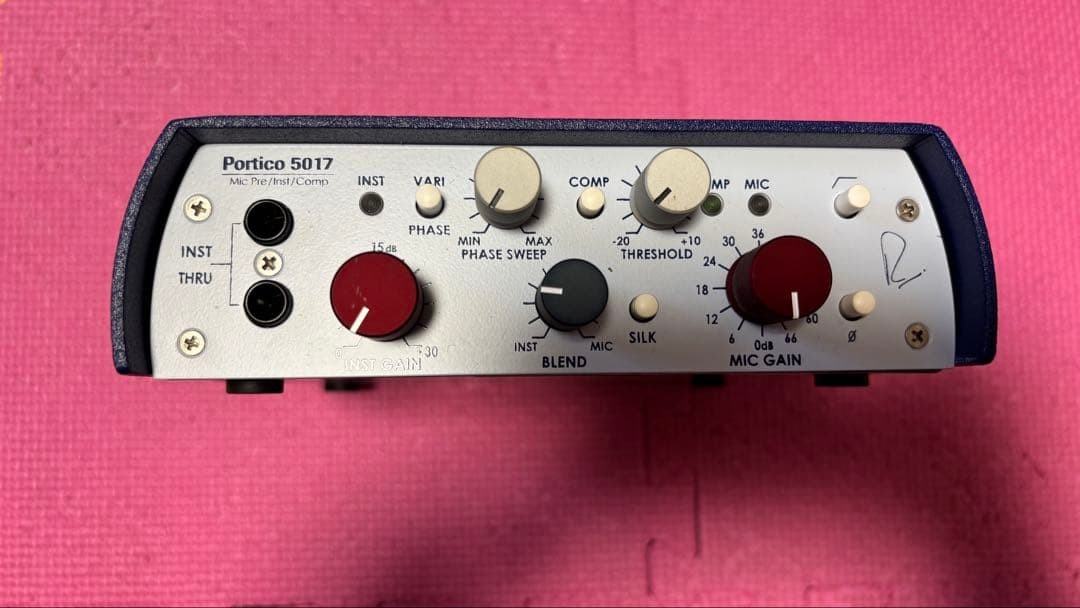
The range is broad. The 5012 Mic Pre Duo and 5032 Mic Pre/EQ are the entry points for tracking. The 5042 Tape FX and 5043 Compressor-Limiter cover processing. The 517 puts a preamp and compressor into the 500 Series format. The Portico II line extends the concept with a channel strip combining mic, line, and DI inputs, EQ, a VCA-based compressor, and output stage in a single-channel, two-rackspace unit. Mix (December 2010, p.54) noted the Portico II's sturdy steel case, thick aluminum front panel, LED-lit push-buttons, multicolor 16-LED gain reduction display, and output meters. It described the interior construction as excellent, with a toroidal output transformer and field-replaceable parts. That is a review, not a brochure.
EQ (May 2006, p.84) listed the 5012 at $1,795. That is real money for a half-rack preamp, and it puts the Portico range in the pro market rather than the project-studio impulse buy. The modules hold value reasonably well because the brand name means something and the transformers are not commodity parts.
For anyone buying today, the practical questions are orientation and racking. A desktop unit with rubber feet is fine on a shelf. A rack full of eight modules in a 5285-RM is a different proposition. Buyers should confirm which format a used unit is in and whether the rack frame is included, because that changes the value considerably.
eBay Listings
As an eBay Partner, we earn from qualifying purchases. This helps support our independent vintage technology research.