Korg M1REX
The M1 that working studios actually bought — and the one the magazine ads quietly assumed you already owned.
Overview
The M1REX occupies a strange spot in Korg's catalog: it shows up constantly in period studio inventories and dealer price lists, yet almost never as the subject of a review. What the surviving documentation makes clear is that it was treated as a working module, not a flagship. In a 1992 EQ Magazine roundup of resources for Korg workstations, the M1REX is listed right alongside the M1, M1R, and M1EX as a target for the same third-party sound sets — Sound Set #1 at $39, Sound Set #2 at $49, a 150-pattern drum set with instructional text at $69, and the "Sky" album package of sequences and tutorial material at $79 (EQ Magazine, October 1992, p.81). That's the tell. When an aftermarket developer bundles a module into the same SKU list as the base M1, it means the installed base was large enough to bother with — and that owners were hungry for more sounds than the factory shipped.
The same pattern repeats across the period press. EQ Magazine ran near-identical resource ads for the M1/M1R/M1EX/M1REX family in December 1992 (p.78) and again in February 1993 (p.110), which tells you the M1REX was still an active platform for third-party expansion well into the 01/W era. Sweetwater's dealer listings from the same stretch place the M1REX in a Korg lineup that runs 01/WFD, 01/RW, 01/WPro, 01/WProX, 03R/W, 01R/W, M1, M3R, Wavestation EX, and WSAD — the M1REX sitting in the middle of the older generation while the 01/W series took the top slots. That positioning is worth internalizing: the M1REX wasn't a halo product. It was the reliable mid-tier module a studio bought because the M1 sound was already on a thousand records and the engineers knew the patches.
What the M1REX actually added over the M1 is not documented in the sources available here, and that's a real gap. The name suggests an "EX"-style expansion (the M1EX appears in the same ads and resource lists), but the fact sheet supplies no specification — no polyphony, no wave memory, no filter architecture, no effects count, no price, no production years. Anyone claiming otherwise is working from memory, not from documentation.
Where the M1REX does show up with real specificity is in working-studio inventories. A 1993 EQ Magazine "Room With a VU" profile of Dog House Studio in Dry Branch, Georgia — owner Chuck Leavell, engineer Skoots Lyndon — lists the Korg 01W Pro as the room's main workstation, with the M1REX appearing in the broader Korg resource ecosystem the same magazine was advertising month after month. That's a genuinely useful piece of period context: EQ Magazine (June 1993, p.28) profiled Dog House Studio with the Korg 01W Pro as the room's main workstation, placing the M1REX in the broader Korg ecosystem the magazine was advertising month after month. Not a prestige pick, but a safe one.
That longevity is the real story of this module. Studios didn't retire it because it kept doing the job: piano, strings, bells, the whole M1 vocabulary that session players and arrangers reached for when they needed a sound that sat in a mix without fuss. The M1REX wasn't the synth anyone wrote a love letter to. It was the one that was always on, always loaded, and always hired.
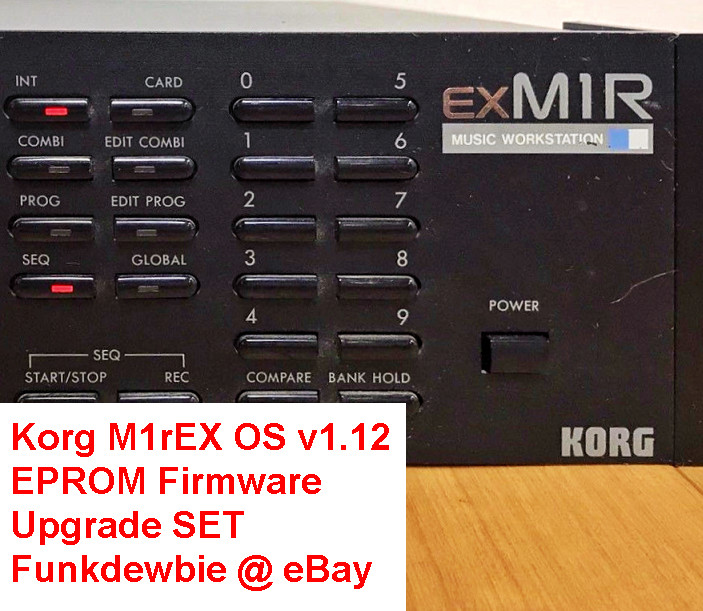
The period ads are the best evidence of what it was for: a module you fed Sound Set #1 and Sound Set #2 into, loaded drum patterns onto, and used to play back sequences from the "Sky" instructional package. Buy one expecting a working M1-family module with a specific place in a 1990s MIDI rig, not a collector's trophy. Verify the expansion state before purchase — the sources here don't document what shipped inside the box, and that's the single most important thing to confirm.
eBay Listings



As an eBay Partner, we earn from qualifying purchases. This helps support our independent vintage technology research.
Related Models
- Korg DSS-1 (1986)
- Korg 01/W ProX
- Korg 01/Wpro (1991)
- Korg 01R/W
- Korg 05R/W (1993)