Korg Wavestation (1990–1994): The Synth That Broke the Loop
While others played back samples, the Wavestation made them move—introducing wave sequencing to craft evolving, cinematic soundscapes that redefined what digital synths could do.
Overview
The Korg Wavestation wasn’t just another digital synthesizer in the crowded early-’90s market—it was a revelation. Released in 1990 at $1995, it arrived when most digital synths were still stuck in the "sample and hold" paradigm, layering static PCM waves into lush but unchanging pads. The Wavestation shattered that inertia with its revolutionary wave sequencing, a feature that allowed users to chain together up to 255 different PCM waveforms in a single oscillator, each with independent timing, crossfade, and looping parameters. This wasn’t just modulation—it was narrative synthesis, where sounds could evolve like film scores, shift like tides, or stutter like broken machinery. It was the first mainstream synth that could convincingly mimic the organic unpredictability of nature or the rhythmic complexity of sequenced electronic music without relying on external sequencers.
Used by composers like Michael Stearns (known for his work on Chronos) and adopted in film and TV scoring for its ability to generate atmospheric textures, the Wavestation became a secret weapon for anyone tired of the Roland D-50’s polished-but-predictable "LA synthesis." Its 16-voice polyphony and 8-part multitimbrality made it a capable workstation, but it was the real-time control—especially via the joystick-driven vector synthesis—that turned performances into live sonic sculptures. You didn’t just play the Wavestation; you conducted it. Whether morphing between four sound sources in real time or programming a wave sequence that cycled through a dozen drum hits with evolving filter sweeps, the Wavestation gave composers tools that felt more like a laboratory than a keyboard.
Specifications
| Synthesis Type | Sample-based subtractive with vector and wave sequencing |
| Polyphony | 16 voices |
| Multitimbrality | 8 parts |
| Oscillators | 2 per voice, with wave sequencing and cross-fading |
| Filters | 1 multi-mode digital filter per voice (low-pass, high-pass, band-pass, notch) |
| Envelopes | 4 envelope generators per voice (DADSR) |
| LFO | 2 LFOs per voice with multiple waveforms |
| Keyboard | 61 keys, velocity-sensitive, no aftertouch |
| Display | 2-line x 16-character LCD |
| Memory | 128 preset programs, 128 user programs, 128 preset performances, 128 user performances |
| Storage | RAM/ROM with cartridge expansion (optional AI-1 3.5\" floppy drive) |
| MIDI | In, Out, Thru |
| Audio Outputs | 2 x 1/4\" balanced (L/Mono, R) |
| Audio Inputs | 1 x 1/4\" unbalanced (for external processing) |
| Foot Controllers | 1 x 1/4\" for sustain, 1 x 1/4\" for expression |
| Dimensions | 985 mm x 365 mm x 110 mm |
| Weight | 14.5 kg |
| Power Supply | AC adapter (DC 12V, 1.5A) |
Key Features
- Wave Sequencing: The Wavestation’s crown jewel. Unlike simple sample playback, wave sequencing allowed each oscillator to play through a user-defined series of PCM waves—think of it as a musical slide show where each "slide" is a different waveform. You could set the duration of each step, add crossfades, reverse directions, or even trigger steps via MIDI. This made it possible to create rhythmic arpeggios, evolving pads, and percussive sequences entirely within a single patch. Try building a sequence that starts with a piano hit, morphs into a string swell, then disintegrates into granular noise—this was the Wavestation’s playground.
- Vector Synthesis: Borrowed from the Prophet VS but enhanced, the Wavestation let you assign up to four different sound sources (waveforms or programs) to the corners of a virtual X/Y plane. The joystick allowed real-time blending between them, creating smooth or abrupt transitions. But unlike the Prophet, the Wavestation let you automate the joystick path via envelopes or LFOs, making dynamic morphing a compositional tool, not just a performance gimmick.
- Dual Oscillators with Deep Modulation: Each voice featured two oscillators, both capable of wave sequencing independently. Combined with four DADSR envelopes (yes, delay included) and two multi-waveform LFOs, the modulation architecture was deeper than most synths of its era—rivaling the Korg M1 in flexibility but surpassing it in motion.
- External Audio Processing: That single 1/4" unbalanced input wasn’t an afterthought. You could route external signals—say, a guitar or drum machine—through the Wavestation’s filters, envelopes, and effects. Suddenly, your entire studio could be filtered and modulated by the Wavestation’s engine, turning it into a dynamic effects processor.
Historical Context
In 1990, digital synthesis was at a crossroads. The Roland D-50 had dominated the late ’80s with its bright, clean LA synthesis, combining sampled attacks with synthesized sustain. But by 1990, that sound was everywhere—from pop ballads to elevator music. The market was saturated with static, polished tones that lacked movement. The Wavestation didn’t just offer an alternative; it offered a philosophy. Where the D-50 was a photograph, the Wavestation was a time-lapse video. It emerged from Korg’s experimentation following the success of the Korg M1, but instead of iterating on workstation formulas, Korg’s engineers went rogue, focusing on dynamic sound design rather than preset accessibility.
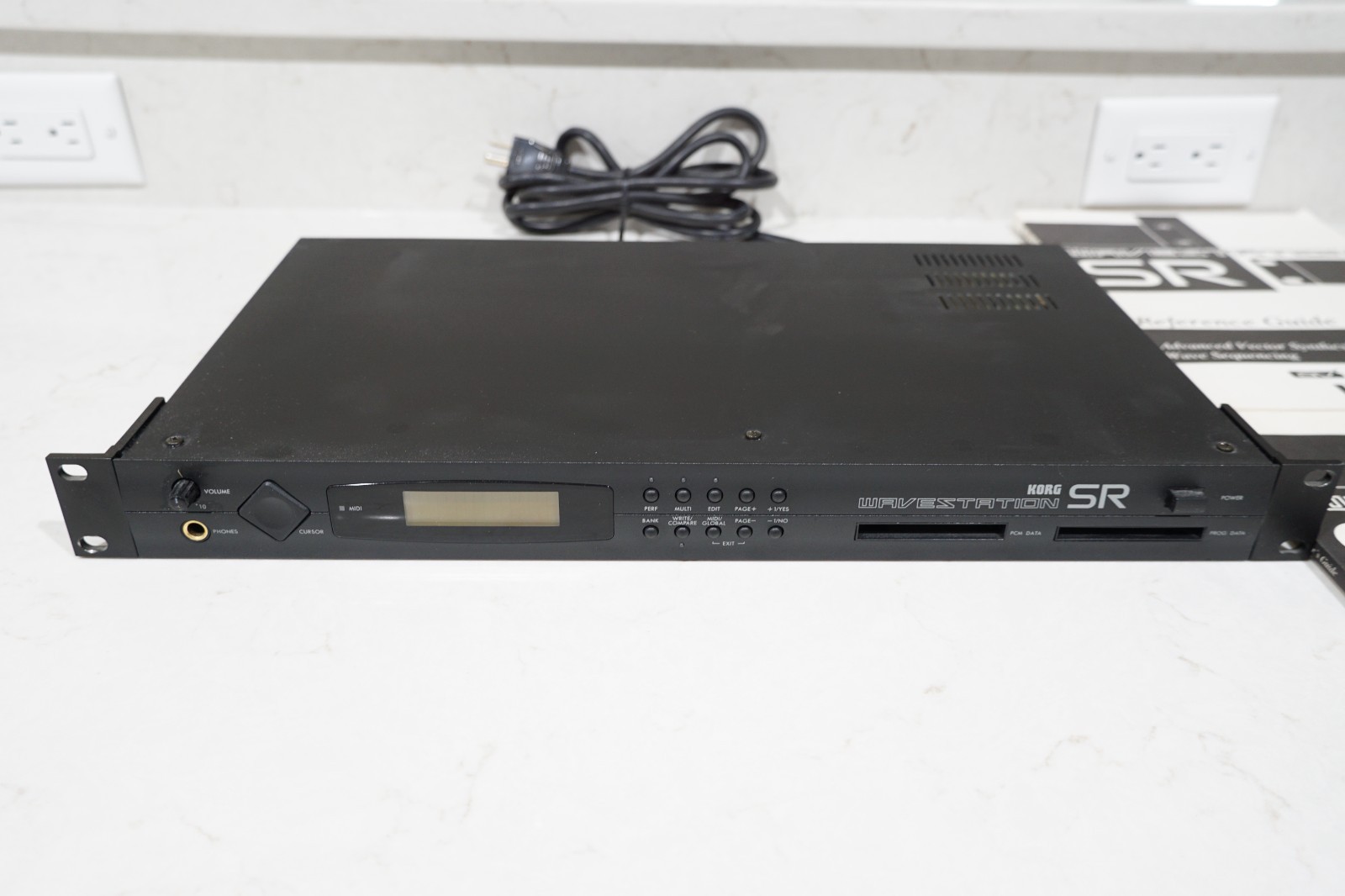
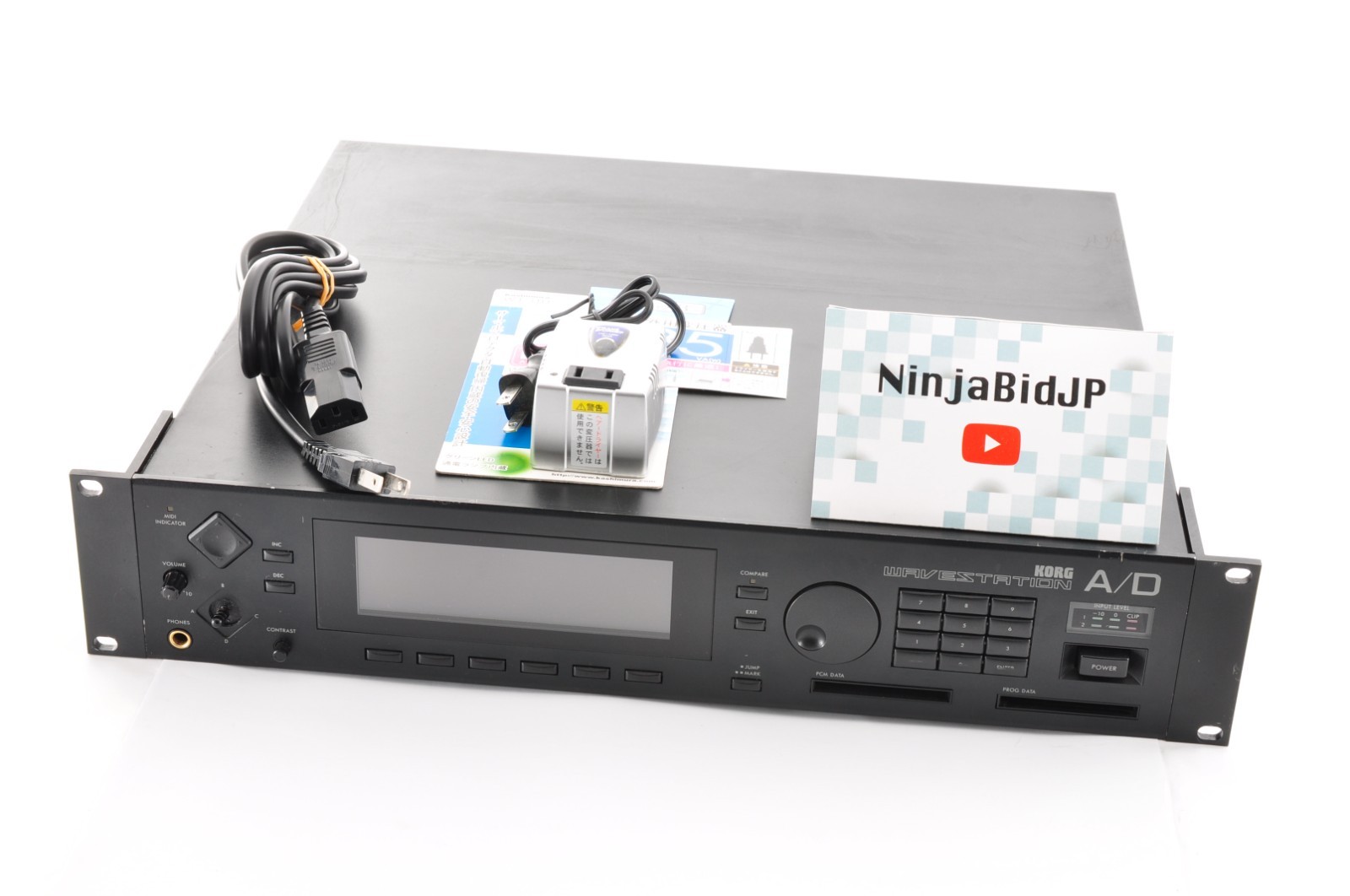
The Wavestation’s influence was subtle but profound. It didn’t top the charts like the M1, but it became a cult favorite among film composers, ambient artists, and electronic producers who needed sounds that unfolded over time. Its wave sequencing prefigured modern granular and spectral synthesis techniques, and its automation of vector mixing hinted at the modulation matrices found in later synths like the Nord Wave or Elektron boxes. When Korg released the Wavestation EX in 1991 with expanded wave sequences, and the Wavestation A/D in 1992 with sampling capabilities, they proved the concept had legs. Even the rackmount Wavestation SR (1992) found a home in studios where space mattered more than the joystick. By 1994, production ended, but the Wavestation’s DNA lived on—in software emulations, in Korg’s own Z1, and in the minds of anyone who heard its alien textures on a late-night sci-fi soundtrack.
Collectibility & Value
Today, the Korg Wavestation is uncommon but not rare—around 5,000 units were reportedly produced across all variants, and they’ve steadily appreciated in value. As of 2025, a working Wavestation typically sells for $800–$1500 USD, with mint-condition EX or A/D models commanding the higher end. The A/D is especially prized for its sampling input and enhanced editing, while the SR is favored by modular and rack-based users. But buying one requires caution: these are aging digital beasts. The most common issues include capacitor leakage, particularly near the power supply board, which can damage nearby components if ignored. The original electrolytic capacitors are now over 30 years old—recapping is often a necessary restoration step.
The LCD display is another weak point; many units suffer from fading, ghosting, or complete failure. Replacement screens are available but require careful soldering. The joystick, while iconic, wears out over time, leading to crackling or erratic vector control—some owners replace it with modern Hall-effect joysticks for smoother operation. When buying, prioritize units with responsive keys, clean audio outputs, and stable MIDI. Check for firmware updates (v1.12 is the final), and if possible, test the AI-1 floppy drive if present. Despite its quirks, the Wavestation remains a rewarding instrument—not just for its sounds, but for the sheer joy of programming something that feels alive. It’s not a nostalgia piece; it’s a still-relevant tool for sonic exploration.
eBay Listings


As an eBay Partner, we earn from qualifying purchases. This helps support our independent vintage technology research.
Service Manuals & Schematics
- Manual — archive.org
- Service Manual — archive.org
- Manual — archive.org
- Manual (1991) — archive.org
- Manual (1991) — archive.org
Related Models
- Yamaha DX7 (1983-1987)
- Access Virus A (1997-1999)
- Access Virus B (1999-2002)
- Access Virus C (2002-2004)
- Access Virus (1997-1999)
- Casio CZ-101 (1984-1988)
- Clavia Nord Lead (1995-2003)
- Ensoniq ESQ-1 (1986-1989)
- PPG Wave 2.2 (1982-1987)
- Roland D-50 (1987-1992)