Korg KARMA (2001)
A music workstation keyboard released in 2001. It pairs Triton-derived synthesis with algorithmic performance technology.
Overview
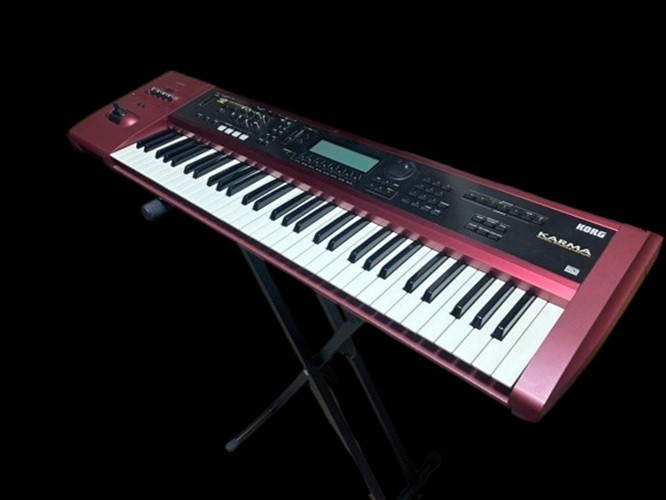
The Korg KARMA is a music workstation keyboard introduced in 2001. It is a specialized variant of the Korg Triton line and shares the Triton's synthesis engine, multi-effects and sequencing, but leaves out sampling. It is built around KARMA technology - Kay's Algorithmic Real-time Music Architecture - developed by Stephen Kay of Karma Lab LLC. KARMA generates musical phrases that respond to what the player does. The keyboard has 61 keys, and the real-time controllers are a joystick, four knobs and two switches. Korg designed it for both studio and live use.
Specifications
| Manufacturer | Korg |
| Model | KARMA |
| Type | Music workstation keyboard |
| Production years | 2001 |
| Number of Keys | 61 |
| Sound Generation | HI (Hyper Integrated) synthesis system |
| Sampling frequency | 48kHz |
| PCM ROM | 32 Mbyte |
| Sound data | 425 multisamples, 413 drum samples |
| Number of Voices | 62 (single mode), 31 (double mode) |
| Timbrality | 8 parts (Combi mode), 16 parts (Sequencer mode) |
| Effects | 5 insert, 2 master, EQ |
| Controllers | Joystick, 4 Control Knobs, 2 Switches |
| Original Price | £1,599 GBP |
Design
The KARMA workstation uses the HI (Hyper Integrated) synthesis system and carries KARMA technology - Kay's Algorithmic Real-time Music Architecture - developed by Stephen Kay of Karma Lab LLC. It is the non-sampling counterpart to the Korg Triton, aimed at real-time performance and generative music control.
Context
The Korg KARMA sits in the Korg Triton family. It has the same core synthesis, effects and sequencing, but swaps sampling for advanced algorithmic performance features. It debuted in 2001 and was aimed at composers and performers who wanted dynamic, interactive sound generation.
Market
Used units were discussed as fairly priced around $700 - $800 in 2007. Listings at $995 and $399.99 were observed. Karma Lab released a sound library in 2003 titled "SONIC VIAGRA!", which shows third-party support for the platform was still going.
eBay Listings



As an eBay Partner, we earn from qualifying purchases. This helps support our independent vintage technology research.