Korg EX-8000 (1986/1987)
A 2U rack box that carries the DW-8000's hybrid voice - digital waveforms, analog low-pass filter - for people who already had a keyboard they liked.
Overview
The EX-8000 is Korg's rack-mounted take on the DW-8000. If you already owned a keyboard controller you trusted, you didn't need to buy another one just to get at the DW-8000's sound. Korg built the module around the same Digital Waveform Generator System (DWGS) engine - digital oscillators feeding an analog resonant low-pass filter and VCA - and packed it into a 2U chassis sized for a studio rack. The unit has 8-voice polyphony, two digital oscillators per voice drawing on 16 built-in waveforms, and a 2-digit 7-segment display for program and parameter work. A period dealer ad for the module touted that it responds to MIDI velocity and channel pressure for full keyboard control, and listed "Key Window" and "A4" among its features. Korg was pitching it at players who wanted expressive control from a remote keyboard, not a set-and-forget tone generator.
Korg's own service documentation is unusually forthcoming about what the EX-8000 is under the hood. The manual describes diagnostic routines entered by holding number keys in the programmer section while powering up. Press 1 and 2 and the value display shows the system ROM version. The same routine sets a write-protect attribute, useful when a unit is on display in a shop. The service literature also warns that the product was thoroughly adjusted at the factory and that only the semi-fixed VRs called out in the servicing procedure should be touched. It also says test data loading overwrites whatever is in memory, so save patches to tape first. That tape interface is real: the rear panel has FROM TAPE and TO TAPE jacks with a HIGH/LOW switch, and the front panel has Save, Load, Verify, and Cancel buttons for it.
Collectors think of the EX-8000 as a sound source, not a showpiece. It lacks a keyboard, and it was never going to win a beauty contest against a keyboard synth. But the analog filter and VCA after the digital oscillators are what people are actually buying. The 12-bit digital delay covers short echoes and chorus-style thickening, and the expansion board slots give the unit somewhere to grow. The 2-digit 7-segment display is the honest limitation. You program this module through a small window and a set of number buttons, not a knob-per-function panel, and owners who want to edit deeply will want the manual and probably a MIDI editor.
Key Features
Digital Waveform Generator System with Two DCOs per Voice
The synthesis engine is Korg's DWGS, with two digital oscillators per voice reading from a bank of 16 waveforms that run from basic analog-style shapes to more complex digital forms. Digital oscillators give stable tuning and waveform variety, and the analog stage after them does the shaping. The service manual's parameter map shows the depth available: oscillator octave (16', 8', 4'), waveform selection, level, plus a second oscillator with interval choices including unison, minor third, major third, perfect fourth, and perfect fifth, and detune up to 25 cents. There's also an auto-bend section with selectable destination (off, OSC1, OSC2, both), up/down mode, time, and intensity.
Analog Resonant Low-Pass Filter and VCA
The filter is the reason the EX-8000 gets talked about at all. It's an analog resonant low-pass design, and the service documentation describes a VCF resonance check and adjustment procedure keyed to specific test programs, with per-voice trim pots (VR103 - VR803) to bring each voice's output into line and a stated tolerance of under 40mV peak-to-peak deviation between voices. The filter section exposes cutoff frequency, resonance, keyboard tracking (0, 1/4, 1/2, 1), envelope polarity, and envelope intensity, with a dedicated VCF envelope offering attack time, decay time, and breakpoint. A noise section with white noise and its own level adjustment feeds the filter as well.
Built-In 12-Bit Digital Delay
The on-board delay is a 12-bit digital design covering short echoes and chorus-type effects. The service manual's parameter table lists delay time, delay factor, delay feedback, delay frequency, delay intensity, and effect level. That's more than a token ambience chip. It's a programmable part of the patch.
Tape Interface and System Exclusive
Patch storage and transfer are handled two ways. The tape interface - Save, Load, Verify, Cancel, with HIGH/LOW input jacks and a TO TAPE output - is the period-correct method, and the manual is explicit that you should save your data before loading test data because the previous contents are erased. The MIDI side goes further. The service documentation lays out System Exclusive messages for single-program and all-program load and save between the EX-8000 and a DW-8000, plus bidirectional transfer with a computer, including loading and saving all 64 sound programs. A write request message includes a program number and a channel parameter, and the manual notes that messages with abnormal channel numbers are ignored when a format ID is received. Today, that SysEx implementation is the practical way to get patches in and out without a cassette deck.
2U Rack Chassis and Front-Panel Programming
The unit is a 2U rackmount, 430 mm wide by 412 mm high by 90 mm deep, and 8 kg. The front panel centers on a 2-digit 7-segment display, PROGRAM/PARAMETER switches, number select buttons, a WRITE switch, and a BANK HOLD switch, with write enable/disable and tape enable/disable switches to keep you from overwriting a patch by accident. The finish is black.
Historical Context
Korg released the EX-8000 in 1986 (some sources say 1987) as the rack version of the DW-8000, the company's first digitally-controlled analog hybrid synthesizer. Musicians who wanted the DW-8000's sound in a modular or space-efficient setup could get it without duplicating controls they already had on a master keyboard. It's part of Korg's 8000 series, and the family resemblance is close enough that the service manual treats data transfer between the EX-8000 and DW-8000 as a routine operation. Contemporary comparisons put it alongside Roland's MKS-70, another rack module aimed at players building a MIDI rig around a controller rather than a stack of keyboards.
Collectibility & Value
The EX-8000 retains interest among collectors of hybrid synths, and it has turned up in artist rigs over the years. Pricing is muddled by the usual mix of asking prices and reported sales. Recent user reports point to purchases around £250 for units in good condition, while listed prices have ranged from $599.00 to $699.99, and observed eBay listings have run $670, $700 for a tested unit, and as high as $900. Equipboard cites best prices from $699.99. Contemporary keyboard rigs of the early 1990s sometimes paired the EX-8000's lineage with workstation keyboards, as in a Georgia studio profile that singled out the Korg 01W Pro for its versatility (EQ Magazine, June 1993, p.28).
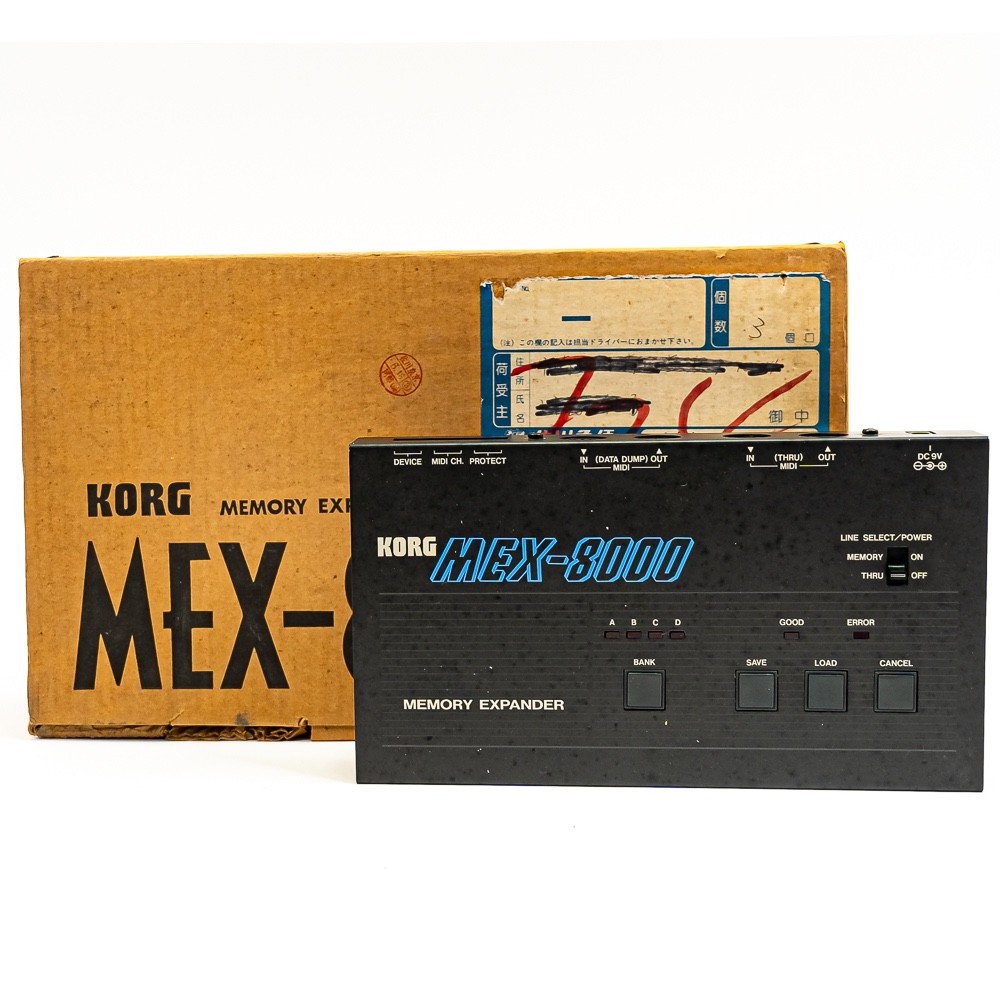
Treat all of that with caution. The market data comes from a single undated source in places, and asking prices are not sale prices. Parts-or-repair units do surface. The MEX-8000 memory expander (shared with the Poly-800 MkII) shows up separately around $325, but that's an accessory, not an EX-8000, so don't confuse the two when pricing a purchase. Some units have been found preloaded with custom patch sets, including a 64-patch bank credited to Espen Kraft.
eBay Listings


As an eBay Partner, we earn from qualifying purchases. This helps support our independent vintage technology research.
Related Models
- Korg 700 (1974-1978)
- Korg DS-8
- Korg DW-6000 (1985)
- Korg DW-8000 (1985–1987)
- Korg EX-800
- Akai Ax73 (1986)
- E-mu Vintage Keys
- E-mu Vintage Pro
- Gates Kurzweil K2000
- Gates Kurzweil K2500