Korg CX-3 (1979–2011)
A dual-generation clonewheel organ: analog in 1979, digital revival in 2000, both designed to emulate the Hammond B3 with portable practicality
Overview
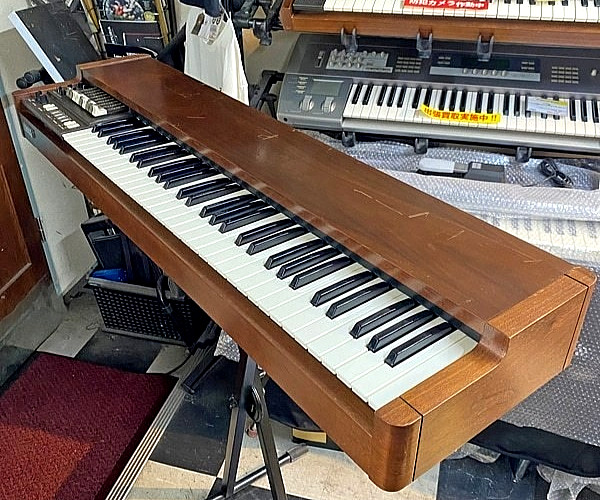
The Korg CX-3 spans two distinct eras. The original 1979 version is a single-manual analog synthesizer weighing about 35 pounds, built as a portable alternative to the heavy Hammond B3. It uses tonewheel simulation and the Siemens SM304 key encoder for keyboard scanning. Nearly two decades later, Korg revived the model in 2000 as a digital clonewheel organ, this time using DSP-based physical modeling to recreate the mechanical and tonal nuances of a tonewheel generator. The digital version features a 61-key velocity-sensitive keyboard, two sets of nine drawbars, and advanced Leslie simulation with adjustable rotor speeds, microphone placement, and Doppler modulation.
Specifications
| Number of Keys | 61 |
| Key Weight | Synth |
| Key Size | Full |
| Touch Sensitive | no |
| Aftertouch | no |
| Polyphony | 1 (monophonic) |
| Sound Generation | Tonewheel simulation |
| MIDI | no |
| AC Power | yes |
| Batteries | no |
| Audio Out | yes |
| Audio In | no |
| Sustain Pedal | no |
| Soft Pedal | no |
| Expression Pedal | no |
| Weight (analog) | approximately 35 pounds (16 kg) |
| Weight (digital) | approximately 37 pounds |
| Keyboard (digital) | velocity-sensitive with fast-scan mechanism |
| Drawbars (digital) | two sets of nine for upper and lower manuals |
| Drawbar pitches | 16', 5 1/3', 8', 4', 2 2/3', 2', 1 3/5', 1 1/3', 1' |
| Drawbar volume levels | 0–8 |
| Polyphony (digital) | full across keyboard |
| Percussion (digital) | adjustable decay, third harmonic options, multi-trigger behavior |
| Vibrato/Chorus (digital) | seven types (V1–V3, C1–C3) |
| EQ (digital) | three-band with overdrive |
| Reverb (digital) | room, hall, plate |
| Leslie simulator (digital) | adjustable rotor/horn speeds, acceleration, microphone distance/spread, Doppler modulation |
| EX mode (digital) | links all 18 drawbars, adds programmable percussion up to 24th harmonic, disables lower manual |
| Programs (digital) | 128 editable (64 standard, 64 EX mode) |
| Outputs (digital) | stereo outputs, headphone jack |
| Pedal inputs (digital) | expression and assignable controls |
| MIDI (digital) | transmits drawbar positions and effects via continuous controllers |
| Case (digital) | wooden with vintage styling |
Design
The 1979 analog CX-3 uses circuit-based synthesis to approximate tonewheel behavior and relies on the Siemens SM304 key encoder for efficient keyboard scanning. The 2000 digital version employs DSP-based physical modeling to simulate tonewheel generators, including leakage noise, key-on clicks, and overtone structures, with Korg’s REMS system handling effects. It uses an additive synthesis system with nine drawbars per manual to control harmonic overtones.
Context
In the late 1970s, musicians sought portable alternatives to the 400-pound Hammond B3, and while combo organs like Farfisa and Vox were lightweight, they lacked tonal depth. The 1979 CX-3 aimed for professional-grade Hammond fidelity in a stage-ready 35-pound package. The 2000 digital revival responded to ongoing demand for authentic clonewheel sound, leveraging modern DSP to surpass earlier analog attempts in nuance and playability.
eBay Listings


As an eBay Partner, we earn from qualifying purchases. This helps support our independent vintage technology research.