Ensoniq ESQ-1 (1986–1989): The Underrated Digital Powerhouse That Packed a Sequencer, Synth, and Soul Into One 6-Voice Beast
Born from sampler DNA and priced to move, the ESQ-1 brought professional-grade wavetable synthesis and an 8-track sequencer to the mid-’80s musician’s living room—for under $900.
Overview
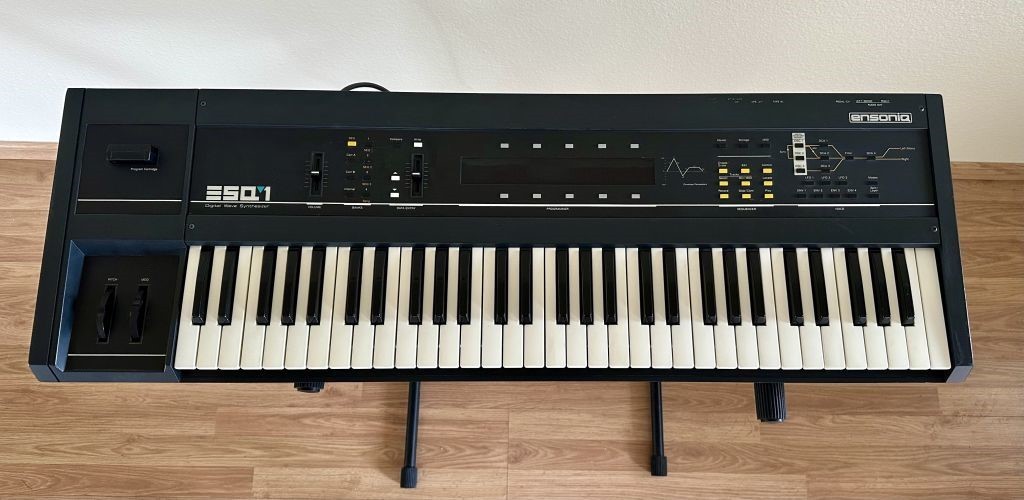
The Ensoniq ESQ-1 wasn’t just another digital synth in the crowded mid-1980s marketplace—it was a statement. At a time when Yamaha’s DX7 ruled with cold FM precision and Roland’s D-50 hadn’t yet arrived to soften the digital edge, Ensoniq carved its own niche with warm, evolving textures and an interface that didn’t require a PhD in synthesis. Released in 1986, the ESQ-1 leveraged the same wavetable engine as the Ensoniq Mirage sampler, repurposing its digital oscillators into a powerful, expressive synthesizer. But unlike the Mirage, the ESQ-1 was built from the ground up as a performance and composition tool—complete with a full 61-key keyboard, velocity and aftertouch sensitivity, and a built-in 8-track sequencer that could record entire songs without external gear.
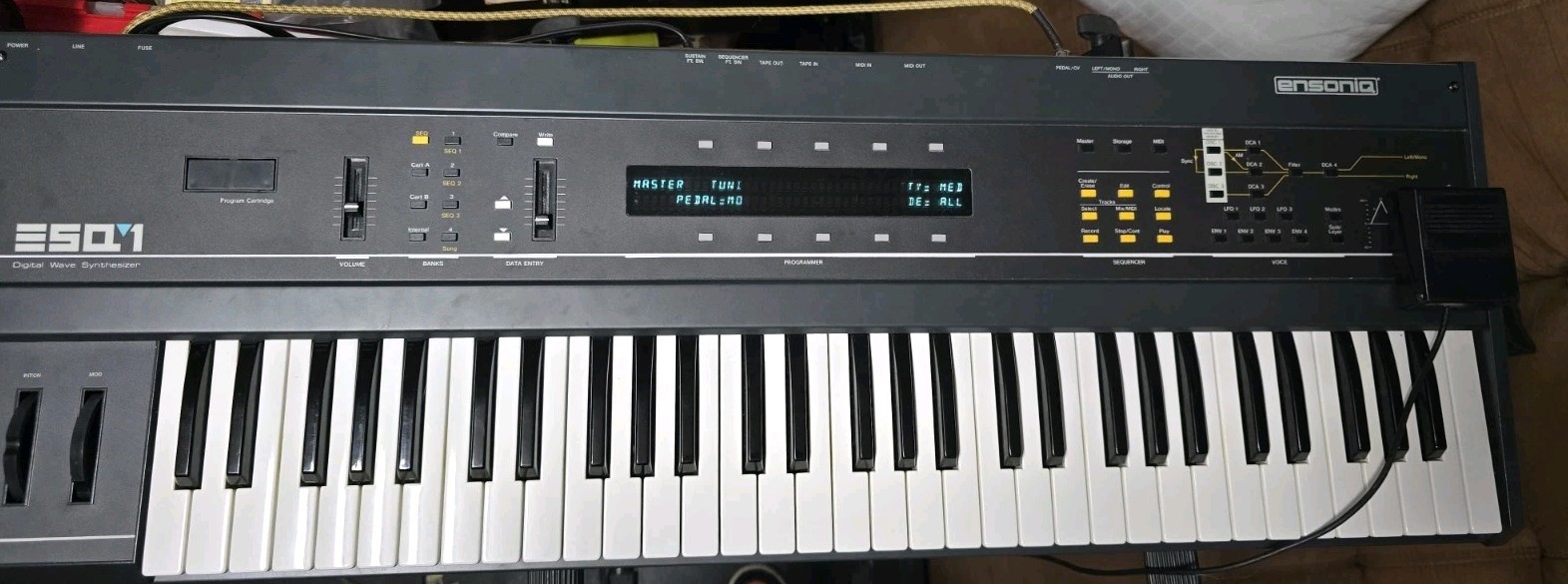
What made the ESQ-1 truly special wasn’t just its sound—it was its accessibility. While competitors buried parameters behind layers of menus or cryptic button combinations, the ESQ-1 offered a relatively intuitive layout with a 2-line by 40-character LCD and clearly labeled buttons. For bedroom composers, indie producers, and synth enthusiasts priced out of the high-end market, the ESQ-1 was a revelation. It delivered six-part multitimbrality, meaning you could layer or split six different sounds across the keyboard or MIDI channels—something few synths under $1,500 could do in 1986. Artists like Vince Clarke (Erasure) and Tony Banks (Genesis) were rumored to have dabbled with it, and its lush pads, metallic basses, and animated digital sweeps found quiet homes in new wave, synthpop, and early electronic rock recordings.
Specifications
| Polyphony | 6 voices |
| Multitimbrality | 6 parts |
| Oscillators per Voice | 2 |
| Waveforms | 32 digital waveforms including wavetables |
| Filter | Resonant 4-pole low-pass, 2-pole high-pass, band-pass (state-variable) |
| Envelope Generators | 2 ADSR (amplifier and filter) |
| LFO | 1 LFO with multiple waveforms (sine, square, triangle, sample & hold, noise) |
| Keyboard | 61 keys, velocity and aftertouch sensitive |
| Sequencer | Built-in 8-track sequencer with 6,000 note capacity |
| Memory | 64 internal patches, 64 cartridge patches, expandable via ROM cartridges |
| Display | 2-line x 40-character LCD |
| Connectivity | MIDI In/Out/Thru, CV/Gate outputs (via adapter), tape I/O, sustain and expression pedal inputs |
| Dimensions | 37.5 x 13.5 x 4.5 inches (95.3 x 34.3 x 11.4 cm) |
| Weight | 34 lbs (15.4 kg) |
| Power Supply | Internal power supply, 100–240V AC |
| Country of Manufacture | United States |
| Original MSRP | $895 (1986) |
Key Features
- Wavetable Synthesis from Mirage DNA: The ESQ-1’s oscillator engine was directly inherited from the Ensoniq Mirage, giving it access to 32 digital waveforms—including evolving wavetables that could sweep through multiple samples over time. This allowed for rich, animated sounds that stood in stark contrast to the static samples of ROMplers or the clinical tones of FM synths. Want a pad that morphs from glassy to gritty over four bars? The ESQ-1 could do that—before it was cool.
- Integrated 8-Track Sequencer: In 1986, having a 6,000-note, 8-track sequencer built into your synth was borderline revolutionary. You could record drums on track 1, bass on 2, chords on 3, and so on—then overdub, quantize, and even transpose entire sections. Real-time and step recording modes made it flexible, and MIDI sync let it play nice with drum machines. For composers without a computer-based DAW (which barely existed then), this was a self-contained studio.
- True 6-Part Multitimbrality: Unlike some synths that claimed multitimbrality but required external MIDI control or sacrificed polyphony, the ESQ-1 let you run six completely different sounds at once—each on its own MIDI channel. This made it a powerful MIDI sound module even when not using the keyboard, ideal for layering textures in a live or studio setup.
- Macro Upgrade (1987): A factory retrofit (and later user-installable mod), the Macro Upgrade added real-time control over multiple parameters via dedicated front-panel buttons. Want to sweep filter cutoff and resonance while increasing LFO rate with one press? The Macro system made it possible—adding performance flair that the original interface lacked.
- Expandable Sound Library: With 64 internal patches and support for ROM cartridges, users could expand their palette beyond factory presets. Third-party cartridges emerged, offering genre-specific sounds—from cinematic strings to industrial percussion—turning the ESQ-1 into a customizable sonic Swiss Army knife.
Historical Context
The ESQ-1 arrived in 1986, a pivotal year in the digital synth revolution. The Yamaha DX7 (1983) had proven that digital synthesis could dominate pop music, but its programming interface was notoriously opaque. The Korg M1, which would go on to become the best-selling synth of all time, was still two years away. In this gap, Ensoniq positioned the ESQ-1 as the thinking musician’s digital synth—affordable, powerful, and programmable without a flowchart taped to the wall.
But Ensoniq wasn’t just competing on price. They were challenging the notion that digital meant sterile. By using wavetable synthesis—where waveforms evolve over time—they created movement and depth that FM and sample-playback synths often lacked. The ESQ-1’s filter, a resonant state-variable design, was also a standout: warm, musical, and capable of self-oscillation, it gave the synth an analog-like character that belied its digital core. This hybrid soul—digital oscillators feeding analog-style filtering—became a hallmark of Ensoniq’s design philosophy.
The ESQ-1’s legacy lived on in its successors: the Ensoniq SQ-80 (1987) expanded on its architecture with more memory and effects, while the Ensoniq TS-10 (1990) brought in graphic editing and enhanced sequencing. Even the Ensoniq ESQ-M, the rack-mount version of the ESQ-1, proved that the platform had legs beyond the keyboard format. While the Korg M1 eventually won the mainstream with its presets and ease of use, the ESQ-1 remained the choice for those who wanted to design sounds, not just select them.
Collectibility & Value
Today, the Ensoniq ESQ-1 is uncommon but not rare—enough units were produced to keep them circulating, but few survived the ravages of time unscathed. In 2025, a working, fully serviced ESQ-1 typically sells for $600 to $1,200, with higher prices for units with the Macro Upgrade or in mint cosmetic condition. Its desirability remains high among synth enthusiasts who appreciate its unique sonic character and all-in-one workflow.
However, buying an ESQ-1 requires caution. Two issues plague most surviving units: capacitor leakage and LCD failure. The original electrolytic capacitors, especially near the power supply and voice boards, are prone to leaking corrosive fluid that can damage circuit traces. A must-check: open the unit and inspect for crusty residue or bulging capacitors. Second, the LCD display—critical for programming—often fails due to aging or corrosion on the ribbon connector. Some units suffer from “faint display” syndrome, where contrast fades over time. Repairs are possible (recapping and LCD replacement kits exist), but they add cost and complexity.
When shopping, prioritize units that power on with a clear display and responsive keyboard. Test all MIDI functions, the sequencer, and aftertouch. Original packaging and manuals boost value, as do factory-installed Macro upgrades. For the vintage synth tinkerer, the ESQ-1 is a rewarding project—its architecture is well-documented, and the community is active. But for the plug-and-play collector? It’s a gem that demands respect—and a soldering iron.
eBay Listings


As an eBay Partner, we earn from qualifying purchases. This helps support our independent vintage technology research.
Service Manuals & Schematics
- Service Manual — archive.org
- Manual — archive.org
- Manual — archive.org
Related Models
- Yamaha DX7 (1983-1987)
- Access Virus A (1997-1999)
- Access Virus B (1999-2002)
- Access Virus C (2002-2004)
- Access Virus (1997-1999)
- Casio CZ-101 (1984-1988)
- Clavia Nord Lead (1995-2003)
- Korg Wavestation (1990-1994)
- PPG Wave 2.2 (1982-1987)
- Roland D-50 (1987-1992)