Clavia Nord Lead 2 (1997–2003)
The synth that made virtual analog feel like a revelation, not a compromise — bright, snappy, and built for real-time mayhem.
Overview
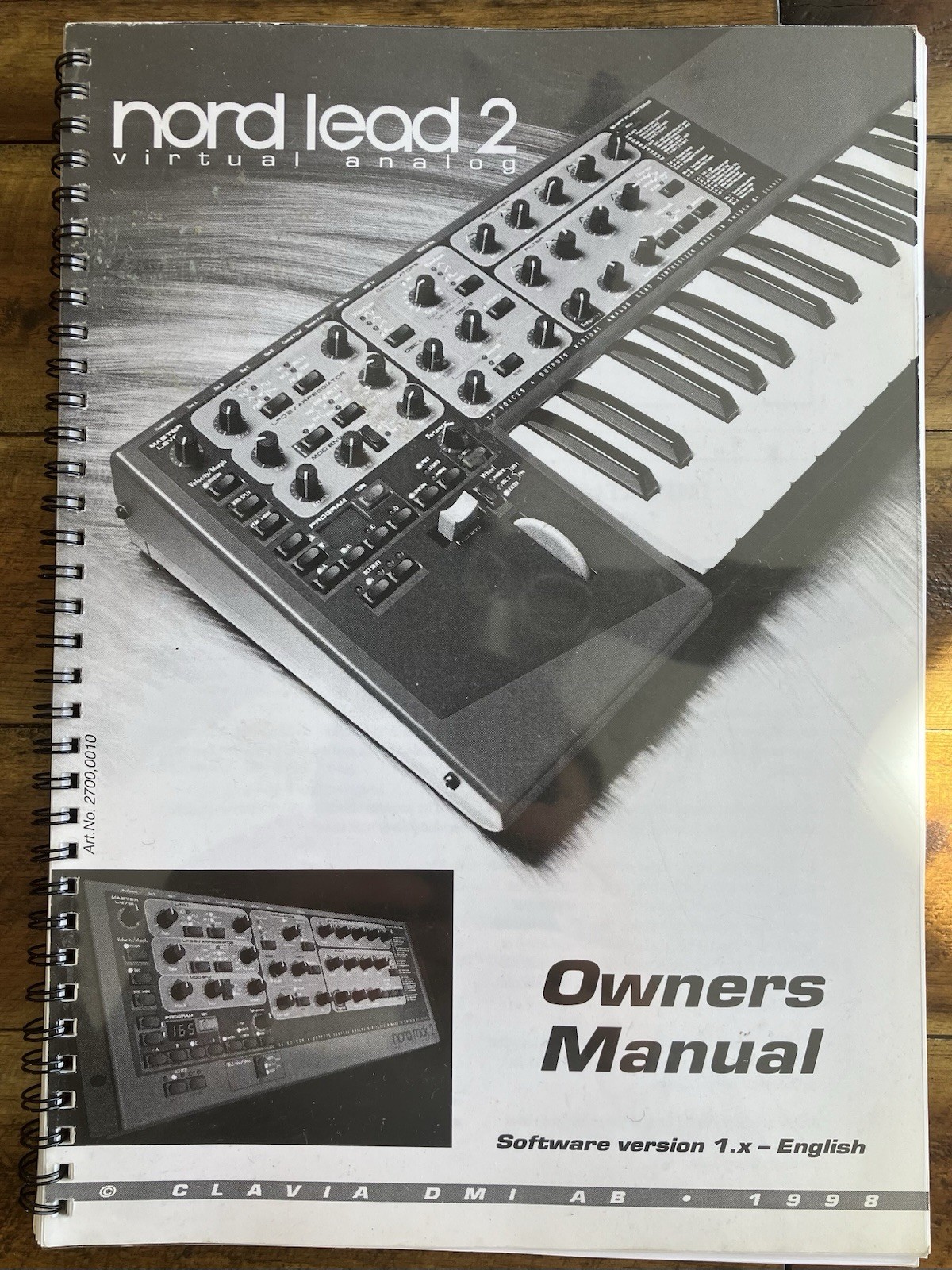
Plug in the Nord Lead 2, hit a chord with both oscillators cranked, filters wide open, and you’re immediately thrown into a world of fizzing harmonics and aggressive clarity — the kind of sound that doesn’t just fill space, it dominates it. There’s no mistaking this for a vintage Prophet or Jupiter; it doesn’t aim for warm, woolly analog saturation. Instead, it delivers something sharper, more precise — a digital scalpel dressed in red aircraft-grade aluminum. When it launched in 1997, the Nord Lead 2 wasn’t just another VA synth. It was the evolution of a revolution. The original Nord Lead had already shaken the industry by proving that digital synthesis could feel analog in spirit, if not in circuitry. The Lead 2 refined that idea with more depth, more control, and a sound engine that refused to play it safe.
This was the machine that powered a generation of trance, techno, and electro — not because it was subtle, but because it wasn’t. Its oscillators scream with harmonic richness, especially when detuned or synced, and the filters, while not Moog-round, have a surgical precision that cuts through dense mixes without needing effects. The two multi-mode filters — low-pass, high-pass, band-pass, and the unique Notch+LP — give it a tonal flexibility that many contemporaries lacked. You can go from glassy plucks to growling basses with a twist of the cutoff and a tweak of resonance, and the way the filter responds to velocity and keyboard tracking makes it feel alive under the fingers.
Polyphony sits at 16 voices, which was generous for the time, and the modulation matrix — with four LFOs and four envelope generators — allows for surprisingly complex movement within patches. The real-time controls, especially the dual D-joysticks on the left side, make performance an integral part of sound design. Want to morph a lead from sine wave purity to FM-edged chaos while modulating filter cutoff with pressure? The Nord Lead 2 doesn’t just allow it — it encourages it.
It wasn’t perfect. The lack of built-in effects was a sore point for some, especially as competitors like the Roland JP-8000 started bundling chorus and delay. But for purists, that absence was a feature, not a bug — a commitment to letting the raw synth voice speak for itself. And let it speak it did: bright, punchy, and unapologetically digital in the best possible way.
Specifications
| Manufacturer | Clavia Digital Musical Instruments |
| Production Years | 1997–2003 |
| Original Price | $2,495 USD |
| Polyphony | 16 voices |
| Oscillators | 2 per voice (virtual analog) |
| Oscillator Waveforms | Sawtooth, Square, Pulse, Triangle, Sine (OSC1); Noise (OSC2) |
| Filter Types | Low-pass, High-pass, Band-pass, Notch+LP (2 multi-mode filters) |
| LFOs | 2 (expanded waveforms and patterns in Lead 2) |
| Envelope Generators | 4 (2 ADSR, 1 AD, 1 modulation envelope) |
| Modulation Matrix | Yes, with multiple sources and destinations |
| Keyboard | 61 keys, velocity-sensitive, aftertouch-capable (via MIDI only) |
| MIDI | In, Out, no Thru |
| Audio Outputs | 4 individual 1/4" outputs |
| Foot Controller Inputs | Switched and continuous pedal inputs |
| Effects | None (dry signal only) |
| Memory | 256 user patches, expandable via PCMCIA card |
| Arpeggiator | Yes, with random pattern mode |
| Ring Modulator | Yes |
| Oscillator Sync | Yes (OSC1 syncs to noise generator) |
| Weight | 12.5 kg (27.5 lbs) |
| Dimensions | 95 x 36 x 11 cm (W x D x H) |
Key Features
Dual D-Joysticks: Performance as Design Philosophy
The twin D-joysticks on the left side of the Nord Lead 2 aren’t just gimmicks — they’re central to its identity. The vertical axis of the left stick controls pitch bend, the horizontal controls modulation. The right stick’s axes can be assigned to any two parameters, making real-time morphing a core part of playing. Want to sweep a filter while modulating oscillator sync depth during a solo? Assign those parameters and go. It’s tactile, immediate, and unlike the static knob-twiddling of many synths, it turns performance into an expressive act. These joysticks, combined with the synth’s responsive keyboard and aftertouch (via MIDI), make it feel less like a machine and more like an extension of the player.
Notch+LP Filter: The Secret Weapon
While most synths offered standard low-pass, high-pass, and band-pass filters, the Nord Lead 2 introduced a hybrid mode: Notch+LP. This combines a notch filter with a low-pass stage, creating a complex, resonant dip in the midrange followed by a smooth roll-off. It’s perfect for crafting hollow, metallic tones, phaser-like sweeps, and percussive textures that sit uniquely in a mix. This filter mode, along with the ability to route keyboard tracking and velocity with precision, gives the Lead 2 a sonic fingerprint that’s hard to replicate — even with modern plugins. It’s not warm, but it’s musical, and in the right hands, it can be devastatingly effective.
PCMCIA Patch Storage and Expandability
At a time when most synths relied on floppy disks or cassette backups, the Nord Lead 2 embraced PCMCIA cards for patch storage — a forward-thinking move that made sharing and archiving sounds far easier. The 8-voice expander (sold separately) allowed for expanded polyphony and additional memory, though it was rarely needed given the 16-voice base. The ability to dump entire kits and performances via SysEx was a boon for studio users, though editing drum kits was awkward due to fixed key mappings. Still, the expandability and data management options made it a favorite in professional environments where reliability and recall mattered.
Historical Context
The late 1990s were a turning point for synthesis. The sample-based romplers of the early decade — machines like the Roland JV-1080 and Korg M1 — had dominated studios, but a growing number of musicians were craving the immediacy and expressiveness of analog synths. The problem? Real analog gear was expensive, rare, and often unreliable. Clavia saw the gap and filled it with the Nord Lead — the first synth to proudly brand itself as “virtual analog.” The original 1995 model was a revelation, but it had limitations: no aftertouch, no random arpeggiator, and a somewhat barebones modulation system. The Lead 2, released in 1997, fixed many of those issues with deeper editing, expanded LFO waveforms, and the addition of the Notch+LP filter.
It arrived alongside the Roland JP-8000, another VA pioneer, but the two took different paths. The JP leaned into analog nostalgia with its supersaw and built-in chorus, while the Nord Lead 2 embraced its digital nature with clarity, precision, and aggressive tonality. It wasn’t trying to sound like a Prophet — it wanted to sound like the future. And for a generation of electronic producers, it did. Used by artists from Moby to The Chemical Brothers, it became a staple in dance music production, especially in genres that valued cut-through and definition over warmth.
Collectibility & Value
Today, the Nord Lead 2 occupies a sweet spot between affordability and desirability. It’s not as rare or expensive as the original Nord Lead, nor as refined as the later 2X or 3, but it’s often seen as the purest expression of Clavia’s early VA sound. Prices on the secondhand market vary widely based on condition and included accessories. A fully functional unit with original box and PCMCIA card can fetch $800–$1,200, while units with cosmetic wear or missing parts sell for $500–$700. Fully serviced models with updated firmware and recapped power supplies command a premium.
The most common failure points are the power supply capacitors, which degrade over time and can cause noise, instability, or complete shutdown. Owners report that recapping is almost a rite of passage — a $100–$150 investment that can extend the life of the synth by decades. The D-joysticks can also wear out, developing jitter or dead zones, but replacements are available and relatively easy to install for those with soldering experience. The PCMCIA slot is generally reliable, but cards are now rare and expensive, so many users rely on SysEx dumps via MIDI-USB interfaces.
Buyers should test all knobs, sliders, and joysticks for smooth operation, check for display anomalies, and verify MIDI in/out functionality. Units that have been stored in humid environments may show corrosion on the PCBs, so a visual inspection (if possible) is wise. Despite these quirks, the Nord Lead 2 is remarkably durable — its aircraft-grade aluminum casing has protected countless units from road wear.
It’s not a synth for everyone. If you’re after warm, vintage analog tones, look elsewhere. But if you want a machine that’s aggressive, articulate, and built for real-time manipulation, the Nord Lead 2 remains a compelling choice — and one that still sounds unmistakably modern, even decades later.
eBay Listings



As an eBay Partner, we earn from qualifying purchases. This helps support our independent vintage technology research.