Clavia Nord Lead (1995–1998): The Synth That Brought Analog Back From the Dead
The first virtual analog synthesizer to convincingly resurrect the warmth and immediacy of analog synthesis—using digital guts and a knob-laden soul.
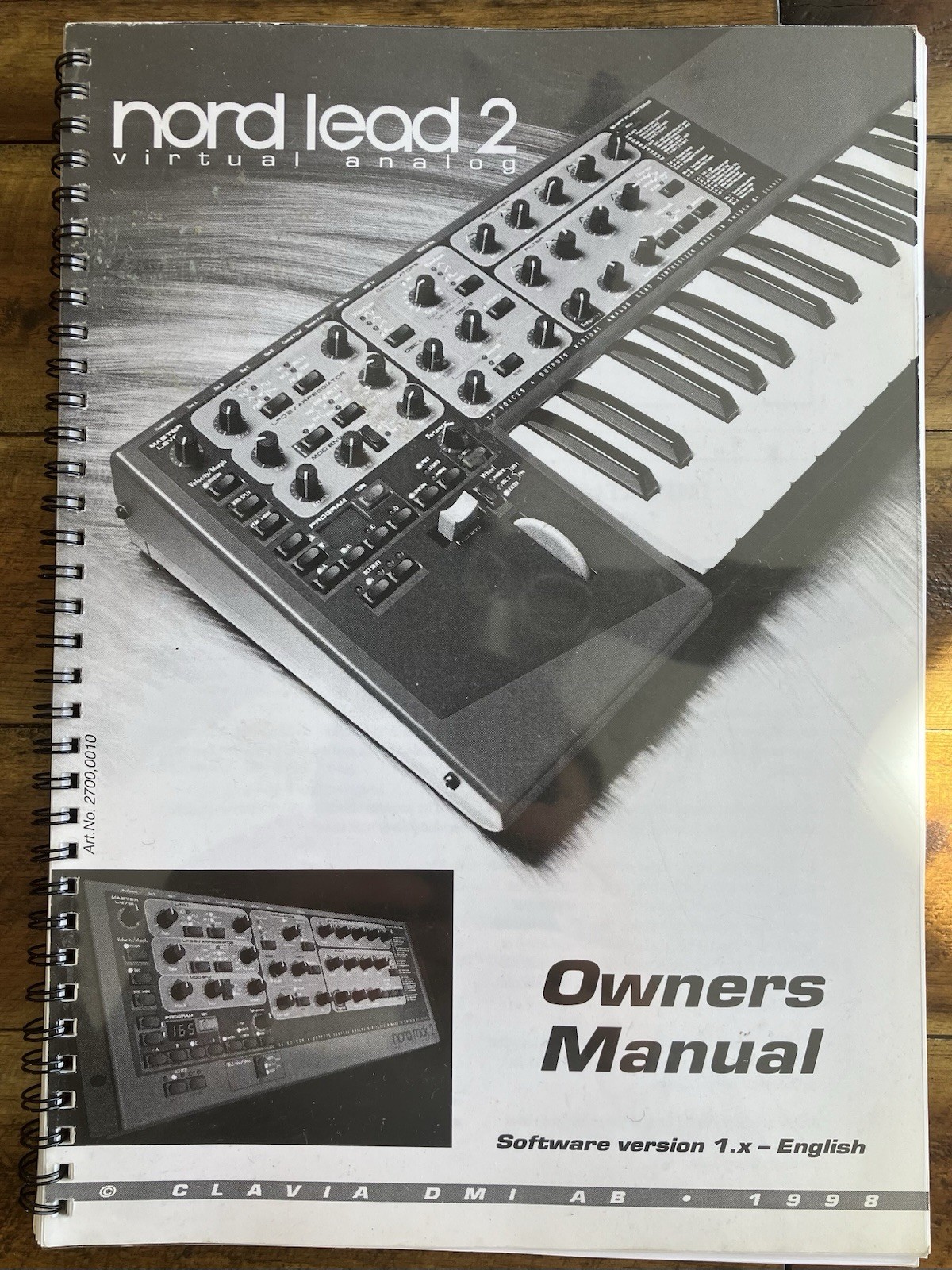
Let’s set the scene: it’s 1995. Analog synths are relics, banished to attic storage and thrift-store purgatory. The world has moved on to sterile sample-playback workstations and cold FM beasts. If you wanted "fat" sound, you bought a secondhand Roland Jupiter-8 and prayed the capacitors didn’t explode. Enter the Clavia Nord Lead—a red-and-black slab from Sweden that didn’t just challenge the status quo; it rewrote the rulebook. This wasn’t another ROMpler or dance-music box. It was the world’s first commercially successful virtual analog synthesizer, using digital signal processing (DSP) to model analog oscillators, filters, and envelopes with uncanny accuracy. And it had knobs—dozens of them—each one begging to be twisted.
From the moment you laid hands on it, the Nord Lead screamed “player’s instrument.” Its 61-key velocity- and aftertouch-capable keyboard felt substantial, its vacuum fluorescent display (VFD) glowed like a spaceship control panel, and its all-knob interface meant you could shape a sound in real time without menu-diving. Artists from Moby to The Prodigy to Daft Punk (yes, those guys) embraced it, not because it was nostalgic, but because it was alive. It could snarl like a Minimoog, scream like a TB-303, or pad out a track with lush, evolving textures. For a generation weaned on digital sterility, the Nord Lead was a revelation: analog-style synthesis wasn’t dead—it had just gone digital.
Specifications
| Polyphony | 16 voices |
| Oscillators | 2 digital oscillators per voice with analog-style waveforms (saw, square, pulse, sine) |
| Filters | 1 resonant 24dB/oct low-pass filter per voice (modeled after analog designs) |
| Envelope Generators | 2 ADSR envelopes (amplitude and filter) |
| LFO | 2 LFOs with multiple waveforms (sine, triangle, square, sample & hold, noise) |
| Keyboard | 61 keys, velocity-sensitive, aftertouch-capable |
| Display | 2-line vacuum fluorescent display (VFD) |
| Memory | 64 user patches, 64 factory patches (expandable via memory cards) |
| Audio Outputs | 1/4" balanced outputs (left/right) |
| Audio Inputs | 1/4" external audio input for filter processing |
| MIDI | In, Out, Thru |
| Dimensions | 950 mm × 350 mm × 90 mm |
| Weight | 12.5 kg |
| Power Supply | External 15V DC adapter (included) |
| Signal-to-Noise Ratio | Greater than 90 dB |
| THD | Less than 0.1% |
| Frequency Response | 20 Hz - 20 kHz |
Key Features
- Virtual Analog Synthesis Engine: The Nord Lead didn’t just fake analog—it modeled it. Using proprietary DSP algorithms, Clavia recreated the behavior of analog VCOs, VCFs, and VCAs with startling authenticity. Unlike the static waveforms of sample-based synths, the Nord’s oscillators drifted slightly, wobbled, and responded to modulation like the real thing. This wasn’t “digital pretending to be analog”—it was digital becoming analog.
- Real-Time Knob Control: While competitors buried parameters in LCD menus, the Nord Lead put nearly every parameter on a dedicated knob or button. Want to modulate pulse width with an LFO? Twist the knob. Crank up resonance until it screams? Go ahead. The tactile immediacy made it a performer’s dream and a sound designer’s playground. And yes, those knobs do wear out—worth it.
- External Audio Input: One of the most underappreciated features: you could route external audio (a drum machine, a guitar, a vocoder) through the Nord’s filter and envelope. Suddenly, your TR-909 could sound like it was being eaten by a robot. This feature alone made it a studio staple.
- Expandable Memory: With only 64 user patches onboard, you’d think that’d be limiting. But Clavia included a memory card slot (using standard PCMCIA cards, yes, those) that let you load and save banks. A lifesaver in the pre-USB era, and a nod to the future.
- Build Quality: Cast aluminum casing, industrial-grade switches, and a keyboard that felt like it could survive a tour bus crash. This wasn’t a toy. It was a tool. And it looked like nothing else on stage—bold red lettering on black, like a Cold War control panel.
Historical Context
The Nord Lead didn’t emerge in a vacuum. By the mid-90s, analog synths had been declared dead for nearly a decade. The rise of MIDI, sampling, and digital synthesis (looking at you, Yamaha DX7) had made analog seem outdated, expensive, and unreliable. Studios were full of Korg M1 workstations and Roland D-50 pads—perfect for pop, but soulless for electronic pioneers craving grit and movement.
Then, in 1995, Clavia dropped the Nord Lead like a red anvil. It wasn’t the only virtual analog synth that year—Korg Prophecy and Roland JP-8000 followed close behind—but it was the first to get it right. Where the Prophecy leaned into physical modeling weirdness and the JP-8000 had a sleek but limited interface, the Nord Lead offered pure, unadulterated analog-style synthesis with modern reliability. It was the bridge between eras: the warmth of the past, the stability of the future.
And it sparked a renaissance. The success of the Nord Lead proved there was a market for hands-on, expressive synthesis. Within five years, analog was back—first in virtual form, then in actual circuitry. Moog rebooted, Dave Smith returned, and the boutique synth scene exploded. The Nord Lead didn’t just ride the wave—it created it.
Collectibility & Value
Today, the original Nord Lead is uncommon but not rare. Around 5,000 units were reportedly produced between 1995 and 1998, and many are still in active use. Its desirability remains high among synth collectors, electronic musicians, and analog purists who appreciate its historical significance and raw sonic character. In 2025, a working unit in good condition sells for $800–$1,500 USD, depending on cosmetic state and included accessories (original box? memory cards? bonus points).
But beware: these machines were worked. The vacuum fluorescent display (VFD) is notorious for dimming or failing entirely—Clavia eventually replaced them under warranty, but replacements are now scarce. Potentiometers and switches, while robust, can wear out from heavy use, leading to crackling or unresponsive controls. When buying, test every knob, every button, and every patch. Check that the external audio input works and that MIDI In/Out/Thru are functional. And for the love of Bob Moog, make sure the display isn’t ghosting or dead.
Still, for those willing to dig, the Nord Lead is a trophy piece—a synth that didn’t just survive its era, but defined it. It’s not just a relic. It’s a working time machine, capable of sounds that still cut through a mix like a laser. And if you’ve ever twisted its filter knob while cranking resonance with an LFO modulating pulse width… well, you know exactly what we mean.
eBay Listings


As an eBay Partner, we earn from qualifying purchases. This helps support our independent vintage technology research.
Related Models
- Yamaha DX7 (1983-1987)
- Access Virus A (1997-1999)
- Access Virus B (1999-2002)
- Access Virus C (2002-2004)
- Access Virus (1997-1999)
- Casio CZ-101 (1984-1988)
- Ensoniq ESQ-1 (1986-1989)
- Korg Wavestation (1990-1994)
- PPG Wave 2.2 (1982-1987)
- Roland D-50 (1987-1992)