Casio DG-20
A guitar-shaped synth controller that straps on like an instrument and thinks like a machine.
Overview
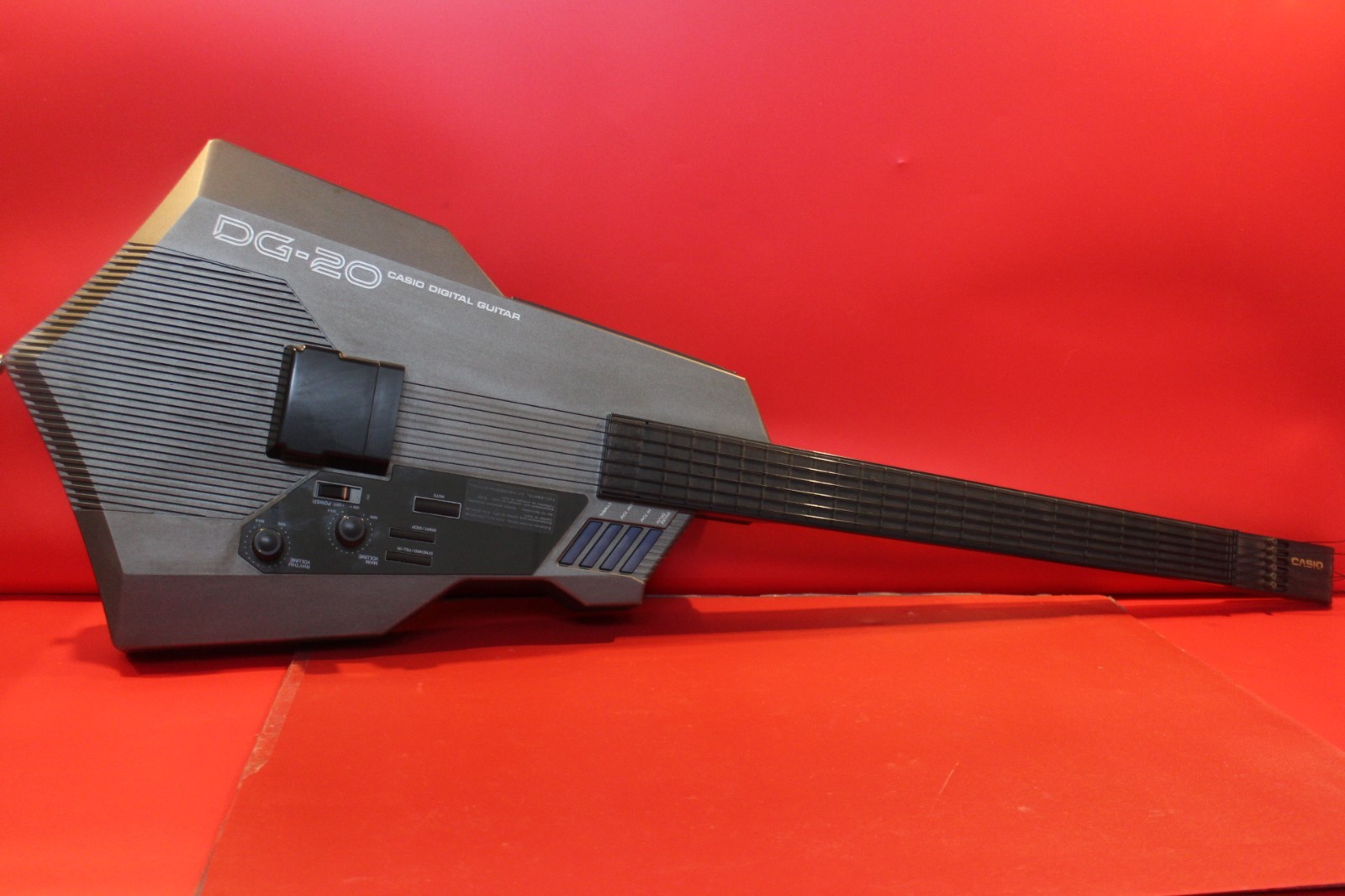
The DG-20 is Casio's top-of-the-line digital guitar. It's a strap-on controller that looks like an electric guitar and behaves like a MIDI device. The service documentation pairs it with the DG-10, and the two share a chassis, a diagnostic routine, and most of the panel. The DG-20 has a handful of features the DG-10 doesn't. In the self-diagnostic program, the foot switch check and the drum pad check are marked for the DG-20 only, and the panel carries four dedicated drum pads that the lower model lacks. Casio's own switch matrix notes plainly that the switches in the diagram are "for DG-20 only."
The instrument is built around a string-and-fret sensor system rather than conventional pickups. Six strings run down a sensor assembly in the neck, and the fretboard reads contact the way a keyboard reads key presses. It's a controller first and a sound source second. The onboard tones and rhythms are there, but the design is clearly aimed at turning playing into data. The service manual's diagnostic modes show what the machine cares about: string sensor sensitivity, fret contact across every position, and DAC bit compensation. Those are the systems Casio expected to need calibration and service.
String changes need care, and the manual is unusually specific about them. The sensor cover has to be pressed down and slid toward the neck without forcing anything in the sensor assembly. Strings pass through a notch at the end of the sensor, then through a hole, then get tied off. The headpiece has to be loosened with the small hex wrench, the string pulled taut, and tension set with the large wrench. Casio warns twice against over-tightening, since excessive tension can warp the neck. There's also a hard requirement: use nylon B strings only, for all six. Nylon B strings are what the sensor expects, and the wrong strings will throw off the whole system.
HiFi-Stereo (December 1988, p.159) listed the DG-20 in a musical-keyboards roundup alongside the Yamaha DD-5, placing it in the same retail tier as the era's consumer drum machines and home keyboards. That's a useful frame: this was never marketed as a professional instrument, and the DG-20's feature set reflects the home-market ambition — a self-contained guitar with onboard tones, rhythms, and drum pads rather than a bare controller for a rack of synths.
The fretboard senses contact, the strings sense pitch, and the internal electronics turn both into sound or MIDI. The panel is dense with switches: tone selection, rhythm selection, transpose up and down, tempo up and down, sustain/reverb, hold, mute, solo, synchro/fill-in, start/stop, and, on the DG-20 specifically, MIDI mode switching between Mode I and Mode II. That's a lot of control surface for a guitar-shaped object.
The onboard sound engine covers acoustic and electric guitar tones, plus a range of others. The diagnostic mode references Jazz Organ, Electric Guitar, Acoustic Guitar, and Glocken tones, and the tone switches run from TONE 0 through TONE 8 plus a TONE SELECT. There's also a percussion generator with drum pads and a rhythm section with patterns including Rock, Pops, Country, Swing, Bossa Nova, and Waltz. The DG-20 will play by itself if you ask it to.
The service manual's pinout shows a dedicated MIDI signal output on the CPU, and the reset-mode switch table lists MIDI as DG-20-only, with the switch toggling between Mode I and Mode II. That means the DG-20 can drive external gear, and it can be configured to behave differently depending on what it's talking to. For a mid-1980s consumer guitar synth, that's the feature that keeps it relevant. It converts string and fret input into MIDI data that a modern rig can still use.
Holding ACO GUITAR, DISTORTION, and SHAMISEN (or ACO. GUITAR 1, ELEC. GUITAR 1, and GLOCKEN on the DG-20) while powering on drops the instrument into a reset mode where all LEDs illuminate if ROM and RAM check out. From there, the player can step through percussion sound checks, foot switch checks, drum pad checks, a full panel switch check, DAC bit compensation adjustment, string sensor sensitivity, and fret contact verification. Each mode has its own escape combination - POPS, SWING, and WALTZ together exits the diagnostic mode entirely. It's a thorough self-test for a consumer instrument, and Casio evidently expected owners and service techs to use it.
Pressing every switch in sequence in the switch check mode should produce a specific pitch in Acoustic Guitar tone. A malfunctioning or wrong switch produces a cymbal sound instead. The DG-20's checking order runs through 28 switches, from the tone buttons through the rhythm buttons, transpose, mute, start/stop, synchro/fill-in, and MIDI.
The major waveforms section of the manual documents what the service bench should see: CPU clock signals, gate array outputs, op-amp stages, the MSM6294 and MN3209 chips, and the analog signal path through the NJM4558 op-amps. The note that "one cycle period varies from 3.5µs to 6µs" only matters when something's wrong, but Casio documented the DG-20 thoroughly enough to repair it.
From the available documentation, the DG-20 is not a conventional guitar. There's no mention of magnetic pickups, no passive electronics, no amplifier output stage in the traditional sense. The strings feed a sensor, the sensor feeds a CPU, and the CPU feeds a DAC and a MIDI output.
The DG-20 is more capable than the DG-10, since the drum pads, the foot switch input, and the MIDI mode switching are real functional differences. It's still a consumer-grade instrument from an era when guitar synths were a niche within a niche. The nylon-B-string requirement and the sensor-based fret reading make maintenance non-trivial, and the self-diagnostic routines exist because these systems drift. A working DG-20 with a clean sensor assembly and functioning fret contacts is more useful today than its original market position would suggest, largely because MIDI doesn't care how old the controller is.
The DG-20 takes a familiar form factor, stuffs it with digital electronics, and sells it to someone who wants to make music without learning a new interface. The MIDI output lets it talk to other gear, and the diagnostic mode is there for checking the sensors and calibrating the DAC.
eBay Listings



As an eBay Partner, we earn from qualifying purchases. This helps support our independent vintage technology research.