Casio VL-1 (1981–1984): The Pocket-Sized Pioneer of Digital Synthesis
The first handheld digital synthesizer with a full keyboard and programmable memory, the Casio VL-1 put affordable, portable music creation in the palms of aspiring musicians—and the backpacks of curious nerds.
Overview
If you’ve ever tapped out a melody on a calculator during math class, you’ve unknowingly paid homage to the Casio VL-1. Released in 1981, this unassuming slab of black plastic wasn’t just another toy keyboard—it was a seismic shift in who could make electronic music. At $69.95 (about $230 today), the VL-1 wasn’t just affordable; it was revolutionary. For the first time, a consumer could own a digital synthesizer that fit in a school binder, ran on AA batteries, and actually let you program your own sequences. No patch cables, no arcane oscillators—just 29 mini keys, a single LED, and a speaker that sounded like a robot humming through a tin can. And yet, it worked.
The VL-1 found its audience among students, bedroom tinkerers, and punk-era DIY musicians who saw past its toy-like exterior. It wasn’t trying to emulate a grand piano or a Moog; it embraced its digital rawness. The 4-bit synthesis gave it a gritty, lo-fi character that, while primitive by today’s standards, had a charm that modern plugins still try to replicate. It wasn’t uncommon to see a VL-1 chained to a backpack with a padlock in high school hallways—this thing was personal. And for many, it was their first real instrument. The VL-1 didn’t just democratize synthesis; it made it portable, personal, and programmable in a way no product had before.
Specifications
| Keyboard | 29 mini keys (2.5 octaves) |
| Sound Generation | Digital synthesis (4-bit) |
| Polyphony | 1 note (monophonic) |
| Preset Tones | 10 |
| Rhythm Patterns | 10 |
| Memory | 64 bytes RAM (stores up to 100 notes in sequence memory) |
| Display | 1-digit 7-segment LED (for note/octave indication) |
| Power | 6V DC (4 x AA batteries or AC adapter) |
| Battery Life | Approx. 20 hours with alkaline batteries |
| Dimensions | 305 mm × 105 mm × 35 mm |
| Weight | 0.7 kg (with batteries) |
| Audio Output | 0.2 W internal speaker, 3.5 mm headphone jack (mono) |
| Frequency Response | 200 Hz - 12 kHz |
| Inputs/Outputs | Audio out (3.5 mm mono), external speaker terminal |
Key Features
- First Handheld Digital Synthesizer with Programmable Sequences: The VL-1 wasn’t just playable—it was programmable. With 64 bytes of RAM (yes, bytes), it could store up to 100 notes in sequence memory. That’s barely enough for “Twinkle Twinkle Little Star” with repeats, but in 1981, this was wizardry. You could record a short melody, set a tempo, pick a rhythm (like “Rock” or “Waltz”), and let it play back. It was the proto-DAW for kids with science fair budgets.
- Built-in Speaker and Battery Power: Unlike most synths of the era that needed wall power and external amps, the VL-1 was truly portable. Pop in four AAs, flip the power switch, and you’re making noise on a bus, in a dorm, or under a desk. The 0.2W speaker was tinny and quiet, but it had character—like a Speak & Spell with ambition. And if you wanted louder sound, the external speaker terminal could drive a small passive speaker.
- 10 Preset Tones and 10 Rhythm Patterns: The presets had names like “Piano,” “Violin,” and “Jazz Organ,” but let’s be honest: they sounded nothing like their real-world counterparts. That’s not a knock—it’s a feature. The 4-bit digital synthesis gave each tone a gritty, crunchy texture that’s now coveted in lo-fi and chiptune circles. The rhythms, while simple, provided a mechanical backbone that made compositions feel less like etudes and more like songs.
- Single 7-Segment LED Display: One digit. That’s it. It showed the current octave or note number during programming. It sounds absurd, but it worked. Programming a sequence felt like coding on a 1970s calculator—methodical, cryptic, and oddly satisfying. You had to think in steps, not real-time, which forced a kind of musical minimalism that’s rare today.
Historical Context
The early 1980s were a battleground for the soul of electronic music. On one side: analog behemoths like the Yamaha PSS-11 and Moog synthesizers, costing thousands and requiring technical know-how. On the other: Casio, a company better known for calculators, betting that music could be digital, disposable, and democratic. The VL-1 wasn’t the first electronic keyboard Casio made—models like the Casio VL-Tone series had experimented with touch-sensitive pads and basic tones—but it was the first to combine a real keyboard, synthesis, and memory in a handheld form.
Released in 1981, the same year as the IBM PC and the Sony Walkman, the VL-1 tapped into a cultural shift toward personal, portable technology. It wasn’t trying to replace the piano; it was the anti-piano. Where traditional instruments demanded years of practice, the VL-1 said, “Press here, hear noise, make music.” It was a product of Japan’s postwar electronics boom, where miniaturization and mass production made the impossible suddenly affordable. And while purists sneered, the VL-1’s influence rippled outward. It directly inspired the Casio MT-30 and later the Casio VL-5, both of which expanded on its formula with better sounds and features. But the VL-1 was the spark.
Collectibility & Value
Today, the Casio VL-1 is a sought-after artifact of early digital music. With a “high” desirability rating among synth collectors and a “uncommon” rarity, finding one in working condition is a minor victory. As of 2025, prices range from $150 to $300 USD, depending on condition, included accessories (like the original AC adapter or dust cover), and—critically—whether the keys still respond. The biggest enemy of the VL-1 isn’t time, but its own design: the membrane contacts under the keys are notoriously fragile. After decades, they degrade, leading to dead or sticky keys. Repair is possible, but the discontinued 4-bit processor makes replacements tricky. Enthusiasts often resort to cleaning the contact pads with isopropyl alcohol or, in extreme cases, retrofitting modern key switches.
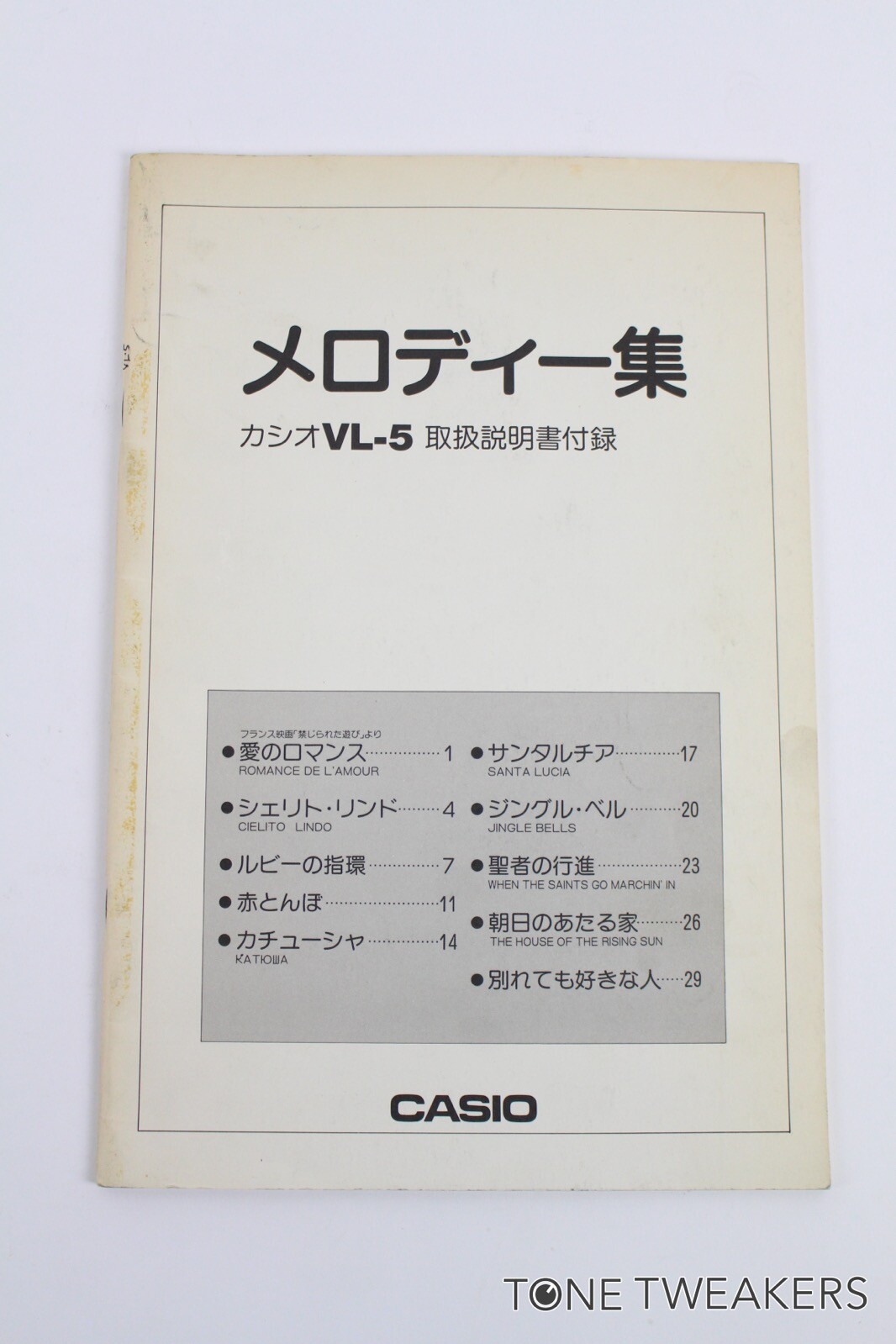
When buying a VL-1, test every key across all octaves and check the sequence memory function—many units lose their programming ability over time. The headphone jack and external speaker terminal should output clean signal, though some hiss is expected. Original boxes and manuals boost value, especially since the user manual is a treasure trove of period-accurate programming tips (like how to fake polyphony by overdubbing rhythms). Despite its flaws, the VL-1 remains a gateway drug to vintage synths—a machine that proves you don’t need complexity to make something magical.
eBay Listings


As an eBay Partner, we earn from qualifying purchases. This helps support our independent vintage technology research.
Related Models
- Hohner Clavinet D6 (1971-1982)
- Rhodes Mark I Stage Piano (1969-1983)
- Wurlitzer 200A Electric Piano (1968-1982)