Casio CZ-101 (1984–1988): The Pocket-Sized Digital Synth That Punched Above Its Weight
A compact, affordable gateway to digital synthesis in the mid-’80s, the CZ-101 brought phase distortion magic to bedroom studios with a keyboard that fit in a backpack and a price tag that didn’t break the bank.
Overview
If you were a budding musician in 1984 with dreams of digital sound but a budget stuck in analog reality, the Casio CZ-101 was your synth-shaped savior. Priced at a shockingly accessible $495 at launch—less than half the cost of a Yamaha DX7—this 8-voice digital workhorse didn’t just compete with the FM giants of the day; it carved out its own niche with Casio’s lesser-known but equally fascinating Phase Distortion (PD) synthesis. While Yamaha was busy selling FM as the future of music, Casio quietly offered an alternative path: one that was simpler to program, surprisingly expressive, and, dare we say, more fun for those who didn’t want to spend hours decoding algorithms.
The CZ-101 wasn’t built for concert halls or studio pros. It was built for the bedroom, the dorm room, the backseat of a station wagon. Its 49 mini-keys (F to F, 4 octaves) were notoriously cramped—pianists cursed them, synth nerds tolerated them, and guitarists barely noticed. But that compactness was the point: this was a synth you could actually carry. It became a favorite among hobbyists, electronic music tinkerers, and even some pros looking for a secondary digital voice with character. And character it had. The CZ-101’s PD engine could conjure everything from glassy pads and metallic bells to gritty basses and surprisingly convincing brass—none of it quite as pristine as FM, but often more organic and less clinical. It was digital, yes, but with a soul that felt just analog enough to be interesting.
Specifications
| Synthesis Type | Phase Distortion (PD) |
| Polyphony | 8 voices |
| Oscillators per Voice | 2 |
| Waveforms | Sine, Pulse, Sawtooth, Square, Reverse Sawtooth, Double Sine, Double Pulse, Triple Sine, Triple Pulse, Quadruple Sine, Quadruple Pulse, Step Modulation |
| Envelopes | 8-stage envelope generator (DCA and DCF) |
| Keyboard | 49 mini-keys (F to F), velocity-sensitive |
| Key Size | Mini keys (smaller than full-size) |
| Pitch Bend | Dedicated pitch bend wheel |
| Modulation | Modulation wheel |
| Memory | 32 preset tones, 32 user-programmable tones |
| Display | 16-character LED display |
| MIDI | MIDI In, Out, and Thru |
| Audio Output | 1/4" phone jack (unbalanced) |
| Headphone Output | 1/4" stereo headphone jack |
| Power Supply | AC adapter (DC 9V, center negative) |
| Dimensions | 830 mm (W) × 255 mm (D) × 78 mm (H) |
| Weight | 5.5 kg (12.1 lbs) |
| Frequency Response | 20 Hz - 20 kHz |
| S/N Ratio | Greater than 90 dB |
| THD | Less than 0.5% |
Key Features
- Phase Distortion Synthesis: Casio’s answer to Yamaha’s FM, PD synthesis worked by reshaping sine waves in real time using “DCW” (Digital Controlled Waveform) parameters. Unlike FM’s complex operator stacks, PD used intuitive waveform deformation—think of it as “bending” a sine wave into pulses or saws via envelope control. It was easier to grasp than FM, and while less mathematically dense, it yielded surprisingly rich and evolving timbres. The CZ-101’s implementation included 8-stage envelopes for both DCA and DCF, giving users granular control over amplitude and filter-like behavior (though it wasn’t a true analog filter).
- Compact 49 Mini-Key Keyboard: At just over 32 inches wide, the CZ-101 was a space-saving marvel. The mini-keys were a love-it-or-hate-it affair—great for portability and synth leads, less so for pianistic passages. But they were velocity-sensitive, a rare feature at this price point in 1984, allowing for dynamic expression. And let’s be honest: if you were using this for sequenced arpeggios or layered pads, finger acrobatics were secondary to sonic flexibility.
- Full MIDI Implementation: In 1984, MIDI was still the new kid on the block. The fact that the CZ-101 included MIDI In, Out, and Thru was a big deal. It could sync with drum machines, be controlled by a master keyboard, or even send program changes—making it a legitimate part of a digital studio setup. For under $500, that was borderline revolutionary.
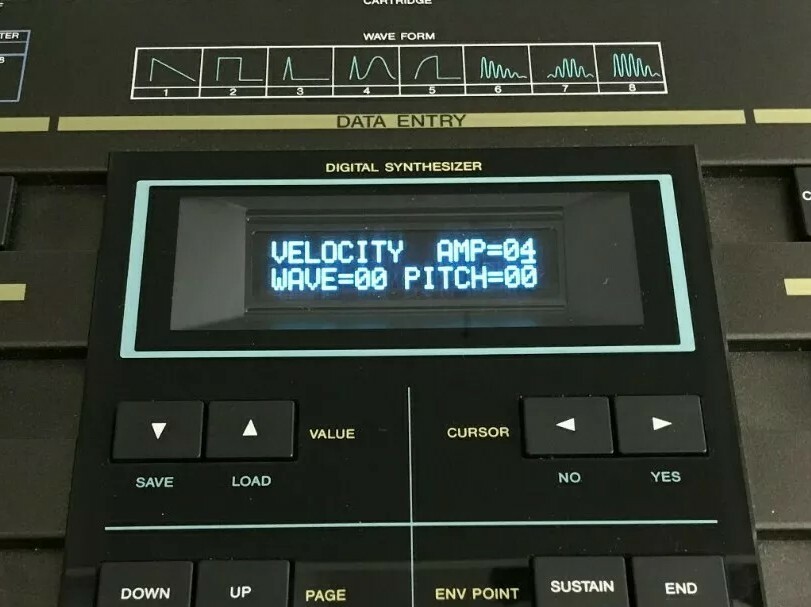
- 32 User-Programmable Tones: While it shipped with 32 factory presets (including some gloriously ’80s staples like “Metallic,” “Glass Bells,” and “Digital Organ”), the ability to save 32 of your own patches meant you weren’t stuck with Casio’s sonic vision. Programming wasn’t flashy—just a single 16-character LED display and a data entry slider—but it was logical. Each parameter was accessible in sequence, and once you learned the flow, it felt almost zen.
Historical Context
The CZ-101 arrived in 1984, the same year as its bigger brother, the Casio CZ-1, and just one year after the groundbreaking Casio CZ-3000. But while the CZ-1 was a flagship with full-sized keys and expanded features, the CZ-101 was the people’s synth. It was part of Casio’s broader push to democratize digital music technology, much like they’d done with calculators and digital watches. At a time when digital synths were still exotic and expensive, the CZ-101 said: “You don’t need to be a pro to make digital sounds.”
It competed directly with the Yamaha DX21—a 4-operator FM synth with similar polyphony and price—but took a different approach. Where the DX21 leaned into Yamaha’s FM complexity, the CZ-101 offered a simpler, more immediate synthesis method. It wasn’t trying to replace the DX7; it was trying to make digital synthesis accessible. And it succeeded. The CZ-101, along with the rest of the CZ series, helped establish Casio as a serious player in the synth world, not just a toy manufacturer. By 1988, when production ended, Casio had sold tens of thousands of CZ synths worldwide—many of them to first-time synth owners who cut their teeth on phase distortion.
Collectibility & Value
Today, the CZ-101 sits in that sweet spot of “uncommon but not rare,” with a current market value between $300 and $600 USD as of 2025. Its desirability is moderate but growing, especially among chiptune artists, retro synth enthusiasts, and producers chasing that early digital texture. It’s not as fetishized as a DX7 or a Jupiter-8, but it’s respected for its unique voice and historical significance as an affordable digital pioneer.
When buying one, watch out for the usual aging issues: mini-keys can become sticky or unresponsive due to worn contacts (cleaning with isopropyl alcohol helps), and the AC adapter jack is prone to failure—many units suffer from intermittent power due to loose connections. Also, check for capacitor leakage on the power board; older electrolytic caps can fail and damage nearby components. A unit with a clean PCB, responsive keys, and stable MIDI is worth the higher end of the price range. And if it still has its original box and manual? You’ve found a keeper.
eBay Listings



As an eBay Partner, we earn from qualifying purchases. This helps support our independent vintage technology research.
Service Manuals & Schematics
- Manual (1986) — archive.org
- Manual — archive.org
- Service Manual — archive.org
- Owner's Manual — archive.org
Related Models
- Yamaha DX7 (1983-1987)
- Access Virus A (1997-1999)
- Access Virus B (1999-2002)
- Access Virus C (2002-2004)
- Access Virus (1997-1999)
- Clavia Nord Lead (1995-2003)
- Ensoniq ESQ-1 (1986-1989)
- Korg Wavestation (1990-1994)
- PPG Wave 2.2 (1982-1987)
- Roland D-50 (1987-1992)