Buchla 200 Series (1970–1978): The Synthesizer That Refused to Play the Keyboard
A radical, touch-sensitive modular system that redefined electronic music composition by rejecting pianos, embracing uncertainty, and speaking directly to the nervous system of avant-garde sound.
Overview
The Buchla 200 Series wasn’t just a synthesizer—it was a manifesto in brushed aluminum and banana jacks. Born in the countercultural ferment of Berkeley, California, and unleashed upon the world in 1970, this modular analog system was engineered not for pop stardom or rock solos, but for composers who wanted to tear up the rulebook. Where Moog was building electronic pianos for the masses, Don Buchla was building nervous systems for the mind. Developed in close collaboration with pioneering electronic composer Morton Subotnick—whose Switched-On Bach contemporary, Silver Apples of the Moon, was composed on its predecessor, the Buchla 100 Series—the 200 Series was designed from the ground up to enable forms of expression that simply weren’t possible on traditional instruments.
What set the 200 Series apart wasn’t just its modular architecture (though that was revolutionary in itself), but its philosophy. It rejected the piano-style keyboard as a relic of acoustic thinking. Instead, it offered capacitive touch plates, pressure-sensitive ribbon controllers, and complex modulation sources that responded to the performer’s proximity and touch dynamics. This wasn’t about playing notes—it was about sculpting behaviors. The system’s DC-coupled signal path meant that control voltages and audio signals lived in the same realm, blurring the line between modulation and sound. You could route a sequencer to modulate a filter’s resonance, then patch the filter’s output into a lag processor to smooth it into a slow, breathing contour—then feed that back into the sequencer’s clock. This wasn’t just synthesis; it was cybernetic feedback, alive and unpredictable.
Specifications
| Brand | Buchla |
| Model | 200 Series |
| Category | modular_synthesizers |
| Years Produced | 1970–1978 |
| Country of Manufacture | United States |
| Original MSRP | $5,000 (1972) |
| Power Requirements | ±15 VDC, 2 A |
| Dimensions | Varies by configuration; typical 19-inch rack or custom enclosure |
| Weight | 20–50 lbs, depending on configuration |
| Control Voltage | 1 V/octave, with exponential and linear response options |
| Audio Signal Path | Fully analog, DC-coupled |
| Patching System | Banana jacks (3.5mm), 1/4-inch output jacks |
| Module Types | Oscillators (208, 259), Filters (292), Envelope Generators (281), Sequencers (245), Lag Processors (280), Mixers (218), Attenuators (214), Slew Limiters, Logic Modules |
| Controller Interface | Touch plates, capacitive keyboards, ribbon controllers |
Key Features
- Touch-Sensitive Capacitive Keyboards and Ribbon Controllers: The 200 Series famously eschewed the traditional piano keyboard in favor of capacitive touch plates—metal pads that responded to finger proximity and pressure without requiring physical contact. This allowed for expressive, gestural control that could modulate pitch, timbre, or amplitude in ways that felt organic and immediate. The ribbon controller, a continuous strip for pitch or parameter control, was equally revolutionary—imagine sliding between microtones with the subtlety of a theremin, but with tactile feedback.
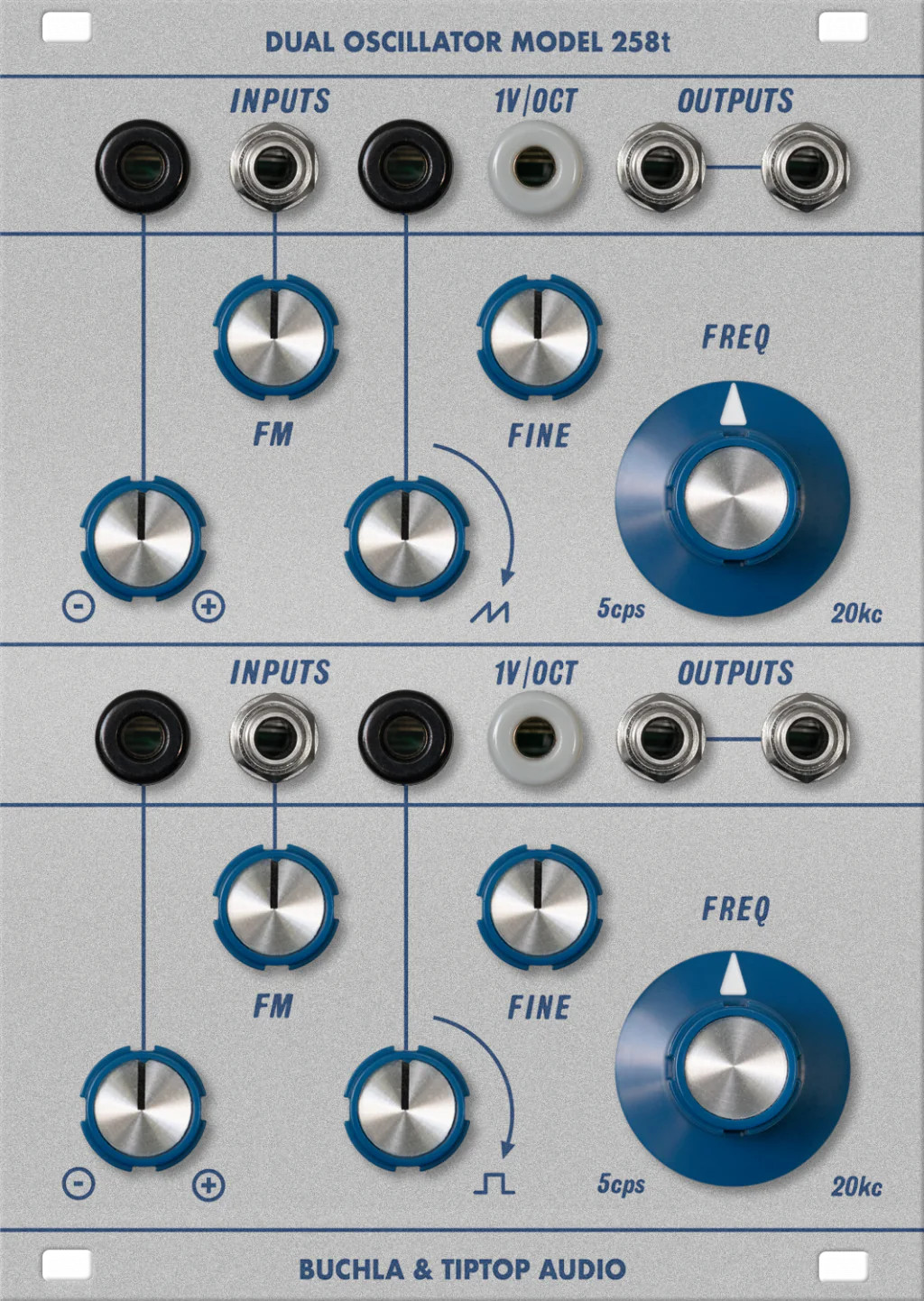
- Complex Modulation and Non-Linear Synthesis: Modules like the 259 Complex Waveform Generator and the 280 Dual Universal Slope Generator (a.k.a. the “lag processor”) were not just tools—they were collaborators. The 259 wasn’t just an oscillator; it was a timbral laboratory, capable of generating waveforms that morphed in real time via modulation of harmonic content. The 280 could smooth stepped control voltages into gliding contours or generate complex envelope shapes with multiple stages. Then there was the 245 Digital Sequencer, which could store and loop sequences with variable timing—rare in 1970.
- Source of Uncertainty (249): Perhaps the most philosophically significant module ever built. The 249 introduced controlled randomness into the system—white noise feeding sample-and-hold circuits, voltage-controlled probability switches, and logic gates that made decisions based on chance. This wasn’t a bug—it was a feature. Composers like Subotnick used it to create music that evolved unpredictably, mimicking natural systems. In an era obsessed with precision, Buchla gave you chaos. And it sounded alive.
- DC-Coupled Signal Path: Unlike many synthesizers of the era, the 200 Series treated audio and control signals as interchangeable. A slow LFO could modulate pitch, yes—but a fast audio oscillator could also act as a tremolo, or even a clock source. This flexibility enabled feedback loops, self-modulating patches, and generative compositions that could run for hours without repetition.
Historical Context
The Buchla 200 Series emerged at a pivotal moment: the dawn of commercial modular synthesis. While Moog Modular 55 was capturing the imagination of rock musicians with its familiar keyboard interface and warm, melodic tones, Buchla was operating in a parallel universe. Funded largely by academic grants and sold to universities and experimental studios (UC Berkeley, Mills College, the BBC Radiophonic Workshop), the 200 Series was never intended for Top 40 charts. It was for composers who saw the synthesizer not as an instrument, but as a compositional environment.
It was also a direct evolution of the Buchla 100 Series, which debuted in 1963 and was one of the first voltage-controlled modular systems ever built. The 200 Series refined that vision with improved stability, expanded modulation options, and a more systematic module numbering scheme. But where the 100 was a prototype for a new idea, the 200 was the fully realized philosophy. After 1978, Buchla moved on to the Buchla 300 Series, which integrated digital control and microprocessor intelligence—foreshadowing the hybrid systems of the 1980s. But the 200 Series remains the purest expression of Buchla’s “West Coast” synthesis: complex oscillators, low-pass gates, and modulation as a first-class citizen.
Collectibility & Value
Today, the Buchla 200 Series is one of the rarest and most coveted modular systems in existence. With no more than a few hundred units ever produced—and many lost to time, neglect, or cannibalization for parts—finding a complete, functional 200 Series is like unearthing a sonic Rosetta Stone. As of 2025, working systems command between $20,000 and $50,000, with fully restored, museum-grade units fetching even more at auction. Its desirability stems not just from scarcity, but from its irreplaceable role in the history of electronic music. Owning a 200 Series isn’t just collecting gear—it’s stewarding a piece of avant-garde heritage.
But beware: these machines are not plug-and-play. Decades-old banana jacks often suffer from oxidation or mechanical failure, and internal cabling can degrade, leading to intermittent signals. Capacitor leakage and power supply instability are common in un-maintained units, and calibration drift is practically guaranteed—these systems were hand-calibrated at the factory using components that age at different rates. A buyer should insist on a recent service by a Buchla-specialist technician. Look for original modules (especially the 259 and 249), intact touch plates, and a clean service history. And if you’re lucky enough to find one that still powers up and tracks within a semitone? You’re not just buying a synth. You’re adopting a living artifact.
eBay Listings


As an eBay Partner, we earn from qualifying purchases. This helps support our independent vintage technology research.
Service Manuals & Schematics
- Schematic — archive.org
Related Models
- Buchla Music Easel (1973-present)
- ARP ARP 2500 (1970-1981)
- Moog Modular 55 (1970-1981)
- Moog Moog Modular System 55 (1964-1981)