Behringer 1004 (Years Not Documented)
A 16 HP Eurorack oscillator that punches above its price with ARP 2500 DNA and dual-core flexibility
Overview
At 16 HP and built for Eurorack, the Behringer 1004 isn’t trying to disappear in the back of your case — it’s meant to be seen, patched, and pushed hard. Marketed as the "Legendary 2500 Series Dual Core VCO Module," this oscillator isn’t some vague homage; it’s a deliberate re-creation of the voltage-controlled oscillator from the ARP 2500, a modular giant of the 1970s. Owners report it delivers sound reminiscent of those original systems, with a character that leans into the raw, analog weight ARP was known for. As part of the broader Behringer 2500 series, the 1004 slots into a lineup aimed at making vintage modular synthesis accessible, though it carries the baggage of that mission: aggressive pricing, outsourced manufacturing, and mixed reliability.
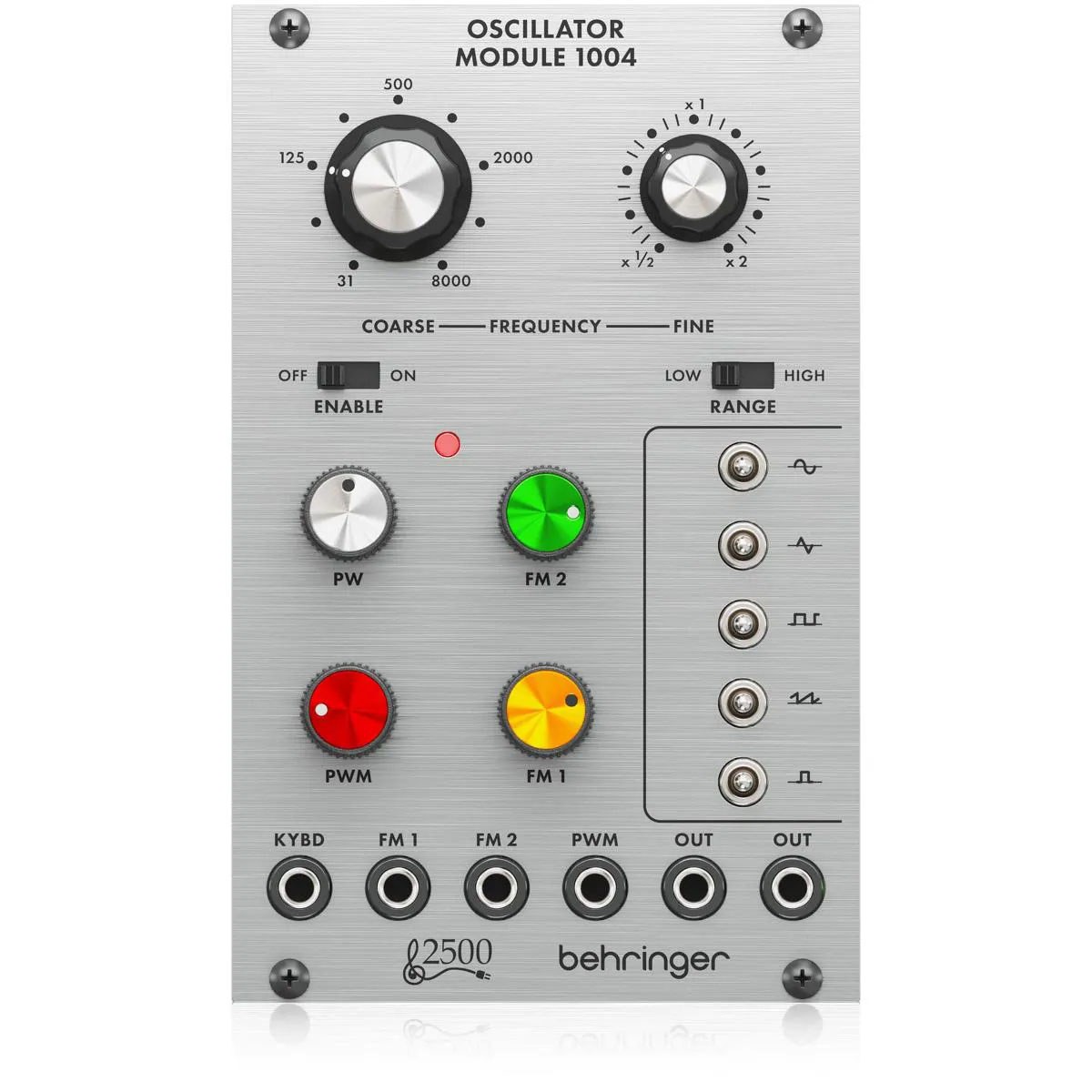
The module is built around a dual-core oscillator design, a nod to the ARP original’s architecture that allowed for complex interactions between waveforms and modulation paths. It covers both audio and sub-audio ranges, switching between LFO duties (0.03 Hz – 32 Hz) and full audio bandwidth (15.5 Hz – 16 kHz), giving it legitimate utility across modulation and tone generation. It’s not just a one-trick analog relic — it includes modern patching conveniences like CV-controllable pulse width modulation, with adjustable length and depth, plus dual frequency modulation inputs for layered control. Outputs are straightforward: a 3.5 mm TS jack sends the oscillator signal to the rest of the system, and waveforms can be routed either normal or inverted, a small but meaningful flexibility for patch design.
While some might dismiss it as a "knock-off," collectors note its accuracy in waveform shape and pitch stability across five octaves — a critical benchmark for any VCO. That said, the lack of official calibration documentation has led users to develop and share their own procedures, a sign of both community resilience and a gap in Behringer’s support. For those willing to dig in, the 1004 offers a surprisingly capable entry point into dual-core synthesis.
Specifications
| Manufacturer | Behringer |
| Model | 1004 |
| Type | Dual-Core VCO Module for Eurorack |
| HP Width | 16 HP |
| Depth | 46 mm deep |
| Dimensions | 46 x 81 x 129 mm |
| Current Draw | 60 mA (+12 V), 50 mA (-12 V) |
| Power Supply | Eurorack |
| Audio Range | 15.5 Hz - 16 kHz |
| LFO Range | 0.03 Hz - 32 Hz |
Key Features
Dual-Core VCO Architecture
The 1004’s dual-core design is its defining trait, replicating the internal structure of the ARP 2500 oscillator. This isn’t just about having two oscillators — it’s about how they interact. The architecture supports complex modulation routing and waveform blending that single-core designs can’t match, allowing for richer, more unstable, and harmonically dense tones. It’s this core layout that gives the module its "authentic" ARP character, particularly when pushed into detuned or modulated patches.
CV-Controlled Pulse Width Modulation
Pulse width modulation is a staple of analog synthesis, but the 1004 goes further by making both the length and depth of PWM controllable via CV. This means external sources — LFOs, envelopes, sequencers — can dynamically shape not just the width of the pulse wave, but how intensely that modulation is applied. It opens up evolving timbres that feel organic and unpredictable, especially when combined with the dual-core design.
Normal and Inverted Waveform Outputs
The ability to output waveforms in both normal and inverted forms adds real patching versatility. Inverting a waveform can be used for phase cancellation effects, differential modulation, or creating complementary control voltages. It’s a feature often omitted in budget modules, so its inclusion here is a quiet win for advanced users building complex, interdependent patches.
Dual Frequency Modulation Inputs
With two dedicated FM inputs, the 1004 invites deep modulation experimentation. One input might accept a steady pitch control voltage, while the second can be patched to a fast LFO or noise source for gritty, metallic textures. The dual-core design enhances this further, as FM can be applied asymmetrically to each core, creating beating and phasing effects that evolve over time.
Historical Context
The Behringer 1004 is a direct descendant of the ARP 2500’s oscillator section, explicitly designed as a replica ("Nachbau") of that system’s core sound generator. It’s part of Behringer’s "Legendary 2500 Series," a product line aimed at recreating classic modular components at a fraction of the original cost. While the ARP 2500 was a rare, expensive, and hand-built instrument of the 1970s, the 1004 brings its architecture into the Eurorack format, making it accessible to a new generation. No production years are documented, but its release aligns with Behringer’s broader push into modular synthesis in the late 2010s.
Collectibility & Value
The Behringer 1004 was sold new at a retail price of $119, with used units appearing on marketplaces like Modular Grid for as low as $81.90 and used listings starting around $66. It’s not a high-value collector’s item — it’s too new, too common, and too tied to Behringer’s reputation for cost-cutting. However, it has practical value as a functional, full-featured VCO in a crowded Eurorack market. Reliability is a known concern: when units fail, repair can be a chore. A dedicated troubleshooting guide exists, underscoring that issues do arise. Calibration is another pain point — no official procedure is published, forcing users to reverse-engineer the process. For those who value sound over polish, the 1004 remains a compelling bargain, but it’s not a "set and forget" module.
eBay Listings
As an eBay Partner, we earn from qualifying purchases. This helps support our independent vintage technology research.